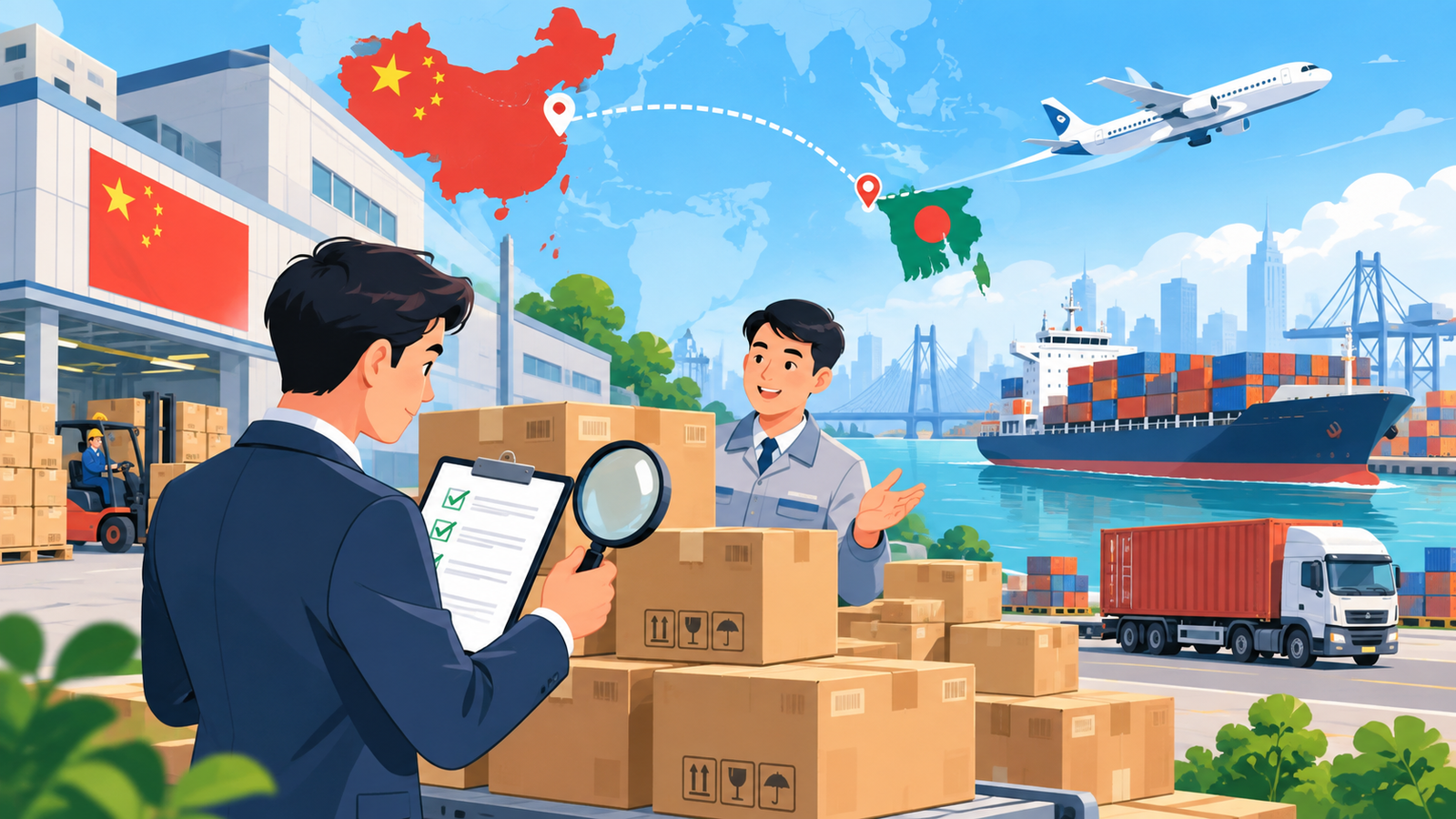
Almost any physical product a brand or retailer sells can be made in China. The hard part is not finding a seller. It is finding the right supplier, agreeing a clear specification, confirming quality before the balance is paid, and getting the goods delivered and cleared at a cost that still makes the product profitable.
This guide explains how to source products from China in eight steps, from product idea to delivered stock. It is written for importers, ecommerce sellers, procurement teams and brand owners placing their first or early orders with Chinese suppliers.
How do you source products from China?
To source products from China, define your product and target cost, find suppliers through B2B platforms, trade fairs, wholesale markets or a sourcing partner, then verify each supplier’s registration and capability. Compare like-for-like quotations, approve samples, agree written terms, inspect goods before paying the balance, and arrange shipping and customs clearance.
The eight steps below follow that order:
- Define the product, specification and target landed cost.
- Find potential suppliers.
- Verify the suppliers on your shortlist.
- Request and compare quotations on the same basis.
- Order and evaluate samples.
- Agree terms and place the purchase order.
- Control quality during and after production.
- Prepare packaging, ship the goods and clear customs.
Why China is still the default starting point
According to the General Administration of Customs of China (GACC), China’s exports grew 6.1% year on year to 26.99 trillion yuan in 2025, out of total foreign trade of 45.47 trillion yuan (figures released 14 January 2026). That scale matters to buyers for practical reasons: deep supplier bases for most product categories, established component and packaging supply chains, and freight connections to most destination markets.
Scale also creates noise. Many sellers listed online are trading companies rather than manufacturers, quality between suppliers of the same product can vary widely, and the buyer, not the supplier, is usually responsible for making sure the product is legal to sell in the destination market. Each step below is designed to remove one of those risks before money changes hands.
Step 1: Define the product, specification and target cost
Suppliers quote what you describe. A vague request (“a stainless steel water bottle, 500 ml”) produces quotes that cannot be compared, because each supplier fills the gaps with its own cheapest assumptions.
Before contacting anyone, write down:
- Materials and grades, dimensions, weight, colours and finishes.
- Functional requirements and how they will be tested.
- Branding: logo method, labels, inserts and packaging type.
- Expected order quantity per order and per year.
- The destination market and the regulations, standards or labelling rules that apply there.
- A target landed cost per unit, including freight, duty, taxes and fees, not just the factory price.
Compliance belongs in this step, not at the end. In the European Union, for example, the General Product Safety Regulation (EU) 2023/988 has applied since 13 December 2024 and places obligations on importers. Other markets have their own rules. Finding out late that a product needs testing or certification is one of the most expensive surprises in sourcing.
If you are still testing whether a product is viable, a structured product research stage can confirm demand, price points and regulatory requirements before supplier work begins. Our pre-sourcing feasibility checklist sets out the go/no-go checks.
If you are developing your own branded or modified product, read how private label and custom products from China are made.
Step 2: Find potential suppliers
Most buyers use a combination of the channels below. Each one reaches a different kind of supplier. For a deeper comparison of the main discovery routes and how to build a shortlist, see our guide on how to find reliable suppliers in China.
| Channel | What it is good for | What to watch |
|---|---|---|
| B2B platforms (Alibaba.com, Made-in-China.com, Global Sources) | Searching many suppliers quickly, in English, with online messaging | Listings mix factories and traders; badges and profile claims still need independent checks |
| 1688.com | Domestic Chinese wholesale pricing and a very wide range | Chinese-language platform built for domestic buyers; overseas buyers usually need a local agent to buy and ship |
| Trade fairs (for example the Canton Fair in Guangzhou) | Meeting many suppliers in person and comparing products side by side | Travel cost and timing; exhibitors still need verifying after the fair |
| Wholesale markets (for example Yiwu) | Small commodities, mixed product ranges and lower quantities | Many booths are traders or showrooms; quality and consistency vary |
| Sourcing agents and sourcing companies | Local search, supplier screening and communication in Chinese | Fees, scope of service and independence vary; ask how they are paid |
The China Import and Export Fair, better known as the Canton Fair, is co-hosted by China’s Ministry of Commerce and the Guangdong Provincial Government and held twice a year, in spring and autumn, with product categories split across three phases. Yiwu in Zhejiang Province is home to one of the largest wholesale markets for small commodities, useful for buyers who need variety across many low-quantity items.
Aim for a longlist of roughly five to ten candidates, then cut it down with the checks in Step 3. More candidates than that rarely improves the outcome and makes comparison harder.
Step 3: Verify the suppliers on your shortlist
Verification answers three questions: does the company legally exist, is it the type of business it claims to be, and can it make your product to your standard? Our Chinese supplier verification checklist goes deeper into the checks to complete before you pay. If you are unsure whether a supplier is a factory or a trader, see how to tell a trading company from a factory.
Check the business registration
Every Chinese company has an 18-digit Unified Social Credit Code (USCC) printed on its business licence. Ask for a copy of the licence and check it against the National Enterprise Credit Information Publicity System (GSXT), the official registry run by the State Administration for Market Regulation (SAMR). Confirm that:
- The Chinese company name and USCC match the licence and the contract party.
- The registration status is active, not cancelled or revoked.
- The registered business scope covers manufacturing of your product, if the supplier claims to be a factory.
- There are no abnormal-operation listings or penalties that need explaining.
GSXT is in Chinese and can be slow to access from outside China, which is why many buyers ask a local team or a commercial data provider to run the check.
Factory or trading company?
Trading companies are not automatically a problem. They can consolidate products from several factories and handle communication well. The risk is not knowing which one you are dealing with, because a trader’s price includes a margin and it may change factories without telling you. Ask directly, check the business scope, and ask to see the production line on a video call or in person.
Check capability, not just existence
For larger or custom orders, an on-site factory audit checks production capacity, equipment, quality systems and working conditions against what the supplier has claimed. It is usually far cheaper than discovering a capability gap after the deposit has been paid.
Step 4: Request and compare quotations on the same basis
Send every shortlisted supplier the same request for quotation (RFQ), built from your Step 1 specification. Ask each one to quote:
- Unit price at two or three quantity levels.
- Minimum order quantity (MOQ), per item and per colour or variant.
- Sample cost and sample lead time.
- Production lead time after sample approval.
- Packaging included in the price, with carton size and units per carton.
- Payment terms.
- The Incoterms rule the price is based on.
Incoterms rules, published by the International Chamber of Commerce (ICC), define which costs and risks the seller covers and where responsibility passes to the buyer. The current version is Incoterms 2020. A FOB (Free On Board) price and an EXW (Ex Works) price for the same product are not comparable until you add the inland transport and export clearance costs that EXW leaves with you.
Put the answers in one comparison sheet and treat an unusually low price as a question, not a win. It often means a thinner material, fewer quality checks or costs that appear later.
To put the quotations on the same basis, follow our five-step guide to comparing quotations from Chinese suppliers.
Step 5: Order and evaluate samples
Samples are where your written specification meets reality. Order from your top two or three suppliers, and evaluate them against the specification rather than against each other.
Check dimensions, materials, finish, function, labelling and packaging. Test the sample the way a customer will use it. Record every issue in writing with photos, and ask for revised samples if needed. See how to order samples from China for costs, shipping and a quality checklist.
Once a sample is approved, keep it as the reference, often called a golden sample. Many buyers keep one approved sample themselves and leave a matching, signed or sealed sample with the supplier, so both sides judge production against the same item.
Step 6: Agree terms and place the purchase order
The purchase order (PO) or sales contract turns everything agreed so far into an enforceable document. It should state:
- The approved specification and golden sample reference.
- Quantity, unit price, currency and Incoterms rule with the named place.
- Delivery date and what happens if it is missed.
- Payment terms and the event that triggers each payment.
- The quality standard and inspection method the goods must pass.
- Packaging, labelling and shipping mark requirements.
- Ownership of any moulds, artwork or custom tooling you pay for.
Payment terms vary by supplier, order size and relationship. A deposit before production with the balance paid after inspection and before shipment is a common structure for telegraphic transfer (T/T) payments. Letters of credit (L/C) give more documentary protection but add bank cost and paperwork. Whatever terms you agree, link the balance payment to a passed inspection rather than to a date.
Pay only to a company bank account in the name of the company you contracted with. A request to pay a personal account, or a sudden change of bank details by email, should be confirmed by phone with a known contact before any money moves.
Step 7: Control quality during and after production
Quality control is easiest to manage as a sequence of checks rather than a single event at the end. See our guide to quality control when sourcing from China for the full inspection-stage workflow.
| Check | When | What it catches |
|---|---|---|
| Pre-production check | Before mass production starts | Wrong raw materials, components or colours before they are used |
| During production inspection (DUPRO) | Typically once part of the order is produced | Recurring defects early enough to correct the rest of the run |
| Pre-shipment inspection (PSI) | When production is finished and most goods are packed | Defects, quantity, packaging and labelling against the order, before the balance is paid |
| Container loading check | At loading | Correct goods, quantities and carton condition going into the container |
Pre-shipment inspections usually use statistical sampling based on ISO 2859-1:1999, the international standard for acceptance sampling by attributes indexed by acceptance quality limit (AQL). ISO published a new edition, ISO 2859-1:1999:2026, in January 2026, replacing the 1999 edition. Agree the AQL levels for critical, major and minor defects in the purchase order, so a failed inspection has an agreed consequence.
A sourcing partner’s quality control team or an independent inspection company can carry out these checks. What matters is that someone working for you, not the supplier, inspects the goods.
Step 8: Prepare packaging, ship the goods and clear customs
Packaging and carton marks
Export cartons need to survive handling, stacking and humidity across a long journey. Confirm carton strength, inner packaging, units per carton, carton dimensions and gross weight, and the shipping marks printed on each carton. These details also feed your freight quote and any marketplace or warehouse receiving rules. Packaging and pre-shipment preparation is often where small mistakes create the largest delays.
Choosing the shipping method
- Courier or express: fastest and simplest for samples and small, high-value shipments, but the highest cost per kilogram.
- Air freight: faster than sea and suited to urgent or lightweight goods.
- Sea freight LCL (less than container load): your goods share a container, suitable when volume does not fill one.
- Sea freight FCL (full container load): usually the lowest cost per unit for large volumes.
A freight forwarder arranges the booking, export documents and, depending on the Incoterms rule, delivery to your door. Typical documents include the commercial invoice, packing list, bill of lading or air waybill, and any certificate of origin or test reports your market requires.
Customs, duties and the HS code
Import duty and taxes are set by the destination country and depend on the product’s Harmonized System (HS) code, its value and its origin. For Bangladesh-specific registrations, payment, shipping and customs steps, see our guide to importing from China to Bangladesh. Confirm the correct HS code and the duty rate with a customs broker or the destination customs authority before you finalise your target cost in Step 1, not after the goods arrive. Your shipping and logistics partner can coordinate the forwarder, documents and delivery.
Key risks at each step
| Step | Main risk | How buyers reduce it |
|---|---|---|
| 1. Define the product | Vague specification and missed compliance rules | Written specification, target landed cost and early regulatory check |
| 2. Find suppliers | Long lists of look-alike sellers | Use more than one channel and shortlist against clear criteria |
| 3. Verify suppliers | Fake, unregistered or misrepresented companies | GSXT and USCC check, factory-or-trader check, audit for larger orders |
| 4. Compare quotes | Quotes on different terms that cannot be compared | One RFQ, one comparison sheet, same Incoterms rule |
| 5. Samples | Approving a sample that differs from production | Evaluate against the specification and keep a golden sample |
| 6. Place the order | Unclear contract and payment fraud | Written PO, balance tied to inspection, verified company bank account |
| 7. Quality control | Defects discovered after the goods arrive | Pre-production checks, DUPRO and pre-shipment inspection with agreed AQL |
| 8. Ship and clear | Damaged cartons, wrong documents, unexpected duty | Packaging specification, forwarder coordination, HS code confirmed early |
Do you need a sourcing agent?
You can import products from China and deal with manufacturers directly, and many buyers do. Whether a sourcing agent or sourcing company is worth it depends less on order size than on how much of the process you can manage yourself: Chinese-language communication, supplier checks, sample follow-up, inspections and shipment coordination.
| Situation | Direct sourcing often works | A sourcing partner often helps |
|---|---|---|
| Product | Simple, standard catalogue item | Custom, branded or technically detailed product |
| Suppliers | One supplier you already know | Several suppliers, or consolidating mixed products |
| Your team | Time and experience to follow up and inspect | No one available on the ground in China |
| Risk tolerance | Small test order you can afford to lose | First large order or a new supplier |
If you decide to work with one, a product sourcing partner should be able to show how it shortlists and checks suppliers. When comparing sourcing partners, ask what the service includes, how they are paid, whether they take commissions from suppliers, and who carries out inspections. Our checklist for choosing a sourcing company turns these questions into a scoring matrix. Our checklist for choosing a sourcing company turns these questions into a scoring matrix.
How long does sourcing from China take?
There is no single answer. The timeline depends on whether the product is a stock item or custom-made, how many sample rounds are needed, whether tooling must be built, production lead time, the shipping method and the destination. A ready-made product with an existing design moves much faster than a custom product that needs a new mould.
Two calendar effects are worth planning around. Factories slow down or close around Chinese New Year, which falls on 6 February 2027, and many workers return late afterwards, so orders due around that period need extra buffer. China’s National Day holiday in early October also affects production and logistics schedules.
Frequently asked questions
How do I start sourcing products from China as a beginner?
Start with a clear product specification and a target landed cost. Then shortlist a few suppliers from more than one channel, verify their registration on GSXT, compare quotes on the same Incoterms basis, and order samples before committing to production. A small first order limits the cost of mistakes.
Where can I find reliable suppliers in China?
B2B platforms such as Alibaba.com, Made-in-China.com and Global Sources, the Canton Fair in Guangzhou, wholesale markets such as Yiwu, and local sourcing partners are the main routes. No channel guarantees reliability, so every supplier should be verified before you pay.
How do I avoid getting scammed by a Chinese supplier?
Check the business licence and USCC on GSXT, confirm the company name on the contract matches the bank account, avoid paying personal accounts, verify any bank-detail change by phone, and tie the balance payment to a passed pre-shipment inspection.
What is the minimum order quantity when buying from China?
MOQ is set by each supplier and depends on the product, materials and how much customisation is needed. Stock items and wholesale-market goods often have low MOQs, while custom colours, packaging or moulds usually raise them. MOQs are often negotiable, sometimes at a higher unit price.
Can I buy directly from Chinese factories?
Yes. Many factories sell directly to overseas buyers, either through B2B platforms or their own export teams. Some smaller factories only work through trading companies or in Chinese, which is one reason buyers use local sourcing partners.
Who is responsible for product compliance when importing from China?
In most markets, the importer of record carries legal responsibility for the product meeting local safety, labelling and chemical rules. Suppliers can provide test reports, but the buyer should confirm which tests and certificates the destination market requires before production starts.
Conclusion
Sourcing from China works best as a controlled sequence: a clear specification, a verified shortlist, comparable quotes, approved samples, a written order, independent quality checks and planned shipping. Skipping a step rarely saves time. It usually moves the problem to a later, more expensive point.
Jingxin Sourcing is a sourcing company with its head office in Dhaka, Bangladesh, and an office in Yiwu, China. Before you pay a deposit, read our 15 questions to ask a Chinese supplier and the common supplier red flags. To decide between a video check and a visit, see remote supplier verification. Need help coordinating supplier search, verification and order follow-up? Learn more about Jingxin Sourcing’s Product Sourcing service.