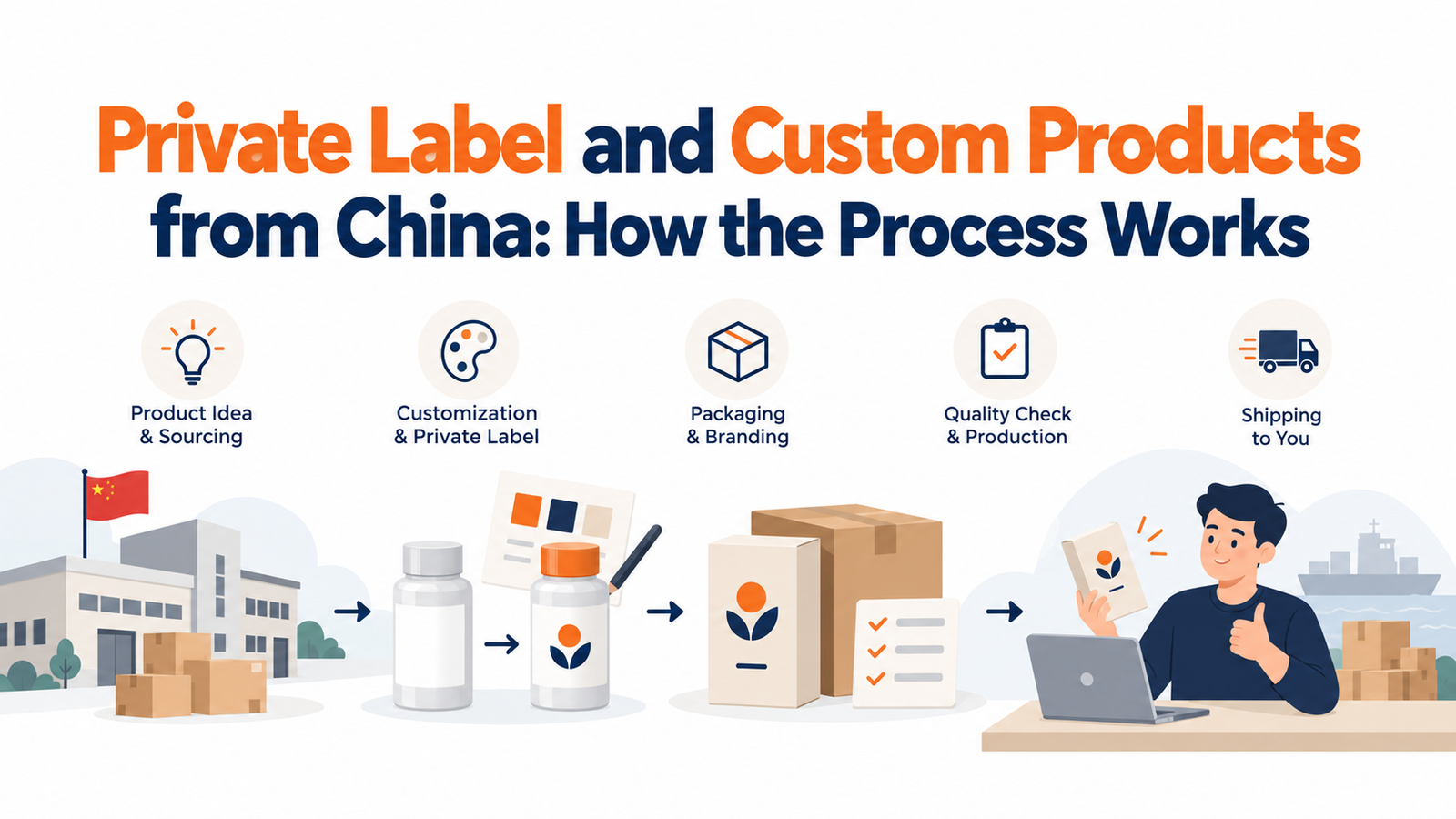
Private label products from China are made by a factory to your specification or from its existing design, then sold under your brand. A custom product goes further: some feature of the product itself, such as shape, material, size or function, is changed. Most projects follow seven steps: choose a route, write a specification, find and verify a factory, approve samples, tool up if needed, finalise packaging, and inspect before shipping.
This guide explains each route, the order of work, the documents factories expect, and the mistakes that most often cost importers time and money. It sits inside our wider guide to sourcing products from China and is general industry education. Where Jingxin Sourcing’s own capabilities apply, they are marked as such.
Quick answer: the seven steps
- Choose the development route (private label, OEM, ODM or modification).
- Write the product specification and branding brief.
- Find and verify factories, then request comparable quotations.
- Develop and approve samples or prototypes.
- Commission tooling or moulds if the product needs them.
- Finalise packaging and artwork.
- Inspect before shipment and arrange transport.
What is a private label product?
A private label product is made by a third-party manufacturer and sold under the buyer’s brand name. The factory may supply a product it already makes, with your logo, colour or packaging applied, or it may produce to your own specification. The brand owner controls the name, packaging and positioning; the factory controls production.
Private label is a commercial arrangement, not a manufacturing method. Two private label products on the same shelf can be very different underneath: one may be a catalogue item with a new label, the other a fully redesigned product. That difference decides your cost, your minimum order quantity (MOQ) and how easily a competitor can copy you.
OEM, ODM, private label and modification: which route fits?
The four routes differ in who owns the design, how much development you pay for, and how distinctive the result can be. The table summarises general industry usage; terminology varies between suppliers, so confirm exactly what a factory means by each term before quoting.
| Route | Who designs the product | Typical use | Main trade-off |
|---|---|---|---|
| Private label on an existing product | Factory (catalogue design) | Fastest way to a branded product | Others may sell the same base product |
| ODM (original design manufacturing) | Factory designs, you select and brand | Choose from a factory’s design range, adjust details | Limited exclusivity unless agreed |
| OEM (original equipment manufacturing) | You supply the design or specification | Distinctive products made to your drawings | More development work: spec, samples, possibly tooling |
| Modified existing product | Shared: factory base, your changes | Change size, colour, material, features or parts | Every change adds a sample round and may raise MOQ |
Use the route comparison above as the starting point, then confirm the supplier’s own terminology in writing before quoting. If you plan to adjust a supplier’s existing product rather than design from scratch, define every requested change in the specification before the factory quotes.
How does the custom product process work, step by step?
The custom product process runs from a written brief to a verified shipment. Each step produces something you can approve or reject, which is why skipping a step usually shows up later as a defect, a delay or a dispute.
Step 1: Choose the route and the level of customisation
Decide how far you want to depart from a standard product. Adding a logo is a different project from changing a material or building new tooling. Be honest about volume: a custom feature that needs new tooling rarely makes sense at very small quantities. Check feasibility early, using a product research before sourcing checklist, before you spend on samples.
Step 2: Write the specification and branding brief
The specification is the contract between your idea and the factory’s production line. Vague briefs produce guesses, and guesses become samples you reject.
A usable brief typically includes:
- Product description, intended use and target market
- Dimensions, weight and tolerances
- Materials, colours and finishes (with references or physical swatches)
- Drawings, CAD files or annotated photos where available
- Branding: logo files, placement, colour codes, labelling text
- Packaging requirements and carton markings
- Target quantity per order and expected repeat volume
- Applicable compliance or testing requirements for the destination market
- Quality criteria: what counts as acceptable and what does not
Treat the written specification and branding brief as the single source of truth for quotations, sampling and final inspection.
Step 3: Find and verify factories, then compare quotations
Send the same brief to several suppliers so quotations are comparable. Use our supplier quotation comparison method to normalise price, MOQ, Incoterm and payment terms. Ask each one whether it manufactures the product itself or outsources it, what its MOQ is for your customised version, and what is included in the price (tooling, samples, packaging, branding).
Before you pay anything, verify the supplier. Common checks include the business licence, company registration, whether the supplier is a factory or a trading company, the factory address, supplier certifications, bank-account details and production capability, ideally with a video call or a visit. See how to verify a Chinese supplier before you pay.
Intellectual property needs attention at this point too. Before sharing sensitive drawings, control who receives the files, use appropriate contractual protection, and take local legal advice for your own situation.
Step 4: Develop and approve samples
Custom projects normally need more than one sample round. A first sample shows whether the factory understood the brief; later rounds correct details. Record every approved or rejected point in writing, with photos, and sign off a final approved sample that production must match.
Do not treat a catalogue sample as proof the customised product will be right. Judge the customised sample. For the practical ordering and evaluation stage, see ordering product samples from China. Keep the final approved sample as the documented reference for production and inspection.
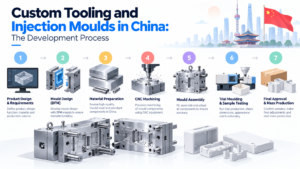
Step 5: Commission tooling or moulds if the product needs them
Products made by moulding, stamping or casting need tooling before mass production. Tooling is usually a significant upfront cost and a long-lead item (the custom tooling process explains each stage), so agree who owns it, where it is stored and what happens if you change supplier before you pay. Jingxin’s Tooling & Moulds service covers tooling and mould sourcing support for projects that need this stage. Not every private label project needs tooling; a labelled catalogue product does not.
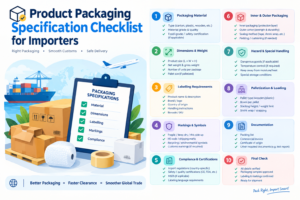
Step 6: Finalise packaging and artwork
Packaging is part of the product for a private label brand. Retail box, inner carton and master carton each have different jobs, and artwork must be approved against the factory’s dieline before printing. A written packaging specification sets out the fields to lock first. Late packaging changes are a common cause of missed shipping dates. For packaging execution support, see Jingxin’s Packaging & Prep service.
Step 7: Inspect before shipment, then ship
Before final payment and release, check the goods against your approved sample and specification. Inspection commonly uses sampling under a standard such as ISO 2859-1 (the basis for AQL tables), with attention to product function, appearance, labelling, packaging and carton marking. Then arrange transport and import documents. Jingxin’s Quality Control service covers inspection support. For the Bangladesh end, see importing from China to Bangladesh step by step.
What do factories need from you to start?
A factory needs enough information to price and build the product without guessing. At minimum, prepare the following before requesting quotes:
| Item | Why the factory needs it |
|---|---|
| Written specification and reference images | Defines what “correct” means |
| Logo and brand files in production-ready format | Allows branding to be applied and approved |
| Target quantity and repeat-order expectation | Drives MOQ and price breaks |
| Packaging requirements | Packaging changes cost and lead time |
| Compliance requirements for your market | Affects materials, labelling and testing |
| Quality criteria and approved sample | Gives inspection something to measure against |
Common mistakes in private label and custom product projects
- Briefing by description only. Words alone leave room for interpretation; add drawings, samples or marked-up photos.
- Comparing quotes that cover different things. One price may include samples and packaging; another may not.
- Approving the catalogue sample, not the custom one. The customised version is what you will receive.
- Ignoring MOQ for customised versions. A custom colour, material or part can carry a higher MOQ than the standard item. See what MOQ means.
- Leaving tooling ownership unwritten. Agree it before paying for the tool.
- Finalising packaging late. Artwork approval and printing can hold up an otherwise finished order.
- Skipping pre-shipment checks. Without a written quality standard, a rejection becomes an argument.
Where Jingxin Sourcing fits
Jingxin Sourcing was established in 2022, with a Head Office in Dhaka and a China Office in Yiwu. Its confirmed support for custom projects includes custom product development, samples and prototypes, custom packaging, tooling and mould sourcing, mould trials and packaging inspection. Its sourcing channels are Alibaba, 1688, Yiwu Market and a direct factory network.
Jingxin Sourcing’s own staff carry out physical factory audits and quality inspections in Yiwu, Shenzhen and Guangzhou, and Jingxin can negotiate product price, MOQ, lead time and payment terms for clients. For Bangladesh importers, Jingxin can help coordinate import documents and customs-related steps.
If you are planning a customised product, see Jingxin’s custom product sourcing support.
FAQ
Is private label the same as OEM?
No. Private label describes who sells the product under whose brand. OEM describes a manufacturing arrangement where the factory builds to the buyer’s design or specification. A product can be private label without being OEM, for example a catalogue item with your logo.
How many samples does a custom product need?
It depends on how far the product departs from the factory’s existing design and on whether tooling is involved. Plan for more than one round for anything beyond a logo change, and approve a final reference sample before production.
Do I always need tooling or moulds?
No. A labelled catalogue product needs none. Tooling is generally needed when a new moulded, stamped or cast part is created. Agree cost and ownership in writing before paying for any tool.
Can I protect my design when working with a Chinese factory?
Contractual protection, such as non-disclosure, non-use and non-circumvention terms, and careful control of who receives your files can help. Legal protection depends on your situation, so take advice from a qualified lawyer.
Can Jingxin Sourcing support custom product projects?
Jingxin Sourcing’s confirmed support includes custom product development, samples and prototypes, custom packaging, tooling and mould sourcing, mould trials and packaging inspection. The scope for a specific project is agreed with the client.