
“Sourcing agent” covers a wide range of people and firms: a freelancer who walks you through a wholesale market, a buying office that places orders on Chinese platforms, or a company that manages suppliers from search to shipment. Before you hire one, it helps to know what the role normally includes and where it stops.
Short answer: A China sourcing agent acts as your representative on the China side. Typically they clarify your requirements, find and shortlist suppliers, check those suppliers, collect and negotiate quotations, coordinate samples, place and follow orders, arrange quality inspections and coordinate shipping documents. They do not make your product decisions, own your product’s compliance or guarantee supplier performance.
What a China sourcing agent does: the 8 core tasks
The exact scope varies by provider and contract, but most full-service agents work across these eight tasks:
- Clarify the requirement. Turn your idea, reference product or drawing into a brief suppliers can quote against: materials, sizes, functions, packaging, target quantity and target market.
- Search for and shortlist suppliers. Search B2B platforms such as Alibaba and 1688, wholesale markets such as Yiwu, and factory contacts, then filter to a short list that fits the product and order size.
- Verify suppliers. Check that the company legally exists, whether it is a factory or a trading company, where it actually produces, and whether its bank details match the contracting entity.
- Collect and negotiate quotations. Request comparable quotes, then negotiate unit price, minimum order quantity (MOQ), lead time and payment terms.
- Coordinate samples. Request samples, check them against your brief, and relay your feedback to the supplier until a sample is approved.
- Place orders and follow production. Place orders (including on platforms that are hard to use from outside China), confirm order details in writing, and track progress against agreed dates.
- Arrange quality control. Inspect goods before, during or after production, depending on risk, and report findings with photos and measurements.
- Coordinate shipping and documents. Work with the supplier and freight forwarder on packing, handover, the commercial invoice, packing list and HS-code information your customs process needs.
For custom products the scope often extends further: specification development, prototypes, custom packaging, and tooling or moulds. Those workflows are covered in our guides to how private label and custom products are developed in China and the custom tooling and injection mould process.
If you are new to the overall journey, our beginner’s guide to sourcing products from China shows where each of these tasks sits from product idea to delivery.
What each task looks like in practice
The list above is the headline. The detail matters, because two agents can both claim “supplier sourcing” and mean very different things.
Requirement clarification and product research
Good agents ask questions before they search. What is the target landed price? Which certifications does the destination market expect? Is a close existing product acceptable, or does the item need to be custom? Some agents also run feasibility research before any supplier contact. If you have not yet tested whether the product makes sense to import, start with our product research and feasibility checklist.
Supplier search and shortlisting
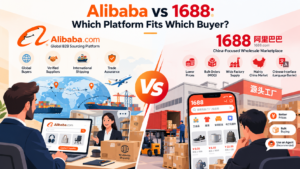
An agent’s value here is reach and filtering, not a secret database. They search the same channels you could, such as Alibaba, 1688, Yiwu market and factory contacts, but in Chinese, on the ground and with a sense of which listings are likely trading fronts. The routes themselves are explained in how to find reliable suppliers in China, and the platform differences in Alibaba vs 1688. For small-quantity, mixed-product orders, many buyers work through the Yiwu wholesale market, where an agent’s local presence is often the main thing you are paying for.
Supplier verification
Verification means checking documents and facts rather than trusting a profile page: business licence, company registration, factory or trading status, real production address, certifications, bank-account ownership and production capability. Where documents are not enough, an agent may carry out or arrange a physical visit. Our pillar on verifying a Chinese supplier before you pay covers the method, and the factory audit checklist covers what an on-site visit should inspect.
Quotations and negotiation
An agent should return quotes in a form you can compare: same specification, same quantity, same Incoterm and the same packaging. The method is set out in how to compare quotations from Chinese suppliers. Negotiation usually covers four levers: price, MOQ, lead time and payment terms. A local negotiator can sometimes achieve a lower MOQ or better deposit terms, but no agent can promise a specific outcome.
Samples
The agent requests samples, checks them against the brief and passes your comments back in clear, specific language. Sample costs, shipping and evaluation are explained in our guide to ordering samples from China. Whether an agent collects samples from several suppliers and ships them together is a service detail to confirm with each provider.
Orders and production follow-up
On Alibaba and 1688, an agent can place the order for you. This matters most for 1688, which is designed for buyers inside China. During production, follow-up means confirming materials, checking progress against the agreed dates and raising problems early, before the goods are packed. A separate guide on production milestones and early warning signs is planned for this cluster.
Quality control
Agents arrange or perform inspections at one or more stages: pre-production, during production and pre-shipment. The stages, and what each one is designed to catch, are explained in our quality control inspection stages guide.
Shipping and documentation
An agent does not usually replace a freight forwarder or customs broker. Its role is coordination: making sure cartons are packed and marked as agreed, that the commercial invoice and packing list are accurate, and that the forwarder collects on time. For Bangladesh-bound goods, the route and port options are explained in shipping from China to Bangladesh.
What a sourcing agent usually does not do
This is where expectations go wrong. Unless your contract explicitly says otherwise, a sourcing agent typically does not:
- Own or run the factory. The agent manages a supplier; it does not control the supplier’s staff, machines or raw-material purchasing.
- Decide what you should sell. Product choice, target market, retail price and order quantity remain your business decisions.
- Guarantee compliance or certification. Testing to a standard is carried out by accredited laboratories and certification bodies. The agent can request reports from suppliers and coordinate testing, but legal responsibility for what you import and sell rests with the importer.
- Guarantee customs clearance or transit times. Customs authorities, carriers and ports control these. An agent can make the paperwork accurate; it cannot guarantee the outcome.
- Pay duties and taxes on your behalf by default. Import duties and taxes are assessed on the importer in the destination country, usually through a customs broker or C&F agent.
- Write your quality standard for you. An agent can help draft it, but you decide what counts as acceptable. Without a written standard, any inspection is guesswork.
- Protect your intellectual property by law. Agents can help you use confidentiality agreements and limit what drawings are shared, but registering trademarks and enforcing rights is legal work.
- Absorb supplier failures automatically. If a supplier misses a deadline or ships defects, who pays for rework or delay depends on your contracts with the supplier and the agent, not on the agent’s presence.
Who is responsible for what
A clear split avoids disputes later. The table below shows a typical arrangement; your contract should state yours.
| Area | Agent typically handles | Buyer typically keeps |
|---|---|---|
| Product decision | Feedback on feasibility and supplier options | What to sell, target price, order quantity |
| Specification | Translating and clarifying the brief | Approving the final specification and quality standard |
| Supplier selection | Search, shortlist, verification checks | Final choice of supplier |
| Commercial terms | Negotiating price, MOQ, lead time, payment terms | Approving terms and signing (or authorising) the order |
| Samples | Requesting, checking, relaying feedback | Approving the sample that production must match |
| Payments | Paying suppliers if the arrangement requires it, with receipts | Funding the order; choosing the payment structure |
| Quality control | Arranging or performing inspections and reporting | Setting acceptance criteria; deciding to ship, rework or reject |
| Shipping | Coordinating packing, handover and export documents | Choosing the shipping mode, budget and forwarder (if separate) |
| Import and compliance | Supplying accurate documents and supplier reports | Import registration, duties, product compliance in the destination market |
Do I still need my own quality control if I use a sourcing agent?
You still need your own quality standard, even if you do not need a separate inspection company. An agent can only inspect against what you have defined: dimensions, materials, functions, packaging, labelling and an acceptable defect level.
Whether you also need an independent inspector depends on two things:
- Independence. If the agent is paid in a way that rewards shipping the order (for example a commission that depends on the order going ahead), its inspection is less independent than one by an unrelated third party. That does not make it worthless; it means you should ask how inspection is separated from the commercial side.
- Risk. For high-value orders, regulated products or a new supplier, some buyers use the agent for day-to-day follow-up and add a third-party inspection before shipment. A dedicated comparison of third-party inspection and sourcing-company quality checks is planned for this cluster.
In both cases, ask for full inspection reports with photos, measurements and the sampling level used, not just a pass/fail message.
Sourcing agent, sourcing company or trading company?
The labels overlap. A “sourcing agent” can be one person or a firm. A “sourcing company” usually means a registered business with staff and defined service lines. A trading company typically buys goods and resells them to you at its own price, which makes it a supplier rather than your representative. The practical question is the same in each case: whose side is this party on, and how are they paid? The trade-offs of an individual agent versus a company, the main fee models, and the broader question of whether you need an agent at all each have their own planned guides in this series.
Notes for Bangladesh importers
For a business importing into Bangladesh, the agent’s China-side work is only half the process. Import registration, letters of credit where used, HS-code classification and clearance through a C&F agent all happen at home. A useful agent should provide documents that match what your bank and customs process require, and should flag early if a supplier’s invoice or packing list will not. The full home-side sequence is set out in our step-by-step guide to importing from China to Bangladesh. Always confirm current rules with the National Board of Revenue (NBR), your bank and your C&F agent, because they change. A dedicated guide to what Bangladeshi importers should expect from a China-based agent, covering payment flow and communication, is planned for this series.
How Jingxin Sourcing covers these tasks
Jingxin Sourcing was established in 2022, with its head office in Dhaka, Bangladesh, an office in Yiwu and a permanent team in China. It sources through Alibaba, 1688, Yiwu market and a direct factory network.
Mapped to the eight tasks above, Jingxin’s confirmed capabilities are:
- Research and requirements: product research before sourcing.
- Supplier search: sourcing products through the four channels named above.
- Verification: checks of business licence, company registration, factory vs trading-company status, factory address, certifications, bank-account verification and production capability, plus physical factory audits.
- Negotiation: price, MOQ, lead time and payment terms.
- Orders: placing Alibaba and 1688 orders on behalf of customers.
- Custom work: custom product development including samples and prototypes, custom packaging, tooling and mould sourcing, and mould trials.
- Quality control: product inspections and packaging inspections, with staff inspection and audit activity in Yiwu, Shenzhen and Guangzhou.
- Shipping and documents: help coordinating Bangladesh import documentation, including commercial invoice, packing list, HS-code and C&F-agent related paperwork where applicable.
Like any agent, Jingxin does not own factories and does not guarantee customs clearance or product compliance.
If you would like to see how this works for your product, Jingxin’s China product sourcing service page sets out the sourcing scope, and on-site supplier checks are described on the factory audits page.
Frequently asked questions
What does a sourcing agent in China do?
A sourcing agent represents a buyer in China. The usual tasks are clarifying the requirement, finding and verifying suppliers, negotiating quotations, coordinating samples, placing and following orders, arranging quality inspections and coordinating shipping documents. Scope varies, so confirm it in writing.
What doesn’t a sourcing agent do?
Agents generally do not own the factory, choose your product, guarantee certification or customs clearance, pay your import duties, or legally protect your designs. They also cannot inspect to a standard you have not defined.
Do I still need my own QC if I use an agent?
You need your own written quality standard either way. Whether you add an independent inspector depends on how the agent is paid and how risky the order is. For high-value or regulated products, many buyers add a third-party pre-shipment inspection.
Can a sourcing agent buy from 1688 for me?
Yes, many agents place 1688 orders for overseas buyers, because the platform is built for buyers within China in terms of language, payment and domestic delivery. Ask how payment, receipts and consolidation of parcels are handled before you start.
Is a sourcing agent the same as a freight forwarder?
No. A freight forwarder books and manages transport. A sourcing agent works with suppliers and coordinates handover to the forwarder. Some providers offer both, but they are separate jobs with separate responsibilities.
How do I know if an agent is working for me rather than the supplier?
Ask how they are paid, whether they accept payments or commissions from suppliers, and whether you will see the supplier’s original invoices. A transparent fee arrangement and access to supplier documents are the best indicators.
The bottom line
A China sourcing agent is a pair of hands and eyes on the supply side: searching, checking, negotiating, following up and reporting. The decisions, the quality standard and legal responsibility for the imported goods stay with you. Write the scope down, ask how the agent is paid, and treat inspection reports as evidence rather than reassurance. Once you know what you need an agent to cover, the next step is comparing providers against a checklist, which is the subject of our guide on how to choose a sourcing company.