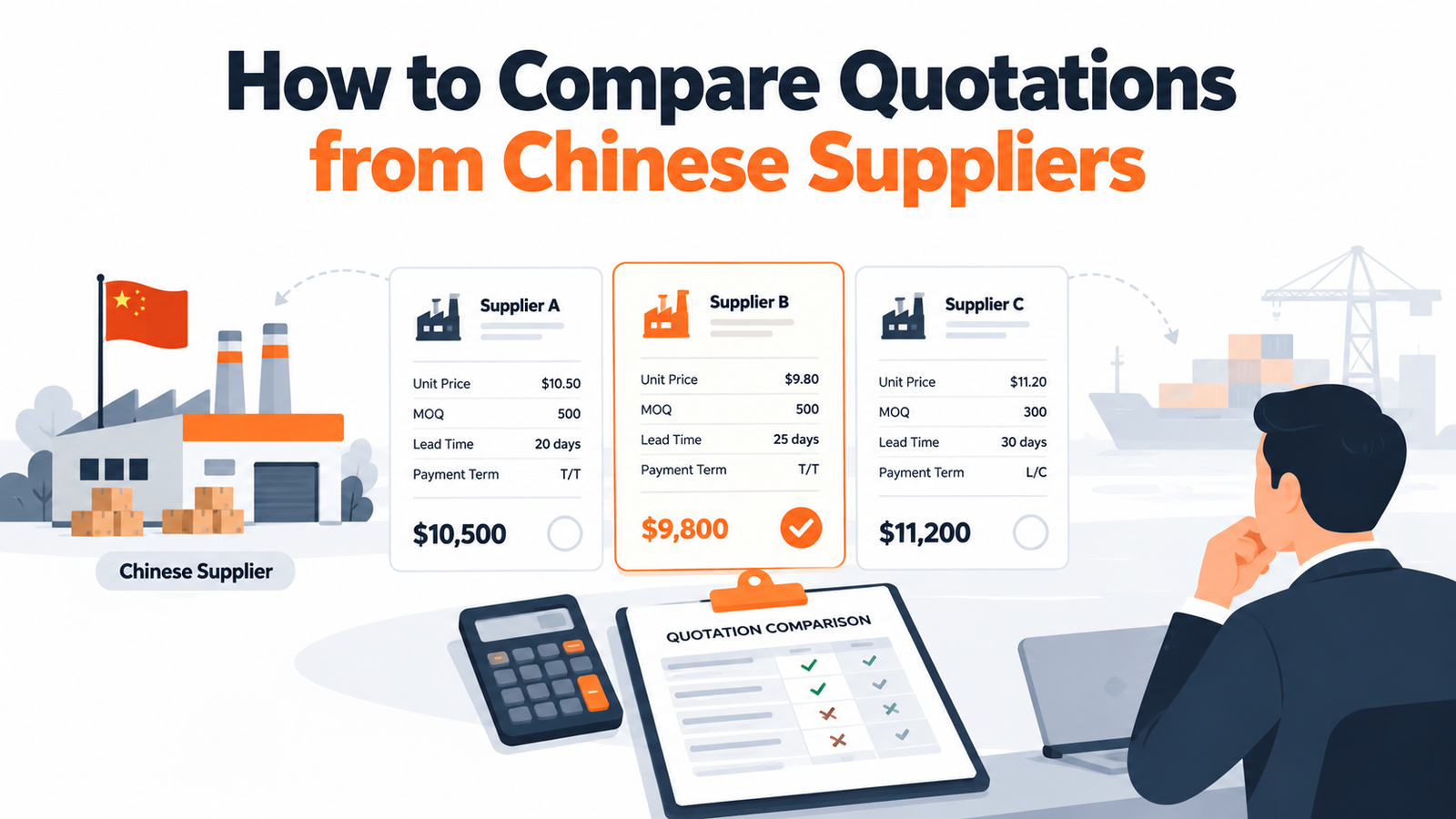
To compare supplier quotations from China fairly, convert every quote to the same basis: the same specification, quantity, Incoterm, currency, packaging, lead time and payment terms. Then calculate the total cost to get the goods to your door and weigh the price against supplier risk. The lowest unit price on the page is rarely the lowest real cost.
This guide gives a five-step normalisation process and a comparison worksheet you can copy, plus the points that most often make two quotes look comparable when they are not.
Why quotes from Chinese suppliers are hard to compare
Two suppliers can quote the same product and still be pricing different things. One may include export cartons and a printed logo, the other may not. One may quote EXW from the factory gate, the other FOB at a port. One may price 1,000 pieces, the other 3,000.
Common sources of mismatch:
- Different specifications: material grade, thickness, finish, accessories or tolerance.
- Different quantities: unit prices usually change with order size.
- Different Incoterms: the price covers different stretches of transport and risk.
- Different packaging: a plain polybag and a printed retail box are not the same cost.
- Different currencies and tax treatment: RMB or USD, and with or without VAT.
- Different payment and lead terms: deposit size, balance timing and production time.
Comparing only the unit-price column ignores all of these.
The 5-step process to normalise supplier quotes
The method below works for two quotes or ten. It is general procurement practice, not a fixed Jingxin procedure.
- Send every supplier the same brief. Use one written specification, one target quantity and one packaging requirement. Use the same written RFQ and sourcing brief for every supplier so the answers stay comparable.
- Align the specification. Confirm in writing that each quote covers the same material, dimensions, colour, accessories and certifications. Ask suppliers to state what they have assumed.
- Align the commercial terms. Put quantity, Incoterm, currency, tax treatment and payment terms on one basis. Ask for revised quotes where a supplier has used a different Incoterm or quantity break.
- Add the costs that sit outside the quote. Include freight, insurance, duty and taxes, clearing charges, inspection and any sample or tooling cost that applies, to reach a landed cost per unit.
- Score price against risk. Compare supplier verification results, sample quality, lead time and payment exposure next to the cost, then choose.
What is a quotation comparison worksheet?
A quotation comparison worksheet is a table that lists each supplier’s quote against the same set of criteria, so differences in price, terms and risk are visible side by side. It is usually a spreadsheet with one column per supplier and one row per cost or term, ending in a total cost per unit.
Use rows like these. The values are placeholders to show the structure, not real prices.
| Comparison row | Supplier A | Supplier B | Supplier C |
|---|---|---|---|
| Supplier type (factory / trading company) | |||
| Specification matches brief? (Y/N, notes) | |||
| Quoted quantity | |||
| Unit price and currency | |||
| Incoterm and named place | |||
| VAT / tax included? | |||
| Tooling or setup charge | |||
| Sample cost and lead time | |||
| Packaging included (retail / inner / master) | |||
| Production lead time | |||
| MOQ | |||
| Payment terms (deposit / balance) | |||
| Quote validity date | |||
| Estimated freight to destination | |||
| Estimated duty, taxes, clearing | |||
| Estimated landed cost per unit | |||
| Verification status (licence, address, bank account) | |||
| Overall risk note |
Example template: educational only. It is not a Jingxin client document.
Why the Incoterm changes the price you are comparing
An Incoterm defines which costs and risks the seller covers and where responsibility passes to the buyer. The Incoterms rules are published by the International Chamber of Commerce (ICC), with Incoterms 2020 the current edition at the time of writing. Check the ICC for the latest version.
In practice, an EXW quote is normally for goods ready at the seller’s premises, while an FOB quote includes delivery to the vessel at the named port of shipment. A CIF quote adds main carriage and insurance to the named destination port. The same product can carry three very different prices under those terms, and none of them is the full cost to you.
To compare fairly, either ask each supplier to re-quote on one Incoterm or add estimated costs to the cheaper-looking terms until all quotes cover the same stretch of the journey. If the terms differ, ask suppliers to re-quote on the same Incoterm before you compare the final numbers.
How MOQ and quantity breaks distort comparisons
MOQ, the minimum order quantity, is the smallest quantity a supplier will produce or sell per order. A low unit price may only apply at a quantity you do not want to buy, while a higher MOQ may carry the better price per piece but tie up more cash.
When comparing:
- Request prices at the same quantity from every supplier, and also at the next quantity break.
- Note whether a supplier’s lowest MOQ requires stock items, standard packaging or no customisation.
- Treat MOQ as negotiable only after you know how the supplier is building its price. Read what is MOQ for the factors behind it.
Costs that rarely appear on the quotation
A quotation shows what the supplier will charge. A purchase decision needs what you will pay in total. Costs often missing from a quote include:
- International freight and insurance, if the quote is EXW or FOB
- Import duty, VAT or other taxes and customs clearing charges in the destination country
- Local transport from the port to your warehouse
- Inspection costs
- Bank charges and exchange-rate movement on payment
- Sample and tooling or mould costs, if they are charged separately
- Packaging upgrades or labelling not covered in the base price
For Bangladesh importers, duty and tax rules depend on the HS code classification and current regulations, so confirm them with an authoritative source such as the National Board of Revenue or a customs clearing agent rather than relying on a general estimate. For operational freight support, Jingxin’s Shipping & Logistics service covers shipment coordination from China.
Look beyond price: lead time, payment terms and supplier risk
A cheap quote with a risky supplier can cost more than a mid-priced quote from a verified one. Weigh these alongside unit price:
| Factor | What to compare | Why it matters |
|---|---|---|
| Supplier type | Factory or trading company | Affects pricing control, customisation and accountability |
| Verification | Business licence, registration, factory address, certifications, bank account | Reduces the risk of fraud or an unsuitable supplier |
| Payment terms | Deposit size, balance timing, payment method | Determines how much money you risk before goods ship |
| Lead time | Production plus packing and pickup time | Affects stock planning and cash flow |
| Sample result | Quality against your specification | Shows whether the supplier can meet the standard |
| Quote validity | How long the price holds | Raw material and exchange-rate changes can move prices |
If a quote is far below the others, treat it as a question, not a win. It may reflect a different specification, a cheaper material, missing packaging, a trading company’s margin on someone else’s production, or a warning sign. If a price looks unusually low, use the checks in our guide on how to verify a Chinese supplier before you pay. Record the agreed payment structure in writing before any deposit is sent.
Common mistakes when comparing quotes
- Choosing on unit price alone
- Comparing quotes with different Incoterms or quantities
- Assuming each quote includes the same packaging and accessories
- Ignoring the quote validity date
- Leaving duty, freight and inspection costs out of the comparison
- Negotiating before specifications are aligned
- Sending different briefs to different suppliers and treating the answers as equal
How a sourcing company can support the comparison
Some importers handle quote comparison themselves. Others prefer support, especially when they cannot check suppliers in person or read Chinese-language listings.
Jingxin Sourcing has a Head Office in Dhaka and a China Office in Yiwu, with a permanent team in China. Its confirmed sourcing channels are Alibaba, 1688, Yiwu Market and a direct factory network. For clients, Jingxin can negotiate product price, MOQ, lead time and payment terms, and can place orders on their behalf through Alibaba and 1688. Its supplier verification checks include business licence, company registration, factory versus trading-company status, factory address, certifications, bank-account verification and production capability.
If you want support collecting and evaluating quotes, see Jingxin’s China product sourcing services.
Next steps after you choose a supplier
Once you have a preferred quote, confirm the final terms in writing, order and approve a sample, and arrange inspection before shipment. Our guide to ordering product samples from China covers that next step, while the beginner’s guide to sourcing products from China shows where quote comparison fits in the full process.
FAQ
How do you compare quotations from different suppliers?
Align the specification, quantity, Incoterm, currency, packaging and payment terms first, then add freight, duty and other costs to reach a landed cost per unit. Compare that figure alongside supplier verification, lead time and sample quality.
Why are some Chinese supplier quotes much cheaper than others?
The difference can come from a different specification or material, missing packaging, a different Incoterm, a different quantity, or a supplier risk such as an unverified company. Ask every supplier to confirm what its price includes before treating a low quote as a better one.
What should a supplier quotation include?
At minimum: product specification, unit price and currency, quantity, Incoterm and named place, packaging, lead time, payment terms, MOQ and quote validity. Tooling, sample and tax treatment should be stated where they apply.
Should I always choose the lowest quote?
No. The lowest quote may exclude costs or carry higher risk. Compare estimated landed cost, supplier verification results, sample quality and payment terms together.
Can I ask suppliers to re-quote on the same Incoterm?
Yes. Asking all suppliers to quote on one Incoterm and one quantity is a standard way to make quotes comparable, and most suppliers can provide revised quotes on request.
A quote that stays far below the others after you normalise it is worth a second look: see when a low price is a red flag, and use the questions that clarify what a quote includes.