
Most quality problems with goods made in China are not discovered at the factory. They are discovered by the buyer’s customer, after the balance has been paid and the container has crossed an ocean. By then the options are expensive: rework at destination, returns, discounts or write-offs.
Quality control moves that discovery back to a point where the supplier can still fix the problem. This guide explains the four standard inspection stages, when each one fits into the order timeline, how sampling decides pass or fail, and how to choose which inspections an order actually needs. Inspection is one stage of the wider process covered in our guide on how to source products from China. Product inspection does not replace supplier due diligence, so new suppliers should also go through a supplier verification process before payment.
What is quality control in China sourcing?
Quality control in China sourcing is the set of checks a buyer arranges to confirm that goods match the agreed specification and approved sample before they ship. The sample stage should be documented first; see our guide to ordering and evaluating product samples from China. Quality control usually combines inspections at up to four points (before, during and after production, and at container loading), with sampling under ISO 2859-1 or ANSI/ASQ Z1.4 to decide whether a lot passes.
The American Society for Quality (ASQ) describes quality control as the part of quality management focused on fulfilling quality requirements, and as “more the inspection aspect” of it. In practical sourcing terms, QC is about the goods: what was produced for your order, measured against what you agreed.
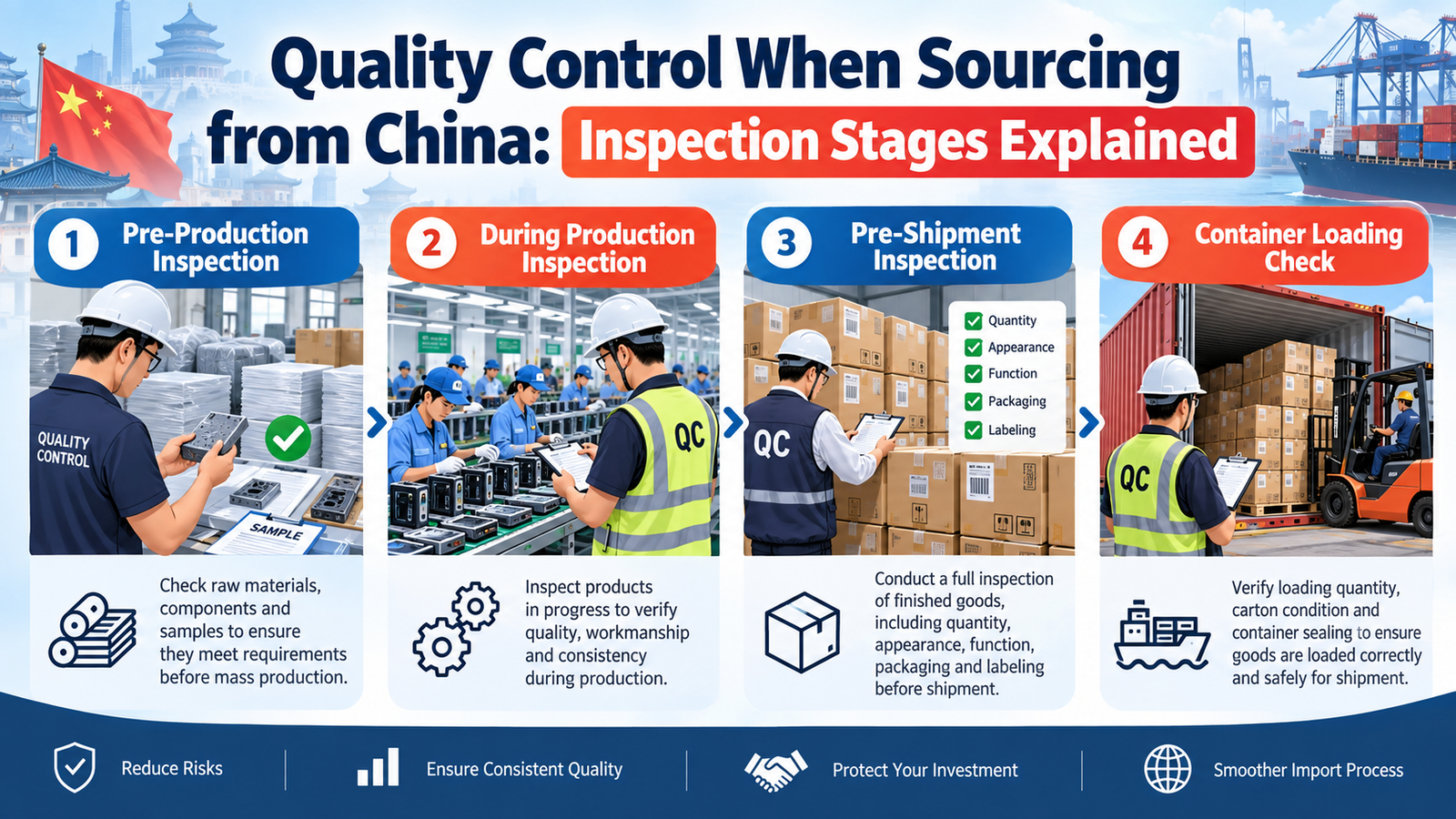
The four inspection stages at a glance
Inspection companies use slightly different names, but the stages below are the common structure. Timings are typical industry practice, not fixed rules, and should be agreed for each order.
| Stage | Also called | Typical timing | Main purpose | Typical output |
|---|---|---|---|---|
| Pre-production inspection | PPI, Initial Production Check (IPC) | Before mass production, or within the first part of the run | Confirm raw materials, components, colours and set-up match the specification before they are used | Report on materials and first units, with photos and any deviations |
| During production inspection | DUPRO, DPI, in-line inspection | Once a meaningful share of the order is produced, often somewhere between 10% and 50% | Find recurring defects while the rest of the run can still be corrected | Defect findings by type, production progress, corrective actions requested |
| Pre-shipment inspection | PSI, Final Random Inspection (FRI) | When production is complete and most goods (commonly at least 80%) are packed | Decide whether the lot meets the agreed quality level before the balance is paid and goods leave | Pass, fail or pending result against the AQL, with defect counts, measurements and photos |
| Container loading check | CLC, loading supervision | During loading at the factory or warehouse | Confirm the right goods, quantity and carton condition go into the container, and record the seal | Loading record with carton counts, container condition, seal number and photos |
Not every order needs all four. A small repeat order of a stable catalogue product may only need a pre-shipment inspection. A first production run of a custom product usually benefits from checks at more than one stage.
Before any inspection: set the quality standard
An inspector can only check goods against something written down. If the standard is vague, a failed inspection becomes an argument instead of a decision. Before production starts, make sure four things exist and that the supplier has accepted them.
- A product specification. Materials, dimensions with tolerances, colours (with a reference such as a Pantone code or physical swatch), functions, markings, labelling and packaging.
- An approved sample. Often called a golden sample: a signed, sealed reference unit kept by both buyer and supplier, so the inspector has something physical to compare against.
- A defect list and quality levels. What counts as a critical, major or minor defect for this product, and the acceptance quality limit (AQL) for each.
- Inspection terms in the purchase order. Which inspections will happen, the buyer’s right to send an inspector, the sampling standard and AQL, and what happens if goods fail, including re-inspection costs.
Linking the balance payment to a passed pre-shipment inspection is what gives the result commercial weight. Without that link, an inspection report is information the supplier can choose to ignore.
Pre-production inspection (PPI or IPC)
A pre-production inspection checks the inputs before they turn into thousands of finished units. Some inspection firms run it before production begins; others, such as QIMA’s Initial Production Check, cover the period from before production up to about 20% completion so the inspector can see the first units off the line.
Typical checks include:
- Raw materials and components against the specification: grade, thickness, composition, colour.
- Quantity of materials on hand compared with the order.
- Artwork, logos, labels and packaging materials before printing runs.
- First units off the line against the approved sample.
- Whether the order is being made at the factory you contracted, not subcontracted elsewhere.
It is most useful for custom products, new suppliers, products with expensive or specified materials, and orders where printing or colour errors would ruin the whole run.
During production inspection (DUPRO)
A during production inspection takes random samples from finished and in-process units once a meaningful part of the order has been made. Its value is timing: a recurring defect found at this point affects part of the order, not all of it, and the supplier can correct the process for the remaining run.
Inspectors typically review defect types and frequency, measurements, assembly and function, production progress against the shipping date, and whether issues found at the pre-production stage were fixed. DUPRO is worth considering for large orders, long production runs, products with many assembly steps, and suppliers you have not worked with before. It is also a sensible addition for the first orders after Chinese New Year, when factories often restart with new or returning staff and quality can be less stable.
Pre-shipment inspection (PSI)
The pre-shipment inspection, also called a final random inspection, is the stage most buyers mean when they talk about quality control in China. It happens when production is finished and most of the goods are packed, so the inspector can draw a random sample from the actual lot that will ship.
A typical pre-shipment inspection covers:
- Quantity produced and packed against the order.
- Visual workmanship and defects, counted by critical, major and minor category.
- Conformity to the specification and approved sample: style, colour, materials, dimensions.
- On-site function, safety and fit tests appropriate to the product, such as drop tests on cartons or functional tests on electrical items.
- Labels, markings, barcodes and required warnings.
- Packaging, carton markings, carton dimensions and weights.
Packaging deserves its own attention because export cartons have to survive stacking, handling and humidity. Our packaging preparation service page outlines the packaging and labelling details that are worth fixing before goods are packed.
The output is a report with a result, usually pass, fail or pending, plus defect counts, measurements and photos. The buyer, not the inspector, decides what to do with a fail: accept, ask for sorting and rework followed by re-inspection, or negotiate. That decision is far easier when the purchase order already says what a failed inspection means.
Container loading check (CLC)
A container loading check supervises the goods going into the container. The inspector confirms the container is in sound condition, that the cartons match the inspected lot, counts what is loaded, checks for damage, and records the seal number with photos.
It cannot fix product defects, because production is over. Its job is to stop a different problem: the right goods passing inspection and the wrong goods, or a short quantity, being shipped. It is most relevant for full container loads, high-value goods, mixed shipments and situations where goods could be swapped between inspection and loading.
How sampling and AQL decide pass or fail
Inspectors rarely check every unit. Instead they use acceptance sampling: a random sample is drawn from the lot, defects are counted, and the count is compared with limits set in a sampling standard. Two standards dominate consumer goods inspection:
- ISO 2859-1, “Sampling procedures for inspection by attributes, Part 1: Sampling schemes indexed by acceptance quality limit (AQL) for lot-by-lot inspection”. ISO published a third edition, ISO 2859-1:2026, in January 2026, replacing the 1999 edition and its 2011 amendment.
- ANSI/ASQ Z1.4-2003 (R2018), “Sampling Procedures and Tables for Inspection by Attributes”, published by ASQ and widely used by inspection companies.
Both began as commercial equivalents of the US military standard MIL-STD-105E. They are closely related but not identical, so name the standard and edition you expect in the purchase order rather than writing “AQL 2.5” on its own.
AQL, which ISO calls the acceptance quality limit and many buyers call the acceptable quality limit, is the worst defect level the buyer will tolerate as a process average. Buyers usually set separate limits for each defect class. A common choice for consumer goods is zero tolerance for critical defects, AQL 2.5 for major defects and AQL 4.0 for minor defects, but the right levels depend on the product, its risk and the buyer’s market.
A worked example
Take an order of 5,000 units inspected at General Inspection Level II, the most widely used level, under ANSI/ASQ Z1.4 normal single sampling.
| Defect class | AQL chosen | Sample size | Accept if defects found are | Reject if defects found are |
|---|---|---|---|---|
| Critical | 0 (buyer’s choice) | 200 units | 0 | 1 or more |
| Major | 2.5 | 200 units | 10 or fewer | 11 or more |
| Minor | 4.0 | 200 units | 14 or fewer | 15 or more |
Passing does not mean the lot is defect-free. It means the sample results are consistent with the quality level you agreed. If a lower defect rate matters, set a lower AQL or a higher inspection level, and accept that the sample size and inspection time will increase.
How inspections fit the order timeline
Inspections work best when they are planned at the time of ordering rather than booked when the supplier says goods are ready. A typical sequence looks like this:
- Approve the sample and sign the specification and purchase order, including inspection terms.
- Pay the deposit, if your terms include one, and agree production dates.
- Run a pre-production inspection as materials arrive or the first units are made.
- Run a during production inspection once a meaningful share of the order is complete.
- Ask the supplier to confirm when production is complete and most goods are packed, then book the pre-shipment inspection with enough lead time before the cargo cut-off.
- Review the report and release the balance only when the lot passes or you formally accept the deviations.
- Supervise loading if the shipment justifies it, and keep the loading record with your shipping documents.
If you pay by letter of credit, the inspection can be built into the payment too. A buyer can ask for an inspection certificate from a named inspection company to be listed among the documents the bank requires, so payment depends on the inspection taking place.
Which inspection matters most?
If an order can only carry one inspection, it is normally the pre-shipment inspection. It checks the finished lot that will actually ship, and it happens while the balance payment is still in your hands. Its weakness is that problems found at this point are slower and costlier to fix, which is why riskier orders add earlier checks.
| Order situation | Inspections usually worth considering | Why |
|---|---|---|
| Small repeat order, stable catalogue product, known supplier | Pre-shipment inspection | Low change risk; the main need is confirming the finished lot |
| First order with a new supplier | Pre-shipment inspection, plus pre-production check for custom elements | No quality history, and early errors in materials or printing are likely to repeat across the run |
| Custom product, new mould or new design | Pre-production, during production and pre-shipment | Several points where the product can drift from the approved sample |
| Large order or long production run | During production and pre-shipment | A recurring defect found late affects the whole quantity |
| Regulated or safety-critical product | Pre-production, pre-shipment, and lab testing where required | Material and safety failures can block import or trigger recalls |
| Full container, high-value or mixed shipment | Pre-shipment plus container loading check | Protects against short shipment, substitution and loading damage |
Laboratory testing is a separate activity. A visual and on-site inspection cannot confirm chemical content, flammability or electrical safety to a regulatory standard; that needs testing by an accredited laboratory against the rules of your destination market.
Who carries out quality inspections?
There are three common options, and they can be combined:
- The supplier’s own QC team. Useful for in-process control, but not independent. Treat a supplier’s report as a claim to verify, not as evidence.
- A third-party inspection company. Independent inspectors booked per inspection, working to your checklist and sampling plan.
- A sourcing partner’s quality control team. Inspections coordinated by the company that also manages your suppliers and orders, which keeps specification, follow-up and corrective actions in one place.
Whichever you choose, ask who pays the inspector, what checklist they will use, which sampling standard they apply, and if you will receive the full report with photos. The important principle is that the person inspecting your goods works for you, not for the factory. A quality control partner should be able to answer those questions clearly before the first booking.
Buyer-commissioned inspections are also different from government pre-shipment inspection programmes. Under the WTO Agreement on Preshipment Inspection, some importing countries’ governments use private companies to check the price, quantity and quality of imports for customs and financial control purposes. Those checks serve the government, not your quality standard.
Quality control vs factory audit
The two are often confused, but they answer different questions.
| Product quality inspection | Factory audit | |
|---|---|---|
| What is checked | The goods produced for a specific order | The factory: legal status, capacity, equipment, processes, quality system and, depending on the audit type, social or environmental practices |
| Question it answers | Does this lot meet the agreed specification? | Is this factory capable of producing what I need, reliably? |
| Typical timing | Before, during and after production of each order | Before placing the first order, then periodically |
| Main output | Pass, fail or pending result with defect counts | Scored assessment of strengths, gaps and risks |
A good audit result does not guarantee a good shipment, and a passed inspection says little about whether the factory can repeat it next time. Many buyers use a factory audit to choose a supplier and inspections to control each order. Our China factory audit checklist explains the evidence buyers should check across legal status, capacity, equipment, materials, quality systems, workforce and safety.
Quality control checklist for your next order
- ☐ Written specification with tolerances, accepted by the supplier
- ☐ Signed and sealed approved sample held by both sides
- ☐ Defect list classifying critical, major and minor defects
- ☐ Sampling standard, inspection level and AQLs written in the purchase order
- ☐ Inspection rights and failed-inspection terms agreed, including re-inspection costs
- ☐ Inspection stages chosen to match the order’s risk
- ☐ Balance payment linked to a passed pre-shipment inspection
- ☐ Lab testing arranged where the destination market requires it
- ☐ Inspection dates planned around production, holidays and the cargo cut-off
Frequently asked questions
When should products from China be inspected?
At minimum, inspect when production is complete and most goods are packed, before you pay the balance. Add a pre-production check for custom products or new suppliers, a during production inspection for large or long runs, and a loading check for full containers or high-value shipments.
Is a pre-shipment inspection enough on its own?
For small repeat orders of stable products from a known supplier, often yes. For custom products, new suppliers or large orders, it can come too late: a defect found at the end affects every unit and leaves little time to fix it before the shipping date.
What AQL should I use?
A common starting point for consumer goods is zero critical defects, AQL 2.5 for major defects and AQL 4.0 for minor defects at General Inspection Level II. Products with higher safety or brand risk often use tighter limits. Agree the levels with your supplier before production, not after the inspection.
What happens if my goods fail inspection?
You decide the next step: ask the supplier to sort and rework the goods and book a re-inspection, accept the lot with a negotiated adjustment, or, in serious cases, refuse it under the contract. Agreeing in advance who pays for re-inspection makes this much easier.
Can I rely on the factory’s own QC report?
It is useful information, but it is not independent. The factory has a direct interest in the goods passing. Use its records to understand the process, and use an inspector who works for you to make the shipping decision.
Does an inspection replace lab testing or certification?
No. On-site inspection checks appearance, dimensions, function, quantity and packaging. Regulatory requirements, such as limits on restricted substances or electrical safety, usually need testing by an accredited laboratory and the documents your destination market requires.
Conclusion
Quality control in China works best as a plan rather than a single check. Set the standard before production, choose inspection stages that match the order’s risk, use a recognised sampling standard, and tie the balance payment to the pre-shipment result. Each step moves the discovery of problems to a point where they are still cheap to fix.
Jingxin Sourcing has its head office in Dhaka, Bangladesh, and an office in Yiwu, China. Bangladesh importers can also follow our step-by-step guide to importing from China to Bangladesh for the wider registration, payment, shipping and customs process. Not sure whether you need an audit or an inspection? See factory audit vs product inspection, which separates checking the supplier from checking the goods. Need help planning inspections for your next order? Learn more about Jingxin Sourcing’s Quality Control service.
