
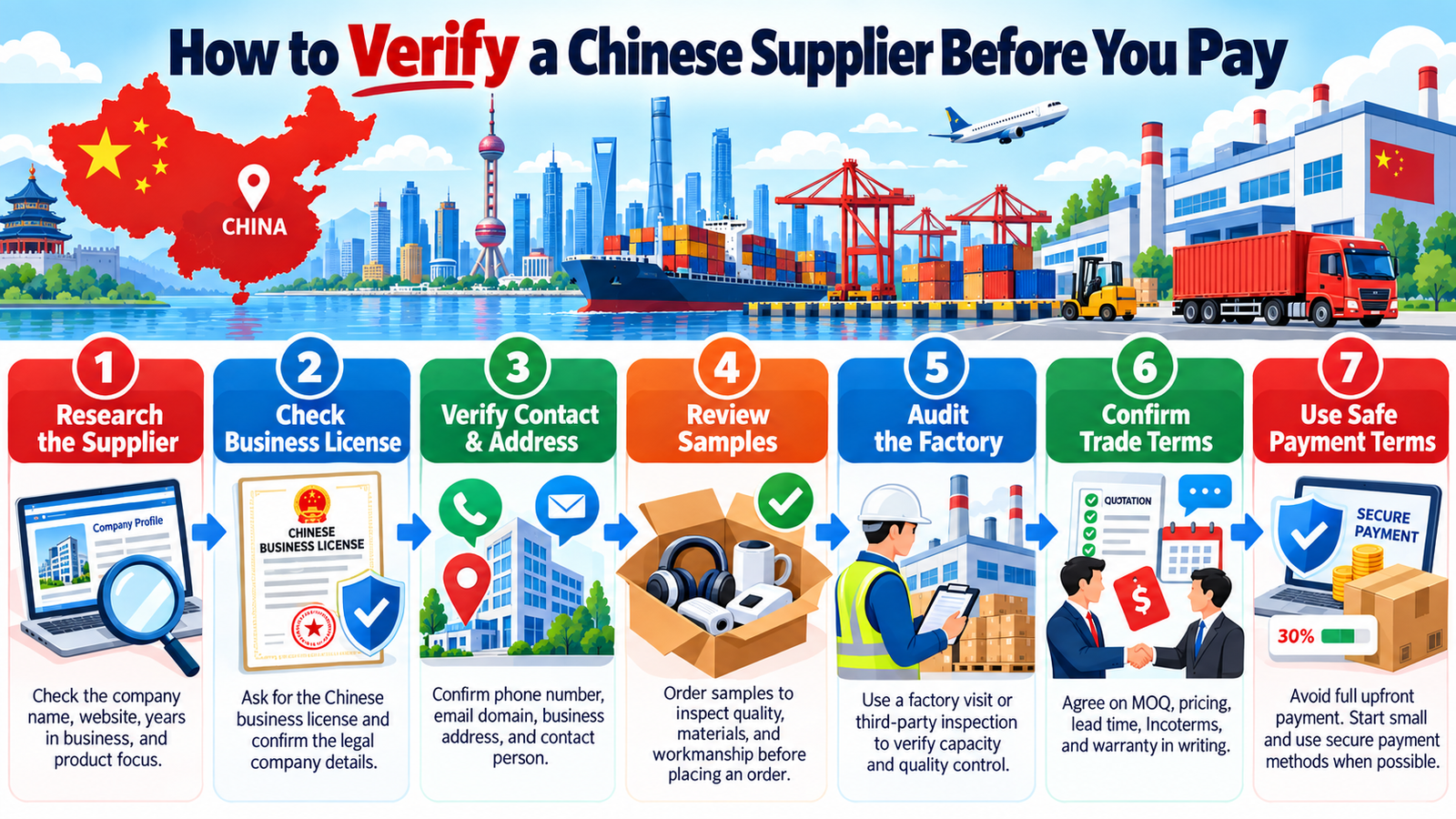
Most supplier problems that cost buyers money could have been caught before the first payment. A company that is not registered, a trading company presenting itself as a factory, a certificate that belongs to someone else, or a bank account that does not match the seller are all things you can check while you still hold the deposit.
This guide shows how to verify a Chinese supplier in ten steps, grouped into document checks, remote checks, an on-site audit where it is justified, and pre-payment checks. It is written for importers, procurement teams and brand owners who already have a shortlist and need to decide who is safe to pay. Verification is one stage of a wider process, covered in our guide on how to source products from China. After verification, compare shortlisted offers using the supplier quotation comparison method.
How do you verify a Chinese supplier?
To verify a Chinese supplier, check its business licence and Unified Social Credit Code on GSXT, China’s official company registry, then look for regulatory and court records, confirm certificates with the issuing body, and establish whether it is a factory or a trader. Follow with a live video walkthrough and product samples, audit larger or custom orders on site, and confirm the contract and bank account name match before paying.
The 10-step supplier verification checklist
Work through the steps in order. Each one is quick on its own, and together they filter out most unsuitable or fraudulent suppliers before money moves.
Document checks
- Get the business licence and check the Unified Social Credit Code (USCC) on GSXT.
- Search for abnormal-operation listings, penalties and court records.
- Verify certificates and test reports with the body that issued them.
- Establish whether you are dealing with a factory, a trading company or a related company.
Remote checks
- Run a live, unscripted video walkthrough of the premises.
- Order and assess samples against your specification.
- Cross-check contact details, website, addresses and references for consistency.
On-site check
- Commission a factory audit when the order value, customisation or risk justifies it.
Pre-payment checks
- Confirm that the proforma invoice and contract name the same legal entity, product and terms.
- Confirm that the bank account holder name matches the contracting company, and verify any change of bank details by phone.
Document checks: confirm the company exists and is what it claims
1. Check the business licence and USCC on GSXT
Every company registered in mainland China has an 18-digit Unified Social Credit Code (USCC), which appears on its business licence. Ask the supplier for a clear copy of the licence, then search the company name or USCC on the National Enterprise Credit Information Publicity System (GSXT), the official registry operated by the State Administration for Market Regulation (SAMR).
The licence copy proves very little on its own, because images can be edited. The registry record is what counts. Compare the two field by field:
| Registry field | What to compare | What should make you pause |
|---|---|---|
| Company name (Chinese) | Exact match with the licence, the contract and the bank account holder | An English name that has no clear link to the registered Chinese name |
| USCC | Same 18 characters on the licence and in the registry | No record found, or the code belongs to a different company |
| Registration status | Active (存续 or 在业) | Cancelled, revoked or in liquidation |
| Date of establishment | Consistent with the experience the supplier claims | A very recent company claiming many years of export history |
| Business scope | Covers manufacturing or trading of your product type | Scope limited to services or unrelated goods |
| Registered address | Matches the address of the premises you are shown | A different city or district from the claimed factory |
| Legal representative and shareholders | Names you can link to the people you deal with, where relevant | Frequent recent changes with no explanation |
GSXT is in Chinese and can be slow or hard to reach from outside China. Many buyers use a browser translation tool, a commercial data provider or a local team to run the search, but the official record should still be the reference point.
2. Search penalty, abnormal-operation and court records
A registered company can still be a risky one. GSXT shows whether a company has been placed on the list of enterprises with abnormal operations, which typically follows problems such as a missed annual report or an unreachable registered address, and whether it appears on SAMR’s list of entities with serious violations of law and dishonesty. It also shows administrative penalties.
Two court databases operated by the Supreme People’s Court add a different view:
- China Judgments Online publishes court judgments. Search the company name for contract disputes, especially repeated claims from customers or suppliers.
- China Enforcement Information Online shows whether a company is subject to court enforcement or listed as a dishonest judgment debtor, which usually means it has not paid a debt a court ordered it to pay.
One old dispute is not a reason to reject a supplier. A pattern of unpaid judgments, enforcement orders or abnormal-operation listings is a strong reason to stop or to ask for much tighter payment terms.
3. Verify certificates and test reports at the source
Suppliers often send ISO 9001 certificates, product certifications and laboratory test reports. Treat each one as a claim to verify, not as evidence:
- Management system certificates (such as ISO 9001): check the certificate number with the certification body that issued it. Certificates issued in China can be searched on the certification database of the Certification and Accreditation Administration of China (CNCA), and many certificates worldwide can be checked on IAF CertSearch. Confirm the certification body itself is accredited, for example by CNAS in China.
- Company name and scope: the certificate should name the same legal entity as the business licence, and its scope should cover your product.
- Validity: check the issue and expiry dates and whether the certificate is suspended or withdrawn.
- Test reports: contact the laboratory with the report number and ask it to confirm the report is genuine. Check that the report covers your exact product and model, the right standard for your market, and is recent enough for your purpose.
A common problem is a genuine certificate or report that belongs to a different company, such as the actual manufacturer behind a trading company. That is not always fraud, but it tells you who really makes the product.
4. Establish whether it is a factory, a trader or a related company
Trading companies are a legitimate and often useful part of China’s supply chain. The risk is not dealing with a trader. It is not knowing that you are. Our guide to telling a trading company from a factory covers the comparison in more depth. Signs worth checking include:
- Business scope on GSXT that mentions production (生产 or 制造) rather than only sales or trading.
- A registered address that is an office building rather than an industrial area.
- A product range far wider than one factory could plausibly make.
- A quotation or contract from one company name and a factory tour of another.
Many Chinese exporters also invoice through a related company, often registered in Hong Kong. If that happens, ask for the related company’s registration details and how it is connected to the mainland entity. Hong Kong companies can be searched through the Companies Registry’s e-Search service (fees apply). The contract, the invoice and the bank account should all name the company you have actually checked.
Remote checks: test what the documents cannot show
5. Run a live, unscripted video walkthrough
A video call confirms that people, premises and some equipment exist at a moment in time. To make it useful, keep control of it:
- Ask to start at the factory gate or company sign and walk to the production floor without cuts.
- Ask to see your product type, or similar products, on a running line, plus raw-material storage, finished-goods packing and the quality check area.
- Ask the person to show a current-day reference, such as a newspaper or a phone screen with the date, if you suspect pre-recorded footage.
- Compare what you see with the registered address and the scale of capacity the supplier claims.
Is a video call enough to verify a supplier?
For low-value, standard catalogue products, a registry check, a good video call and an approved sample may be a proportionate level of checking. It is not enough when the order is large, the product is custom, or quality and compliance matter. A call cannot confirm who owns the site, how production is actually managed, whether a quality system is followed, or whether the premises shown are the supplier’s own.
6. Order and assess samples against your specification
Samples test the product, not only the company. Evaluate them against a written specification covering dimensions, materials, finish, function and packaging, and keep an approved sample as the reference for later production. Ask who made the sample and where. A sample made by a different workshop from the one producing your order is a common source of disappointment.
7. Cross-check contact details and references
Fraudulent and misrepresented suppliers often show small inconsistencies. Check that:
- The email domain belongs to the company, and the website content matches the registered company and products.
- Phone numbers and addresses are the same across the website, marketplace profile, licence and contract.
- Marketplace badges or membership years can be confirmed on the platform itself, not only in screenshots.
- References are customers you can contact independently, ideally in your own market, rather than contacts the supplier introduces by email only.
On-site check: when you need a factory audit
8. Commission a factory audit where the risk justifies it
A factory audit is an on-site assessment of a supplier’s premises, capacity, equipment, quality management and, depending on scope, working conditions. It confirms what document and remote checks can only suggest. Use this simple rule: if a wrong supplier would cost you more than the audit, or the order cannot easily be moved to another supplier, audit before the deposit.
| Situation | Audit before paying? | Why |
|---|---|---|
| Small trial order of a standard catalogue product | Usually optional | Registry checks, samples and pre-shipment inspection may be proportionate |
| First large order with a new supplier | Recommended | Capacity and quality systems need to match the order size |
| Custom product, private label or new tooling | Recommended | You depend on the supplier’s engineering, process control and tooling ownership |
| Regulated product (for example children’s products or electrical goods) | Recommended | Compliance depends on controlled materials and consistent production |
| Your customers require social or ethical compliance | Required in practice | Retailers and brands often need an audit report as evidence |
| Document or remote checks raised unresolved questions | Yes | An audit is the most direct way to settle what you could not confirm |
An audit is a snapshot. It reduces supplier risk but does not replace quality control inspections during and after production.
Pre-payment checks: protect the deposit
9. Match the proforma invoice and contract to the verified company
Before paying, read the proforma invoice (PI) and purchase contract together. Check that:
- The seller’s legal name and address match the company you verified on GSXT, or a related company you have also checked.
- Product description, specification, quantities, unit prices, currency and Incoterms rule match what was agreed.
- Payment terms, including the deposit and when the balance is due, are written out. Linking the balance to a passed inspection gives you leverage.
- Lead time, packaging, inspection rights and what happens if goods fail inspection are stated.
10. Confirm the bank account name and guard against changed details
The account holder name on the payment instructions should match the contracting company exactly. Treat these as stop signs until resolved:
- A request to pay a personal account, or an account in a name you have not verified.
- A late change of bank details, especially by email or chat, often with a reason such as an audit or a tax issue.
- An account in a third country with no clear connection to the supplier.
Changed bank details are a classic sign of payment diversion fraud, also called business email compromise (BEC), where criminals intercept or imitate a supplier’s emails. The FBI’s Internet Crime Complaint Center recorded 24,768 BEC complaints and adjusted losses of just over US$3 billion in its 2025 report. UK police guidance on mandate fraud advises confirming any payment change directly with the supplier using contact details you already know to be genuine, and limiting who in your business can change payment details.
In practice, that means calling a known contact on a number from your records, never one given in the email that asks for the change. For a first payment to a new supplier, some buyers also send a small test amount and confirm receipt before sending the full deposit.
How the checks connect
Each source answers a different question. Knowing what a source cannot prove is as important as knowing what it shows.
| Record or check | Source | What it confirms | What it does not confirm |
|---|---|---|---|
| Business licence and USCC | GSXT (SAMR) | The company legally exists, its status, scope and address | That it makes your product or operates the premises you were shown |
| Penalties and abnormal operations | GSXT (SAMR) | Regulatory problems and missed filings | Product quality or delivery reliability |
| Judgments and enforcement records | Supreme People’s Court databases | Disputes and unpaid court-ordered debts | Disputes that were settled privately |
| Certificates and test reports | Issuing body or laboratory | That a specific document is genuine and current | That every production batch meets the standard |
| Video walkthrough and samples | Supplier, under your direction | Premises and products exist and look as expected | Ownership of the site, capacity or process control |
| Factory audit | On-site auditor | Capacity, equipment, quality system and conditions on the audit day | Quality of your finished goods |
| Contract and bank account match | Your documents and the supplier’s bank details | That money goes to the company you checked | Anything about product quality |
Together they form a chain: the USCC on GSXT identifies the legal entity, and that same entity should appear on the certificates, the audit report, the contract, the invoice and the bank account. A break anywhere in that chain is the thing to investigate.
Frequently asked questions
How do I know if a Chinese supplier is legitimate?
Start with the official registry. A legitimate supplier has an active GSXT record that matches its licence, contract and bank account, no pattern of penalties or unpaid judgments, certificates that the issuing body confirms, and premises and samples that match its claims. Legitimate does not automatically mean suitable, so capacity and quality still need checking.
How can I check a company in China for free?
GSXT, China Judgments Online and China Enforcement Information Online are free to search, although they are in Chinese and can be slow from abroad. Certificate databases such as the CNCA search and IAF CertSearch also offer free basic lookups. Commercial data providers and local teams charge for translation, reports and convenience.
Is a video call enough to verify a supplier?
Only for small, low-risk orders of standard products. A video call shows premises and people at one moment, but cannot confirm ownership, capacity, quality systems or whether the site belongs to the supplier. For large, custom or regulated orders, combine it with document checks and an on-site factory audit.
When do I need a factory audit?
Audit before paying when the order is large, the product is custom or regulated, new tooling is involved, your customers require compliance evidence, or earlier checks left questions unanswered. For a small trial order of a catalogue product, registry checks, samples and a pre-shipment inspection may be enough.
Is it a red flag if a supplier asks me to pay a Hong Kong company?
Not by itself. Many mainland exporters invoice through a related Hong Kong company. It becomes a concern when the Hong Kong company is not named in the contract, cannot be linked to the supplier you checked, or appears only in a last-minute change of payment instructions.
What should I do if a supplier changes its bank details?
Do not pay until you have confirmed the change by phone with a known contact, using a number from your own records. Ask for the reason in writing, check that the new account holder name matches the contracting company, and update the contract or PI if the change is genuine.
Conclusion
Verifying a Chinese supplier is a sequence of small, specific checks: the registry record, regulatory and court history, certificates, factory or trader status, a controlled video walkthrough, samples, an audit when the risk justifies it, and a final match between contract and bank account. Done before the deposit, these checks cost far less than recovering money from the wrong supplier.
Jingxin Sourcing has its head office in Dhaka, Bangladesh, and an office in Yiwu, China. For the registry step in detail, see how to check a Chinese business licence online; for what to watch for, see Chinese supplier red flags; and before paying, use the questions to ask a supplier before a deposit. To choose between a video check and a visit, see when video checks work and when they don’t, and to understand the options for an on-site check, see what a factory audit is. Need help checking a supplier before you commit? Learn more about Jingxin Sourcing’s Factory Audits service, or see how our Product Sourcing service supports supplier selection.
