
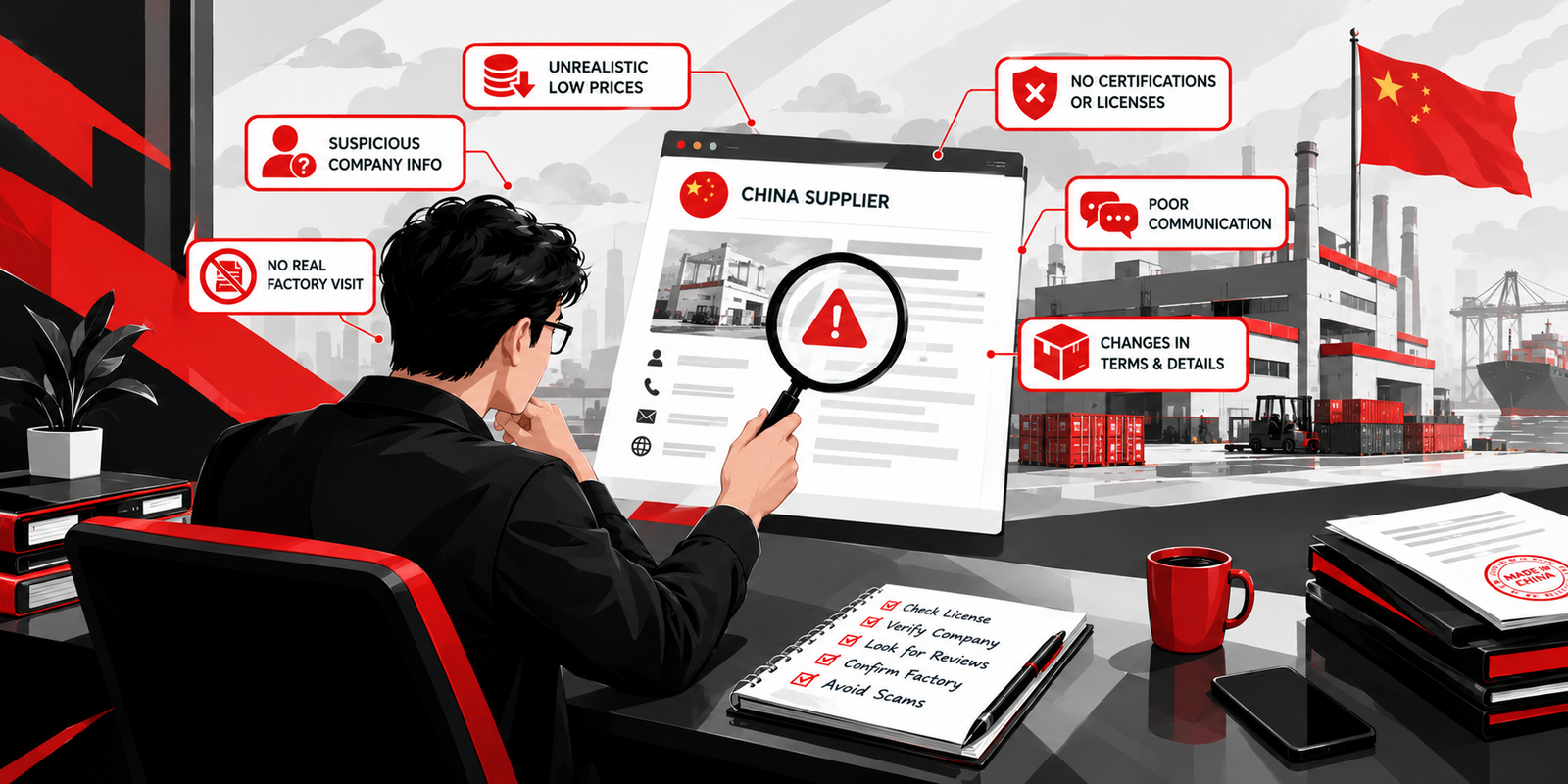
The deposit is the point of greatest exposure in most China orders. Before it, you can walk away at no cost; after it, your leverage shrinks and recovering money from a supplier in another jurisdiction is slow and uncertain. That makes the days before payment the right time to look hard for warning signs.
Quick answer: The most serious Chinese supplier red flags are requests to pay a personal or third-party bank account, bank details that change by email, a business licence that does not match the official registry, and prices far below every other quote. Each sign has a specific check — a registry lookup, a call on a known number, a sample or a live video — that confirms or clears it before you pay.
Red flag or just a difference in business culture?
Not every unfamiliar behaviour is a warning sign. Slow replies around public holidays, brief emails in imperfect English, a request for a 30% deposit, or a supplier that turns out to be a trading company are all normal in China sourcing. A red flag is something that either removes your ability to recover money or suggests the supplier is not who it says it is. The test for each sign below is simple: is there a check that would clear it, and is the supplier willing to let you run it?
Honest suppliers usually welcome verification. Resistance to a reasonable check is often more telling than the original sign.
12 Chinese supplier red flags, with the check for each
Communication red flags
1. Pushing you off the platform before payment. A supplier met on a B2B platform urges you to move to personal messaging and pay outside the platform’s payment system. Check: Ask why. If the platform offers buyer protection on orders paid through it, find out what you lose by leaving it — our Alibaba vs 1688 comparison explains how buying differs on each platform.
2. Evasive answers and no live video. Technical questions get generic replies, and requests for a live video of the production area are postponed indefinitely. Check: Ask for an unscheduled live video call showing the production line and the company name at the entrance. A short, specific technical question — machine size, cycle time, material grade — is also revealing.
3. Pressure to pay quickly. “This price is valid today only”, “raw-material prices go up tomorrow”, “the line is booked unless you pay now”. Check: Ask for the quotation validity in writing with a date. Genuine price movements exist, but a legitimate supplier will usually hold a quote for a stated period.
4. Inconsistent or look-alike contact details. A free webmail address instead of a company domain, a domain that differs by one letter from the one you used before, or phone numbers that change between messages. Check: Compare the email domain character by character with earlier correspondence and with the company’s website. Confirm important instructions through a phone number you obtained independently, not one given in the same email.
Document red flags
5. A licence that is missing or does not match the registry. The supplier will not share its business licence, or the details differ from the official record. Check: Search the 18-character credit code on GSXT, China’s official company registry — the method is set out step by step in how to check a Chinese business licence online.
6. Certificates you cannot verify. Test reports or certificates that are blurry, cover a different product, or are issued to a different company. Check: Confirm the certificate number, holder name, address and scope with the issuing body or its online database. A certificate belonging to another company may mean you are dealing with a trader — which is not necessarily a problem, as long as it is disclosed. Our guide to telling a trading company from a factory covers this.
7. Product photos that appear elsewhere. The same images appear on many unrelated listings, or the supplier cannot send fresh photos of the actual product with today’s date written beside it. Check: Run a reverse image search, then request a pre-production sample. Our guide to ordering and evaluating samples from China explains how to judge them.
8. A proforma invoice with the wrong seller. The company named on the proforma invoice (PI) differs from the licence, or key details — product description, Incoterm, payment terms, bank details — are missing. Check: The seller on the PI, the licence holder and the bank beneficiary should be the same legal entity, or the difference should be explained in writing before you pay.
Pricing red flags
9. A price far below every other quote. One quote is dramatically cheaper than several comparable ones. Check: First make sure the quotes are genuinely comparable — same specification, packaging, Incoterm and payment terms — using the method in how to compare quotations from Chinese suppliers. If the gap remains, ask the supplier to itemise material and specification. Extreme low prices often mean thinner material, a different grade, missing components or no intention to deliver.
10. Yes to everything. Any MOQ, any customisation, any lead time, any certification — with no questions asked. Check: Ask what they would need from you to make the change, and what it would do to price and lead time. Experienced manufacturers ask questions back; they rarely accept every request unconditionally.
Payment red flags
11. A personal or third-party bank account. The supplier asks you to pay an individual’s account, or a company with a different name from the one you are buying from. Check: Do not pay until the beneficiary matches the contracting company. If the supplier gives a reason, get it in writing and verify it independently. Paying a personal account removes most of your recourse if something goes wrong.
12. Bank details changed by email. You receive a message — sometimes from what looks like the supplier’s normal address — saying the bank account has changed, often with an urgent reason. Check: Treat every change of bank details as suspicious until confirmed by a phone or video call to a contact you already know, using a number you already had. This pattern is a common feature of business email compromise fraud, where criminals intercept or imitate a real supplier’s emails.
Severity at a glance: stop or investigate?
| Sign | Severity | What to do before paying |
|---|---|---|
| 12. Bank details changed by email | Stop | Confirm by phone or video with a known contact; do not reply to the email to verify |
| 11. Personal or third-party account | Stop | Insist on the contracting company’s account, or use a protected payment route |
| 5. Licence missing or mismatched | Stop | Registry check; walk away if unexplained |
| 8. Wrong seller on proforma invoice | Stop until resolved | Align PI, licence and beneficiary |
| 1. Push to pay off-platform | Investigate | Understand what protection you lose |
| 9. Price far below other quotes | Investigate | Normalise quotes, itemise cost, sample |
| 6. Unverifiable certificates | Investigate | Check with the issuing body |
| 2. No live video, evasive answers | Investigate | Unscheduled live call; consider an on-site audit |
| 3. Pressure to pay quickly | Investigate | Written, dated quote validity |
| 4. Inconsistent contact details | Investigate | Compare domains; confirm by known phone number |
| 7. Recycled product photos | Investigate | Reverse image search; pre-production sample |
| 10. Yes to everything | Investigate | Ask how they would achieve it and at what cost |
One “investigate” sign that clears quickly is normal. Several unresolved signs together, or any “stop” sign, should pause the deposit.
Is a very low price a red flag?
Often, yes — but not always. Prices can legitimately differ because of factory scale, material grade, location, or because one supplier is a manufacturer and another a trader. A low quote becomes a red flag when it remains far below comparable quotes after you have matched specification, packaging, Incoterm and payment terms, and the supplier cannot explain where the saving comes from. In that case the likely explanations are a lower specification than you asked for, hidden costs added later, or a supplier that does not intend to deliver at all.
Should I pay a Chinese supplier’s personal bank account?
As a rule, no. For international trade, pay a company bank account whose beneficiary name matches the supplier on your contract and proforma invoice. A personal account makes it much harder to pursue the company if the order goes wrong, and it is a common feature of fraud. Some small sellers do use personal accounts for domestic trade, which is why the request is sometimes made innocently — but that does not reduce your risk. If you cannot pay a matching company account, use a payment route that offers protection, such as a platform’s own payment system, or work through an intermediary you have verified. Deposit structures and payment methods are explained in a separate upcoming guide to paying Chinese suppliers with T/T, L/C and deposit terms.
Red flags for Bangladesh importers
Bangladeshi buyers paying through a bank remittance or a letter of credit (L/C) face the same risks, plus a documentation angle: the beneficiary on the bank instruction, the seller on the proforma invoice and the shipper on the transport documents need to line up. A supplier that asks you to change the beneficiary after the L/C or remittance has been prepared is showing a payment red flag, not just causing an administrative delay. Check the requirements of your bank and C&F agent for the current rules; our China-to-Bangladesh import guide shows where each document fits.
What to do if you have already paid
If you suspect fraud after paying, act quickly — speed matters more than anything else:
- Contact your bank immediately and ask whether the transfer can be recalled or the receiving bank alerted.
- Stop further payments to the same account and warn colleagues who handle payments.
- Preserve evidence: emails with full headers, chat logs, invoices, bank confirmations and the supplier’s listing.
- Report to the platform if you found the supplier on one, and to law enforcement. In the United States, the FBI’s Internet Crime Complaint Center (IC3) takes online fraud reports; in England, Wales and Northern Ireland, Action Fraud is the national reporting centre. In Bangladesh and elsewhere, report to your local police and ask your bank which authority to notify.
- Do not pay “release fees” or “recovery fees” to anyone who contacts you offering to retrieve the money; this is a common follow-on scam.
Recovery is never guaranteed, which is why the checks before payment matter so much.
How red-flag checks fit into supplier verification
Red flags are a screening layer. They tell you where to look harder; they do not replace verification. The complete process — document checks, registry lookups, remote checks, on-site audit triggers and pre-payment checks — is set out in the guide to verifying a Chinese supplier before you pay. The natural next step is to put your remaining doubts directly to the supplier; our list of the questions to ask a Chinese supplier before paying a deposit turns these warning signs into a structured conversation.
When the warning signs point to a capability or identity question that cannot be answered remotely — “is this really a factory?”, “does this address actually produce our product?” — a physical visit settles it. Jingxin Sourcing carries out independent factory audits in China, with staff conducting audit and inspection work in Yiwu, Shenzhen and Guangzhou. Its supplier-verification checks include the business licence, company registration, factory address, factory vs trading-company status, certifications, bank-account verification and production capability. For buyers who prefer someone else to place platform orders, Jingxin can also place Alibaba and 1688 orders on a customer’s behalf through its China product sourcing service.
Frequently asked questions
How do I spot a fake Chinese supplier?
Look for mismatches: a licence that differs from the GSXT registry, a bank beneficiary that differs from the company, recycled product photos, and refusal to allow a live video or factory visit. Fake suppliers depend on you not checking, so a quick registry lookup and a call on an independently obtained number remove many of them.
Is a 30% deposit a red flag?
No. A deposit of around 30% before production, with the balance before shipment or against documents, is a common structure in China trade. Requests for full payment up front on a first, large, custom order from an unverified supplier deserve more caution, especially when combined with other signs.
Is it a red flag if the supplier turns out to be a trading company?
Not by itself. Many trading companies are legitimate and useful. The red flag is misrepresentation — claiming to be a factory when it is not — because that hides who controls production and quality.
What should I do if a supplier emails new bank details?
Do not pay and do not verify by replying to that email. Call your known contact on a number you already had, confirm the change verbally or by video, and ask for the change on company letterhead consistent with the licence. Bank-detail changes by email are a common fraud pattern.
Can a supplier with a verified Alibaba profile still be a red flag?
Yes. Platform verification reflects the platform’s checks at a point in time and does not cover every risk. Payment requests, bank details and product claims still need your own checks.
Conclusion
Most supplier problems announce themselves before the deposit, if you know where to look: the account you are asked to pay, the documents that should match, the price that should make sense and the questions that should get straight answers. Treat each warning sign as a prompt to run one specific check. If the supplier passes those checks without resistance, you can pay with far more confidence; if it resists, you have learned what you needed to know at the lowest possible cost. If doubts remain, commissioning a factory audit is the usual next step, and how to run a tougher video check shows how to test a supplier remotely first.
