The first number many importers notice on a Chinese supplier’s listing is not the price. It is the MOQ. A product that looks right at a good unit price can still be out of reach if the supplier will only make 3,000 pieces per colour, and a buyer who does not understand where that number comes from has little room to change it.
This guide explains what MOQ means, why factories set minimums, how they differ from one product type to another, and the practical levers buyers use to work with them. If you are earlier in the process, start with our guide on how to source products from China.
What is MOQ?
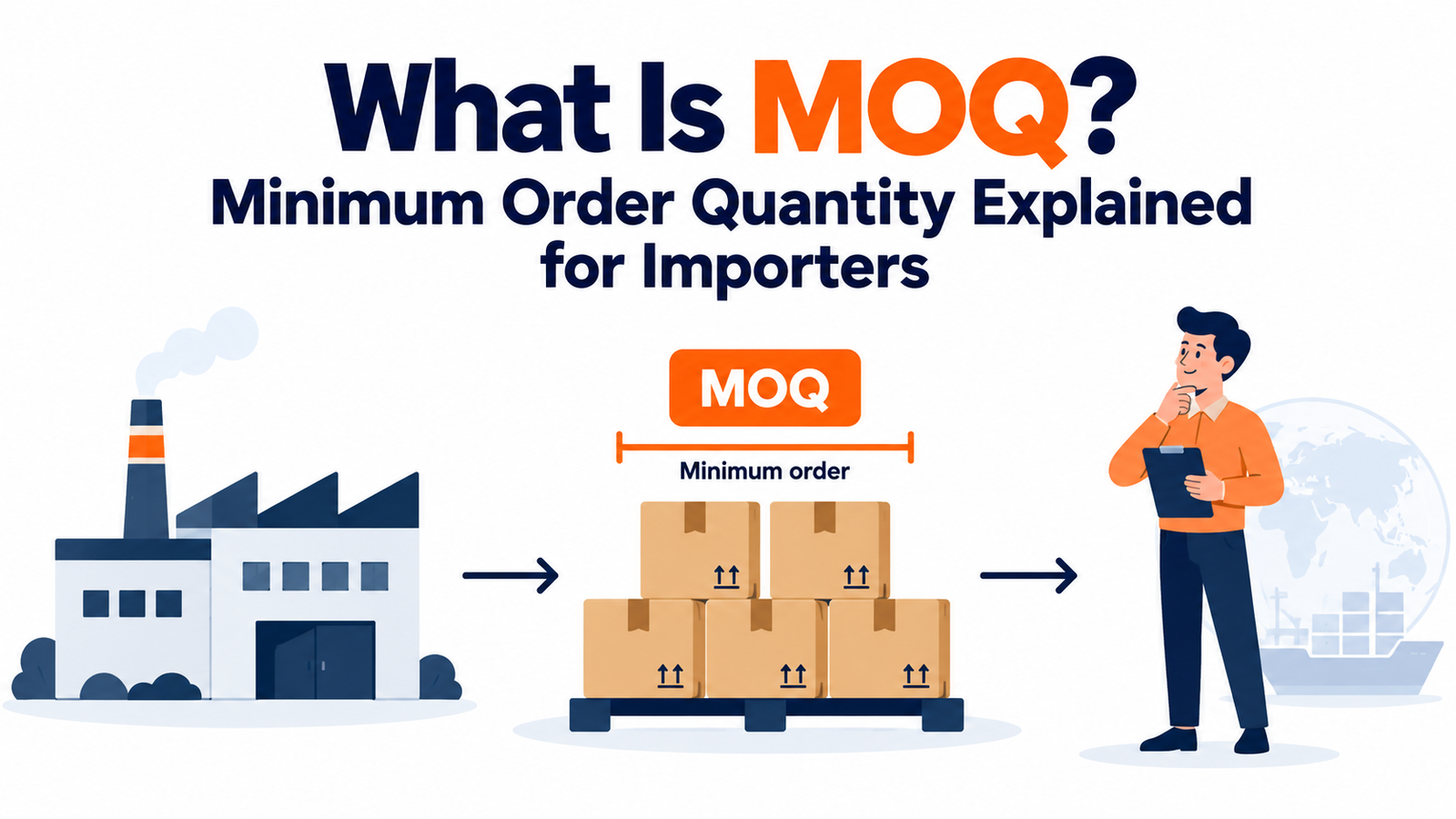
MOQ (minimum order quantity) is the smallest quantity a supplier will accept in a single order, usually stated in units, sets, metres or kilograms per product, colour or variant. Suppliers set it so that each order covers their fixed setup and material costs and still earns a profit.
An MOQ is a commercial term, not a law or an industry standard. Each supplier sets its own, which is why two factories making the same item can quote very different minimums.
How suppliers express MOQ
“MOQ: 500” on a listing can mean different things. Before comparing suppliers, confirm which of these forms applies.
| Form of MOQ | What it means | What to check |
|---|---|---|
| Per item (per SKU) | A minimum number of units of one product | Whether different sizes count as one item or several |
| Per colour or variant | The minimum applies to each colour, print or finish separately | Five colours may mean five times the stated MOQ |
| Per order value | A minimum spend, for example a set amount in US dollars per order | Whether you can mix several products to reach it |
| In pack multiples | Goods are sold in full cartons, rolls or reels, so quantities round up | The quantity per carton or reel and whether part packs are possible |
| First order vs repeat order | A different minimum for a trial order and for later orders | What the repeat-order MOQ and price will be |
Why do factories set MOQs?
Most minimums come from costs that are the same whether a factory makes 200 units or 20,000. Spreading those costs across too few units makes the order unprofitable, so the factory sets a floor.
- Setup time. Changing moulds, threading a loom, cleaning a filling line or setting up a printing press takes hours of labour and machine time before the first good unit is made.
- Raw material minimums. The factory’s own suppliers sell fabric, yarn, resin, printed film or components in minimum quantities. A custom colour of fabric or a custom-printed label often has its own MOQ further up the chain.
- Waste during setup. The first metres of fabric, the first shots of a mould and the first printed sheets are often scrap while settings are adjusted.
- Batch processes. Dyeing, mixing and curing happen in batches. A half-empty dye vat costs almost as much to run as a full one.
- Packaging and handling. Cartons, inner boxes and labels are ordered and packed in fixed quantities.
- Cost of serving the buyer. Quoting, sampling, paperwork and export documents take the same effort for a small order as a large one.
Tooling shows the effect most clearly. As an illustration with hypothetical figures, a mould that costs USD 6,000 adds USD 12 to every unit if only 500 units are made, but USD 1.20 per unit across 5,000 units. A factory that pays for tooling itself will usually set an MOQ high enough to recover it, or ask the buyer to pay for the mould separately.
How MOQs vary by product and material
There is no typical MOQ for “products from China”. The minimum depends mostly on how much of the order is made specifically for you. The more customisation, the higher the minimum tends to be. If you are planning branding, modification or OEM development, see how private label and custom products from China move from specification to production.
| Product type | What drives the MOQ | Usual flexibility |
|---|---|---|
| Stock and wholesale goods | Already made; MOQ is mostly about carton size and handling cost | Often low, sometimes one carton or less |
| Stock product with your logo | Printing or engraving setup, plus logo approval | Low to moderate; depends on the decoration method |
| Garments and textiles | Fabric dyeing and knitting or weaving minimums, usually per colour | Lower if you use the mill’s stock fabric and colours |
| Injection-moulded plastics | Mould cost, machine setup and resin colour batches | Low only when an existing mould is used |
| Electronic products and components | Component reels and trays sold in fixed quantities, plus assembly line setup | Limited by the components with the highest minimums |
| Custom printed packaging | Printing plates, cutting dies and press setup | Low for digital printing; higher for offset or flexo printing |
| Cosmetics and formulated products | Batch size of the mix and the minimums of bottles, tubes and labels | Lower with the factory’s existing formulas and stock containers |
Two points catch buyers out. First, a custom product’s MOQ is often set by its most demanding input, such as a special fabric colour or a printed box, not by the factory’s own assembly line. Second, electronic parts are commonly supplied on reels to the EIA-481 tape-and-reel standard, and reel quantities are fixed by component size, so even a small run may require buying whole reels.
MOQ and related terms
| Term | Meaning | How it relates to MOQ |
|---|---|---|
| MOQ | Minimum order quantity the supplier will accept | Set by the seller |
| MPQ (minimum package quantity) | The smallest pack the item is sold in, such as one carton or one reel | Orders are rounded up to MPQ multiples |
| MCQ (minimum colour quantity) | The minimum per colour or variant | Multiplies the MOQ when you order several colours |
| EOQ (economic order quantity) | The buyer’s own most cost-efficient order size, balancing ordering and storage costs | Set by the buyer; may be above or below the supplier’s MOQ |
| Sample or trial order | A small quantity to check quality before a bulk order | Usually outside the MOQ, at a higher unit price |
Can MOQ be negotiated?
Yes, often, but rarely for free. A supplier will usually accept a smaller order if the fixed costs behind the MOQ are covered another way, such as a higher unit price, a setup fee, simpler specifications or a credible plan for repeat orders. Alibaba.com’s own guidance to sellers suggests offering lower first-order MOQs as trials at higher unit prices.
Where the MOQ comes from a hard upstream limit, such as a mill’s minimum dye lot or a full component reel, the factory has less room to move. Asking the supplier what drives its MOQ tells you which lever is worth pulling.
Six levers for working with a supplier’s MOQ
- Accept a higher unit price. Offer to pay more per unit for a smaller first run. This is the most direct way to cover the supplier’s fixed costs.
- Pay setup or tooling costs separately. If the MOQ exists to recover a mould, plate or die, paying for it up front can bring the minimum down. Agree in writing who owns the tooling.
- Use the supplier’s existing materials. Choosing stock fabric, standard colours, existing moulds or stock packaging removes the upstream minimums that custom inputs create.
- Reduce the number of variants. Fewer colours, sizes or print designs let the full quantity count towards one MOQ instead of being split across several.
- Commit to volume over time. A written forecast or a blanket order with scheduled deliveries can secure a smaller first shipment, as long as the factory can produce efficiently in one or two runs.
- Combine products with the same supplier. If the supplier sets a minimum order value, adding related items from its range can meet it without overbuying one product.
Whatever you agree, record it on the proforma invoice or purchase contract: the quantity, unit price, any setup fee, and the MOQ and price for repeat orders. A low trial MOQ is only useful if the repeat terms still work for your business.
Where to find low-MOQ suppliers in China
If your order is small, it is often easier to choose suppliers whose business model suits small orders than to push a large factory below its minimum. Start by comparing the discovery routes in our guide on how to find reliable suppliers in China.
- “Ready to Ship” and stock listings on B2B platforms. On Alibaba.com, suppliers set their own MOQs; some will sell a single item, and Ready to Ship listings let buyers order set quantities directly from the product page. If you are comparing domestic and export platforms, see Alibaba vs 1688.
- Wholesale markets such as Yiwu. Market stalls and their online channels sell finished goods by the carton, which suits mixed orders of many small lines. Our Yiwu Market guide explains what buyers can source there and how mixed orders are handled.
- Trading companies. Traders often combine several buyers’ demand and may accept smaller orders, though you should know which factory actually makes the goods.
- Smaller factories. Workshops with shorter production lines may accept smaller runs, but check capability and quality controls more carefully.
The trade-off is control. Low-MOQ routes usually mean standard designs, stock materials and less influence over specifications. Before committing to any quantity, it helps to test demand and define the product clearly; our Product Research service covers that groundwork.
The hidden cost of ordering too little
Meeting a supplier’s MOQ is only part of the calculation. Many import costs are charged per shipment rather than per unit, so a very small order can have a high landed cost per piece even at a good factory price.
- Sea freight for part-container (LCL) cargo is charged on the greater of volume in cubic metres or weight in tonnes, and minimum charges often apply.
- Customs clearance, documentation and agent fees are largely fixed per shipment.
- Bank charges for letters of credit or wire transfers are charged per transaction, which matters for importers in markets such as Bangladesh where letters of credit are common.
- A pre-shipment inspection usually costs the same per visit regardless of order size.
Work out the landed cost per unit at two or three order quantities before deciding how hard to negotiate the MOQ. Sometimes the supplier’s minimum turns out to be close to the most economical quantity anyway.
Questions to ask a supplier about MOQ
- Is the MOQ per item, per colour, per size or per order value?
- What drives the MOQ: materials, setup, tooling or packaging?
- What is the unit price at the MOQ and at two higher quantities?
- Is a smaller first order possible, and at what price or setup fee?
- Would a stock material, standard colour or existing mould lower the minimum?
- What are the MOQ and price for repeat orders?
- How many units are in each carton, and will quantities be rounded up?
Asking every shortlisted supplier the same questions makes quotations easier to compare, because the MOQ basis is often what makes two prices look different. Use our five-step supplier quotation comparison method to normalise price, terms and risk. A sourcing partner can manage this comparison for you through a structured product sourcing process.
Frequently asked questions
What does MOQ mean on Alibaba?
It is the minimum quantity the supplier will sell in one order, shown next to the price on the listing. Each supplier sets its own MOQ, so it varies widely for similar products, and many suppliers will discuss a different minimum through messages before an order is placed.
What happens if I order below the MOQ?
The supplier will usually decline, offer stock alternatives, or quote a higher unit price or a separate setup fee. Some will agree a small trial order if you share a realistic plan for repeat orders.
Do samples count toward the MOQ?
No. Samples are normally a separate purchase, charged at a higher unit price plus shipping. Some suppliers credit the sample fee against the first bulk order, so it is worth asking.
Is a lower MOQ always better?
Not always. A lower MOQ reduces stock risk and cash tied up, but usually means a higher unit price, less customisation and higher shipping and clearance costs per unit. Compare landed cost per unit, not just the minimum.
Does the MOQ apply to repeat orders?
Usually yes, and it can change. A trial MOQ agreed for a first order may rise to the standard minimum afterwards, so confirm the repeat-order MOQ and price in writing before you launch.
Why do suppliers quote MOQ per colour?
Because dyeing, printing and moulding in a new colour each need their own setup and often their own batch of material. Each colour therefore carries its own fixed cost, which the per-colour minimum is designed to cover.
Conclusion
An MOQ is a supplier’s way of covering fixed costs, not an arbitrary barrier. Once you know what drives a particular minimum, whether setup, materials, tooling or packaging, you can choose the right lever: pay for setup, simplify the product, commit to future volume or choose a supplier built for small orders. Judge the result on landed cost per unit and on repeat-order terms, not on the first number in the listing.
Need help finding suppliers whose minimums fit your order and comparing their terms? Learn more about Jingxin Sourcing’s Product Sourcing service.