
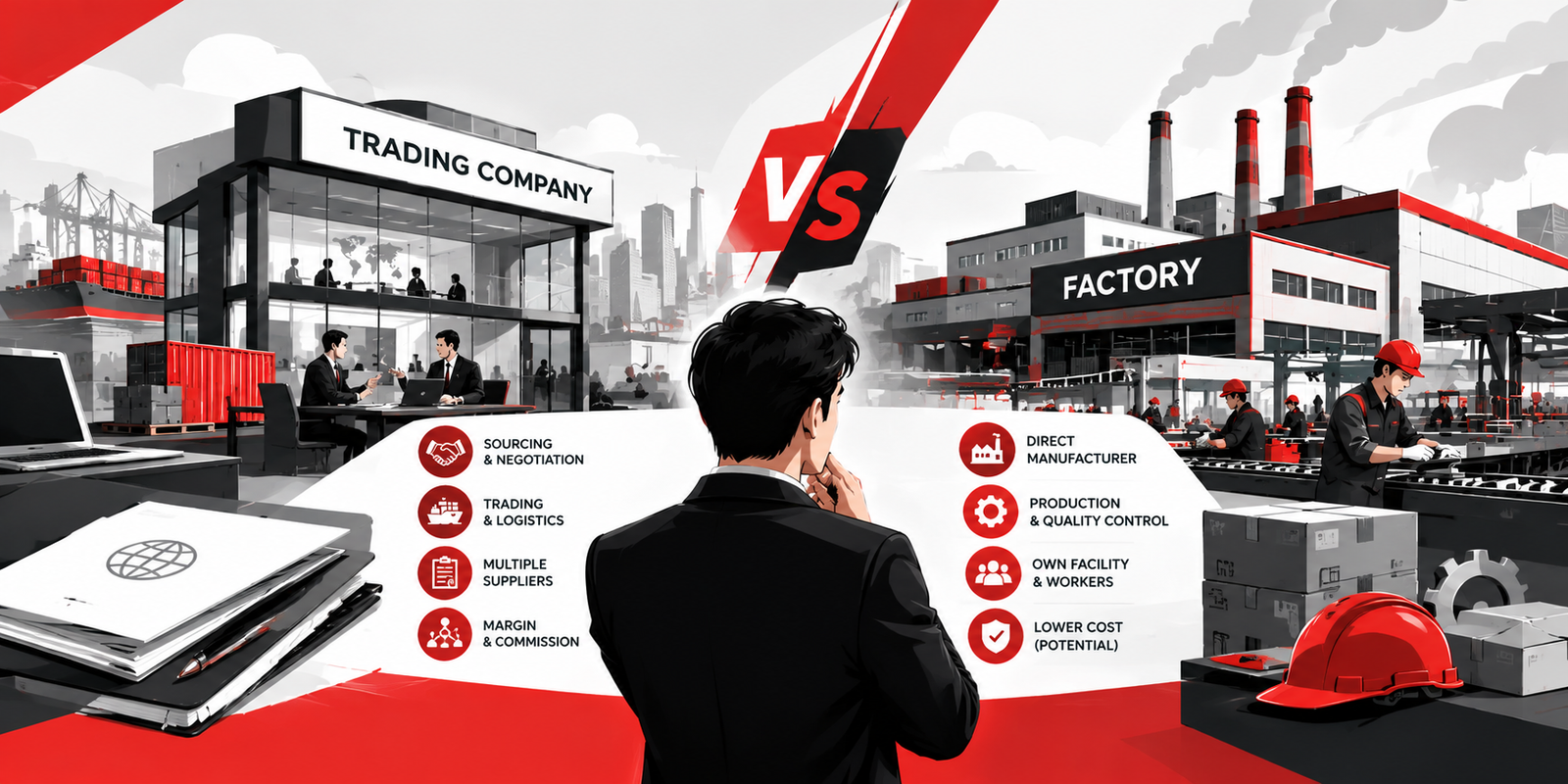
Almost every supplier listing in China says “manufacturer”. Some are; many are trading companies with good relationships at one or more factories; a growing number are hybrids that own a small workshop and outsource the rest. Knowing which one you are dealing with changes how you negotiate, what you inspect and who is responsible when something goes wrong.
Quick answer: A factory (manufacturer) makes the product on its own production lines; a trading company buys from factories and resells, adding services such as consolidation, communication and export handling. Neither is automatically better. You can tell them apart by checking the business scope on the Chinese business licence, matching the registered address to a real production site, and testing the supplier’s technical depth.
Trading company vs manufacturer: the core difference
The difference is control. A manufacturer controls the machines, the materials purchasing, the workforce and the production schedule. A trading company controls the relationship with you and, to a varying degree, the relationship with the factory — but not the production floor itself.
That single difference drives most of the practical consequences:
- Price: a trader’s price includes a margin on top of the factory price. Whether that margin is worth paying depends on what the trader does for it.
- Technical changes: a factory can tell you directly whether a material, dimension or finish can change. A trader has to ask, and the answer can lose detail on the way.
- Accountability: when goods fail, a factory can investigate root cause on its own line. A trader has to push the factory to do it — or quietly switch factories.
- Range: a factory usually makes one family of products well. A trader can supply many unrelated products in one order.
Comparison table: factory, trading company and hybrid
| Factor | Factory (manufacturer) | Trading company | Hybrid (“industry and trade” company) |
|---|---|---|---|
| What it owns | Production lines, equipment, workforce | Supplier relationships, sales and export team | Some production, plus outsourced processes or products |
| Typical product range | Narrow, one process or product family | Broad, often unrelated categories | Core range made in-house, extras bought in |
| Price position | Usually the base price; depends on volume | Factory price plus margin | Mixed; in-house items closer to factory price |
| MOQ flexibility | Often tied to line efficiency and material minimums | Can be lower if the trader pools orders or holds stock | Varies by item |
| Customisation | Direct engineering discussion possible | Relayed to the factory; slower | Possible for in-house items |
| Communication and export handling | Varies widely; some have strong export teams | Usually a core strength | Varies |
| Quality accountability | Direct; root-cause analysis on own line | Indirect; depends on trader’s leverage | Direct for in-house work only |
| Main risk | Weak export documentation, language gaps, capacity overcommitment | Hidden factory, factory switching between orders, unclear responsibility | Undisclosed subcontracting of key processes |
| Best fit | Custom products, tooling, larger repeat volumes | Mixed small-quantity orders, many SKUs, first trial orders | Buyers who need one core product plus accessories |
The word “manufacturer” on a platform profile is not evidence. The checks below are.
7 checks that show whether your supplier is a factory
No single check is conclusive. Use them together and look for consistency.
- Read the business scope on the business licence. Ask for a copy of the licence and look at the business-scope field (经营范围). Manufacturing companies normally list production or processing activities (wording such as 生产 or 制造 — “production”, “manufacturing”). Trading companies typically list sales, wholesale and import-export activities (销售, 批发, 进出口). Then confirm the licence details against the official National Enterprise Credit Information Publicity System (GSXT), so you are not relying on a document that could be edited. The step-by-step lookup is covered in our next guide on checking a Chinese business licence online.
- Match the company names. The name on the licence, the name on the platform storefront, the name on the proforma invoice and the beneficiary name on the bank account should be the same legal entity, or the supplier should be able to explain clearly why not. A mismatch is not proof of fraud, but it often reveals a trader invoicing for a factory, or a factory exporting through a sister trading company.
- Compare the registered address with the production address. A licence registered to an office tower in a city centre, with production supposedly happening elsewhere, needs explaining. Check the address on online maps and ask for the production address in writing.
- Look at the breadth of the product range. A supplier selling phone cases, garden tools and children’s clothing is almost certainly trading. A factory’s range usually follows one material or process — injection-moulded plastics, sewn textiles, sheet-metal parts.
- Ask process-specific technical questions. Ask about cycle time, machine size or tonnage, material grade, the number of production lines and who maintains the moulds. A factory engineer answers quickly and specifically; a trader often needs “a day to check”.
- Check who certifications belong to. An ISO 9001 or product test certificate is issued to a named entity, at a named address, for a defined scope. If the certificate belongs to a different company from the one you are paying, you are probably looking at a trader’s supplier.
- Verify on site or by structured live video. A live, unscheduled walk-through — production lines running, the company name visible at the gate, staff working on your product type — is far stronger than a showroom video. For higher-value or custom orders, an on-site audit by someone independent of the supplier is the most reliable confirmation.
Is a trading company always worse?
No. A trading company is a legitimate business model, and for some orders it is the better choice. The problem is not trading companies — it is suppliers that pretend to be factories, because that hides who is actually responsible for quality.
A trader often makes sense when:
- You need many different products in small quantities. Assembling a mixed order from ten factories, each with its own MOQ, is hard for a small buyer. A trader can combine them.
- You are buying commodity or stock items. For standard goods with little customisation, the trader’s margin may be smaller than the time and risk of managing several factories yourself.
- You need strong export handling. Some small factories have limited experience with export documentation, labelling and communication in English.
- You are testing a market. A first trial order through a capable trader can be sensible before committing to a factory relationship.
A direct factory relationship usually makes more sense when:
- The product is custom, needs tooling, or has tight technical tolerances.
- Volumes are large and repeating, so the trader’s margin becomes significant.
- You need traceability — knowing exactly where and how the product is made.
- Root-cause analysis after defects matters to your business.
If you want a deeper look at how minimum order quantities shape this decision, our guide to how MOQ works and what you can negotiate explains why factories set their minimums and why traders can sometimes go lower.
What about hybrids and “industry and trade” companies?
Many Chinese suppliers register as “industry and trade” (工贸) companies. The name signals that the company both manufactures and trades. In practice the split varies: some make 90% of what they sell, others own a small assembly workshop and buy everything else.
With a hybrid, the useful question is not “factory or trader?” but “which parts of my product are made in-house, and which are outsourced?” Ask for this in writing. If a critical process — injection moulding, plating, PCB assembly, printing — is outsourced, you want to know the subcontractor and whether your quality requirements reach them.
Trading companies in Yiwu and on B2B platforms
In wholesale markets such as Yiwu International Trade City, many booths are run by traders or by factory sales representatives, and it is not always obvious which is which. That is normal for a market built around small, mixed orders; our Yiwu Market buyer’s guide explains how buying there works.
On B2B platforms, the same mix exists. Platform labels such as “manufacturer” or verification badges are useful starting points but are based on the platform’s own criteria, which can change. Read how Alibaba and 1688 differ for buyers for context on each platform, and treat any label as a claim to verify rather than proof.
Does it matter for Bangladesh importers?
Yes, mainly for documentation and payment. If a trading company invoices you while a factory produces the goods, the trader is your contractual seller, so the proforma invoice, commercial invoice, beneficiary on the payment and any letter-of-credit documents need to name the same entity consistently. Mismatches can create problems at the bank or at customs. Before paying, confirm who your legal counterparty is; our step-by-step guide to importing from China to Bangladesh shows where these documents fit in the overall process, and banking or customs requirements should always be checked with your bank and C&F agent for the current rules.
Red flags that suggest a hidden trader
These signs do not prove anything on their own, but together they justify a closer look:
- The supplier refuses or delays a live video of the production floor.
- The licence business scope lists only sales or import-export, yet the profile says “factory”.
- Factory photos look like stock images or show a different company’s signage.
- Prices for unrelated products all come back within a day.
- The bank account is in a different company’s name, or in a personal name.
- Lead times change unexpectedly between orders, suggesting a change of factory.
Payment-related warning signs, especially requests to pay a personal account or a newly “updated” account, are covered in depth in our upcoming article on Chinese supplier red flags before a deposit.
How to decide which supplier type to work with
Use this sequence once you know what you are dealing with:
- Classify the supplier using the seven checks above.
- Classify your order: standard or custom, single or many SKUs, trial or repeat, low or high value.
- Match them: traders suit mixed, standard, trial orders; factories suit custom, tooled and repeat orders; hybrids need clarity on what is outsourced.
- Ask for transparency, not a label. A trader that openly names its factory and lets you inspect there is often a lower risk than a “factory” that will not show you its lines.
- Verify before paying. Our supplier verification guide sets out the full pre-payment process, and the factory audit checklist shows what an on-site check covers.
Supplier type also affects how you read their offer. When comparing a factory quote with a trader quote, make sure both cover the same Incoterm, packaging and payment terms — the method is set out in how to compare quotations from Chinese suppliers.
Where Jingxin Sourcing fits
Jingxin Sourcing was established in 2022, with its head office in Dhaka and an office in Yiwu, and keeps a permanent team in China. Factory versus trading-company status is one of the supplier-verification checks Jingxin carries out, alongside business licence, company registration, factory address, certifications, bank-account verification and production capability. Jingxin staff carry out physical factory audits and inspections in Yiwu, Shenzhen and Guangzhou.
If the supplier’s answers do not add up and the order is large enough to justify a visit, an independent on-site check is the clearest way to settle the question. See how Jingxin’s factory audits confirm who you are really buying from. If you are still building a shortlist, the China product sourcing team works across Alibaba, 1688, Yiwu Market and a direct factory network.
Frequently asked questions
How do I know if my Chinese supplier is a factory?
Check the business scope on the business licence for production or manufacturing wording, confirm it on GSXT, match the registered address to a real production site, and ask for a live video of the production lines. Process-specific technical questions are a useful extra test: real factory staff answer them quickly and precisely.
Is it cheaper to buy directly from a factory?
Usually the unit price is lower because there is no trader margin, but the total cost is not always lower. Factory MOQs can be higher, and you may need to manage several factories, consolidate goods and handle quality yourself. Compare total landed cost and your own time, not just the unit price.
Can a trading company be trusted?
Yes, if it is transparent. A trustworthy trader states that it is a trading company, names or discloses its production sources when asked, accepts inspection at the factory, and invoices consistently in its own legal name. The risk lies in suppliers that misrepresent their status.
What does “industry and trade” mean in a Chinese company name?
It indicates a company registered to both manufacture and trade (工贸). It does not tell you how much is made in-house. Ask which processes and products are produced on its own premises and which are outsourced.
Does the business scope prove a company is a factory?
Not on its own. Production wording in the business scope shows the company is registered to manufacture, but some registered manufacturers outsource most production. Combine the scope check with address, certification and on-site evidence.
Conclusion
“Factory or trading company?” is the right question to ask, but the goal is not to eliminate traders — it is to remove ambiguity. Once you know who controls production, who invoices you and who answers for quality, you can choose the supplier type that suits your order and verify the claims that matter. The quickest objective starting point is the business licence: confirming it against the official registry turns a supplier’s claim into a checkable record; our guide to checking a Chinese business licence online shows how, and Chinese supplier red flags covers the warning signs to watch for. For what a video tour can and cannot prove, see remote supplier verification, and for the on-site option, what a factory audit is.
