Changing sourcing partners mid-project is expensive. Your suppliers, samples, payments and production schedule may all sit with the company you picked, so a weak choice tends to surface only after deposits have been paid. This checklist is designed to be used before that point, with evidence you can actually check.
Short answer: To choose a sourcing company, first define the scope you need. Then assess each candidate on nine criteria: legal identity, presence in China, scope fit, supplier-verification method, quality-control process, fee and payment transparency, communication, import support for your country, and contract terms. Ask for documentary proof of each claim and score the candidates side by side.
Step zero: know what you are hiring for
You cannot judge a provider until you know the job. A buyer who needs one-off help placing a 1688 order needs something very different from a brand developing a moulded product with custom packaging.
Before you contact anyone, write down:
- The product (or product idea), target quantity and target market.
- Which tasks you want covered: supplier search, verification, negotiation, samples, order placement, production follow-up, inspection, shipping coordination, custom development.
- What you will keep in-house, such as final supplier approval, payments or freight booking.
- Your budget for the service and any deadlines that cannot move.
If you are unsure which tasks a provider normally takes on, our explainer on what a China sourcing agent does, and where its responsibilities stop sets out the typical split. If you have not yet tested whether the product is worth importing, do that first with the pre-sourcing feasibility checklist. A separate guide on what to put in a sourcing brief before requesting quotes, and another on deciding whether you need a sourcing agent at all, are planned for this cluster. If you are still mapping the overall process, start with the beginner’s guide to sourcing products from China, which shows where outside help fits.
The 9-point checklist for choosing a sourcing company
Use these criteria in order. The first three are filters: if a provider fails one, stop there. The rest separate good providers from adequate ones.
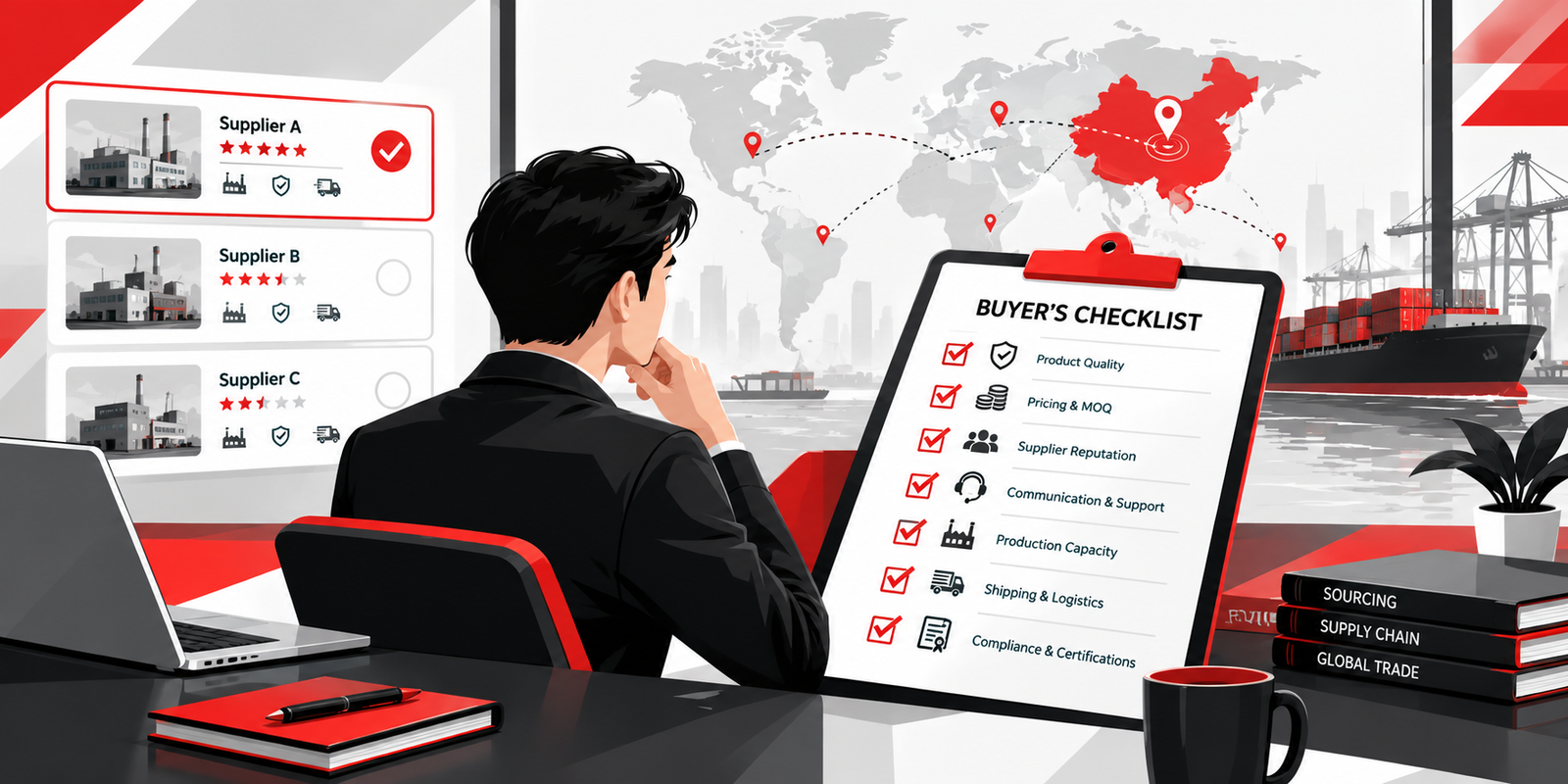
- Verifiable legal identity. The company is registered, has a real address, and the entity you will contract with matches the one you pay.
- Real presence in China. You know where its staff are based, which cities they can physically reach, and whether they are employees or occasional freelancers.
- Scope that fits your project. Its services match the tasks you listed in step zero, in writing.
- A clear supplier-verification method. It can explain which checks it runs on a supplier and show what the output looks like.
- A documented quality-control process. It can describe inspection stages, sampling method, defect classification and report format, and explain how inspection is kept separate from sales pressure.
- Transparent fees and payment flow. You know what you pay, for what, and whether the company earns anything from suppliers. You know whose bank account your money goes into at each step.
- Reliable communication. You have a named contact, an agreed reporting rhythm and a shared language for specifications and approvals.
- Import support for your destination. It understands the documents your country’s customs process and bank require, not just how to get goods out of China.
- Sensible contract terms. Confidentiality, ownership of samples, moulds and supplier information, liability limits and how disputes are handled are written down.
What proof to ask for
Sales pages make every provider sound the same. Proof separates them. The table below lists, for each criterion, what to ask for and how to check it.
| Criterion | Proof to request | How to check it |
|---|---|---|
| Legal identity | Company registration or trade licence; registered address; name of the contracting entity | Check the registration with the issuing authority where possible; confirm the name matches invoices and bank details |
| China presence | Office address in China; names and roles of China-based staff; a live video call from the office | Look up the address; ask for a walk-through on the call rather than a static photo |
| Scope fit | Written service description or draft agreement listing included and excluded tasks | Compare line by line against your step-zero list |
| Supplier verification | A redacted example of a supplier check (licence review, factory vs trader finding, address confirmation) | Look for specific findings, not “supplier verified” with no evidence |
| Quality control | A redacted inspection report with photos, measurements, sampling level and defect counts | Check that the sampling method is named (for example ISO 2859-1 / AQL) and defects are classified |
| Fees and payment | Written fee model; statement on supplier commissions; who pays suppliers and how receipts are shared | Ask whether you will see the supplier’s original proforma invoice |
| Communication | Named account contact; sample progress update; agreed response times | Note how quickly and clearly your pre-sales questions are answered |
| Import support | Example document set (commercial invoice, packing list) prepared for your country, redacted | Ask your customs broker or C&F agent whether the format would work |
| Contract terms | Draft service agreement; confidentiality clause; mould and sample ownership wording | Have a lawyer or experienced colleague review before signing |
On references: a client reference you can speak to is useful, but many sourcing relationships are confidential. Treat a refusal to name clients as normal; treat a refusal to show any redacted work sample as a concern.
Warning signs when choosing a sourcing company
Each of these is common, and each should prompt a harder look:
- No verifiable registration, or the contracting company changes between the quote, the agreement and the invoice.
- “Free” sourcing with no explanation of how the company earns money. The income has to come from somewhere, usually a margin on goods or supplier commissions you cannot see.
- Supplier names withheld permanently. Keeping supplier identities confidential until you commit can be reasonable; never being allowed to know who makes your goods is not.
- Payment requested to a personal account or to an account in a different name from the contracting company.
- Guarantees nobody can give: guaranteed customs clearance, guaranteed lowest price, guaranteed zero defects or guaranteed certification.
- Inspection reports without evidence: pass/fail statements with no photos, measurements or sampling level.
- Vague scope: “we handle everything” without a written list of what is and is not included.
- Pressure to pay before details are agreed, especially deposits for orders that have no confirmed specification.
Many of the same signals apply to suppliers. A dedicated guide to supplier red flags before a deposit is planned, and our pillar on verifying a Chinese supplier before you pay covers document checks you can reuse when assessing a sourcing company.
Questions to ask a sourcing company on the first call
These questions are designed to produce answers you can verify later.
Company and team
- Which legal entity will I contract with, and where is it registered?
- Where are your staff in China based, and which cities can they visit in person?
- Who will be my day-to-day contact, and who covers when they are away?
Method
- What checks do you run on a supplier before recommending it? Can I see a redacted example?
- How do you decide which inspection stage a project needs? What sampling standard do you use?
- What happens when an inspection finds defects? Who decides whether goods ship?
Money
- How are your fees calculated, and what exactly do they cover?
- Do you receive any commission, rebate or margin from suppliers?
- Will I pay suppliers directly, or through you? Will I see the supplier’s own invoice?
Ownership and confidentiality
- Who owns samples, moulds and artwork paid for during the project?
- Will you sign a confidentiality agreement covering my designs and supplier list?
Destination
- Have you prepared shipping documents for my country before? What do you need from my customs broker?
For a deeper list of questions aimed at the factory rather than the sourcing company, see our planned guide to questions to ask a Chinese supplier before paying a deposit.
A scoring matrix for comparing sourcing companies
Once you have answers and proof, score each provider. Weights reflect what matters most for a typical first or second China order; adjust them to your project. A custom-moulded product might weight quality control and contract terms higher, while a mixed-SKU wholesale order might weight China presence and communication higher.
Score each criterion from 1 (weak or unproven) to 5 (strong and evidenced). Weighted score = weight × score ÷ 5.
| Criterion | Suggested weight | What a 5 looks like |
|---|---|---|
| Legal identity | 10 | Registration checked; contracting entity matches bank and invoices |
| China presence | 15 | Named staff in an office you have seen; able to visit your supplier’s city |
| Scope fit | 10 | Written scope covers every task you need; exclusions are clear |
| Supplier verification | 15 | Redacted check shows specific findings on licence, status, address and capability |
| Quality control | 15 | Redacted report with named sampling standard, photos, measurements, defect classification |
| Fee and payment transparency | 15 | Written fee model; supplier commissions disclosed or excluded; supplier invoices visible |
| Communication | 10 | Named contact; clear, prompt answers during evaluation; agreed reporting rhythm |
| Import support for destination | 5 | Example documents suit your customs process |
| Contract terms | 5 | Confidentiality, ownership and dispute terms in a written agreement |
| Total | 100 |
Hypothetical example: A buyer compares two providers. Provider A scores 4, 5, 4, 4, 3, 5, 4, 3, 4 across the nine criteria, giving a weighted total of 82. Provider B scores 5, 2, 5, 3, 4, 2, 5, 4, 3, giving 70. B communicates well and has a polished agreement, but cannot show where its China staff are and will not disclose whether it takes supplier commissions. On this matrix A is the stronger choice, and B’s low scores point to exactly what to press it on before ruling it out.
The matrix does not replace judgement. A provider that fails a filter criterion (identity, presence or scope) should not be rescued by high scores elsewhere.
Sourcing agent or sourcing company?
The checklist works for both. In practice, an individual agent may score well on communication and cost but lower on continuity and capacity, while a company may offer broader coverage at a different price point. Our planned comparison of sourcing agents and sourcing companies covers accountability and continuity in detail, and the planned guide to sourcing agent fees explains commission, fixed-fee and retainer models so you can read the fee answers you collect above.
If you import into Bangladesh
Bangladesh importers should add one more layer to criterion 8. A sourcing company that only manages the China side can leave gaps at home: invoice and packing-list details that do not match an LC, missing HS-code information for your C&F agent, or documents in a format your bank questions. Ask candidates how they coordinate with your bank and C&F agent, and whether they have handled the document set for Bangladesh before. The full home-side sequence is set out in our guide to importing from China to Bangladesh, with planned guides on HS codes, letters of credit and the IRC to follow. Rules change, so confirm current requirements with the National Board of Revenue (NBR), Bangladesh Bank guidance via your bank, and your C&F agent.
Applying the checklist to Jingxin Sourcing
It is fair to ask us the same questions. Here are the facts we can state.
- Identity and location: Jingxin Sourcing was established in 2022. Its head office is in Dhaka, Bangladesh, and it has an office in Yiwu, China, with a permanent team in China. Company background is on the About Jingxin Sourcing page.
- China presence: Jingxin staff carry out inspection and audit activity in Yiwu, Shenzhen and Guangzhou.
- Channels and scope: sourcing through Alibaba, 1688, Yiwu market and a direct factory network; product research; negotiation of price, MOQ, lead time and payment terms; placing Alibaba and 1688 orders for customers; custom product development, packaging, tooling and mould sourcing.
- Supplier verification: checks of business licence, company registration, factory vs trading-company status, factory address, certifications, bank-account verification and production capability, plus physical factory audits.
- Quality control: product inspections and packaging inspections.
- Import support: help coordinating Bangladesh import documentation, including commercial invoice, packing list, HS-code and C&F-agent related paperwork where applicable.
Like any sourcing company, Jingxin does not guarantee customs clearance, supplier performance or product compliance. Put the checklist questions to us directly and judge the answers the same way you would for any other provider.
To see what the sourcing service covers in practice, read the Jingxin product sourcing service overview. If you would like to put these checklist questions to the team directly, send your questions through the contact page.
Frequently asked questions
What should I look for in a sourcing company?
Look for a verifiable legal identity, real staff presence in China, a written scope that fits your project, a clear supplier-verification method, evidence-based quality control, transparent fees and payment flow, dependable communication, import support for your country and fair contract terms.
What proof should I ask a sourcing company for?
Ask for registration documents, the address of its China office, a written scope, redacted examples of a supplier check and an inspection report, a written fee model with a statement on supplier commissions, and a draft agreement covering confidentiality and ownership.
What are the warning signs of a bad sourcing company?
Unverifiable registration, payments to personal or mismatched accounts, unexplained “free” service, permanently hidden supplier identities, guaranteed clearance or zero defects, and inspection reports without photos or measurements.
How many sourcing companies should I compare?
Two or three is usually enough for a first project. More than that tends to produce long calls with similar sales answers. Shortlist on the three filter criteria, then score the remaining providers in detail.
Should I choose the cheapest sourcing company?
Not on fee alone. A lower fee can be offset by hidden supplier margins, weaker inspection or poor document support. Compare total cost and the evidence behind each criterion, not only the headline fee.
Can I test a sourcing company with a small project first?
Yes. Many buyers start with a limited task, such as verifying a shortlist or placing a small order, before handing over a full project. It lets you check reporting quality and responsiveness with less money at risk.
Final word
Choosing a sourcing company is less about finding the most impressive pitch and more about finding the provider whose claims survive checking. Filter on identity, presence and scope; collect proof for the rest; score candidates on the same matrix; and start with a project small enough that a wrong choice is recoverable.
To test any provider’s claims yourself, check the registration of Chinese entities online and put the pre-deposit questions to them in writing.