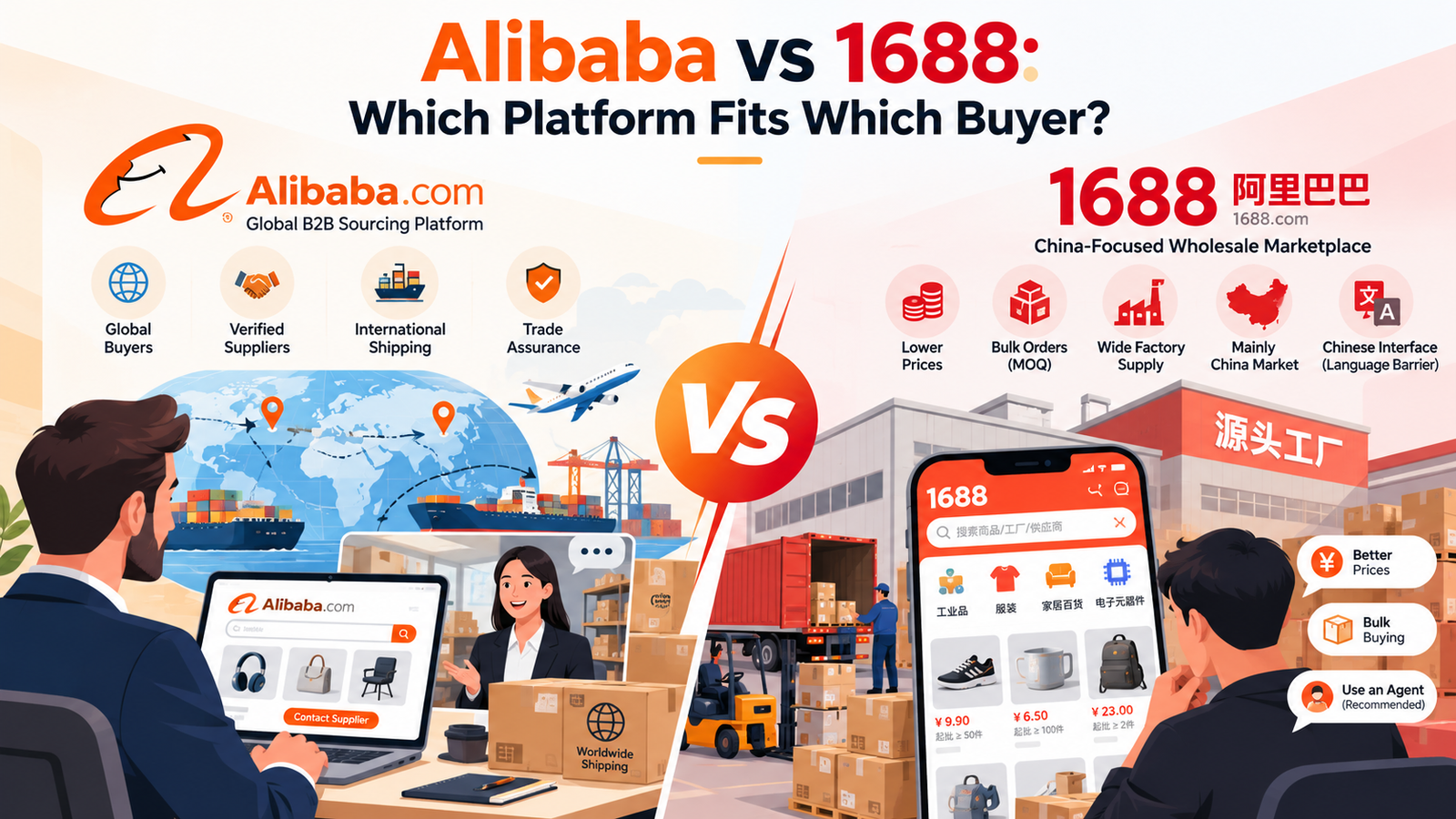
Alibaba.com and 1688.com are both owned by Alibaba Group, and both connect buyers with Chinese factories and wholesalers. They are built for different buyers, though. Comparing prices on the two sites without understanding that difference is how importers end up surprised by extra costs, missing paperwork or goods that cannot leave China easily.
This comparison of Alibaba vs 1688 covers language, payment, pricing, minimum order quantities, buyer protection and export support, so you can decide which platform fits your business. If you are new to buying from China, start with our guide on how to source products from China.
Alibaba vs 1688: the short answer
Alibaba.com is Alibaba Group’s English-language marketplace for international trade, with prices in US dollars, overseas payment and Trade Assurance order protection. 1688.com is its Chinese-language domestic wholesale site, with prices in yuan, payment built around Alipay and delivery within mainland China. 1688 is often cheaper per unit, but overseas buyers usually need an agent or forwarder to order, pay and export.
What are Alibaba.com and 1688.com?
Alibaba.com is Alibaba Group’s cross-border B2B marketplace. Chinese manufacturers and trading companies list products for overseas buyers, communicate in English and quote in US dollars. Orders can be placed and paid on the platform.
1688.com, founded in 1999, is described by Alibaba Group as China’s leading integrated domestic wholesale marketplace and the product source for Chinese ecommerce. Many sellers on Taobao, Douyin and other Chinese retail platforms buy their stock there. The site is designed for buyers inside mainland China.
The two sites ran independently for over 20 years. In September 2026, Alibaba began bringing 1688 and Alibaba.com under unified management, with the stated aim of connecting Chinese suppliers with overseas buyers. No change to how overseas buyers access 1688 had been announced as of October 2026, so the differences below still apply.
Alibaba vs 1688 comparison table
| Criteria | Alibaba.com | 1688.com |
|---|---|---|
| Target market | Overseas businesses buying from China | Businesses and resellers inside mainland China |
| Language and currency | English and other languages; prices mostly in USD | Chinese; prices in CNY (yuan) |
| Payment | Cards, bank transfer (T/T), digital wallets and other overseas methods through the platform | Alipay, WeChat Pay and Chinese bank transfer; some cross-border options, but coverage is inconsistent |
| Pricing | Export prices, often quoted FOB or EXW, with room to negotiate | Domestic wholesale prices, often lower per unit, excluding export costs |
| MOQ | Set by each supplier; often higher for custom or private-label orders | Often low, sometimes one or a few pieces for stock items |
| Buyer protection | Trade Assurance on orders paid through Alibaba.com | Domestic buyer protection services for deliveries within China |
| Export capability | Suppliers expect to export and can usually ship internationally or work with your forwarder | Sellers usually deliver only to addresses in China; export is arranged separately |
Can foreigners buy on 1688?
Yes, but it takes more work than Alibaba.com, and three practical barriers remain.
- Language. Listings, seller chat and order terms are in Chinese. Browser translation and image search help with finding products, but they are not reliable for negotiating specifications or resolving a problem.
- Payment. 1688 is built around Alipay, WeChat Pay and Chinese bank accounts. WorldFirst describes its World Pay service as 1688’s official cross-border payment provider, and some listings accept international cards, but availability varies by country, seller and listing.
- Delivery. Most sellers only ship to addresses in mainland China. You need a forwarder, agent or warehouse in China to receive the goods, check them and arrange export.
Alibaba has also been testing a cross-border version of 1688 in a small number of countries, starting with Vietnam and Kazakhstan in 2025. Check whether it covers your country before relying on it.
In practice, most overseas businesses that buy from 1688 work through a buying agent or sourcing partner in China who places orders, pays sellers in yuan, collects goods from several sellers and ships them as one consignment. That adds a service fee, but it also adds someone who can read the listing and speak to the seller. See what a China sourcing agent does and how to choose a sourcing company before you hire one.
Is 1688 cheaper than Alibaba?
The listed unit price on 1688 is often lower, because it is a domestic wholesale price for Chinese buyers. It usually excludes the costs of getting goods out of China, which Alibaba.com suppliers tend to build into an export quote. The fair comparison is the landed cost, not the listing price.
| Cost element | Buying on Alibaba.com | Buying on 1688 (through an agent) |
|---|---|---|
| Unit price | Export price in USD | Domestic price in CNY, often lower |
| Domestic delivery in China | Usually included in an FOB quote | Paid separately, from each seller to the agent or warehouse |
| Agent or service fee | Not needed if you order directly | Usually charged as a percentage or per order |
| Consolidation, checking and repacking | Done by the supplier for a single-supplier order | Often needed when goods come from several sellers |
| Export documents and customs declaration | Normally handled by the supplier | Arranged by the agent or forwarder |
| Payment and currency conversion | Bank or card charges on USD payment | Bank charges plus conversion into CNY |
| Freight, duties and taxes at destination | Same principles for both | Same principles for both |
For small mixed orders of stock items, 1688 often still comes out cheaper after these costs. For a single product in larger volume, or anything custom, the gap usually narrows, and an Alibaba.com supplier that handles export may be simpler and comparable in total cost. Work out both before deciding.
Price is not the only difference. Goods listed on 1688 are made for the Chinese market. Labels and manuals may be in Chinese only, plugs and voltages follow Chinese norms, and products may not have the test reports your market requires. Confirm compliance before you treat a low 1688 price as a bargain.
Which platform has buyer protection?
Both platforms offer buyer protection, but they are designed for different transactions.
Alibaba.com Trade Assurance
Trade Assurance covers orders placed and paid through Alibaba.com. Under Alibaba.com’s current policy, buyers can claim a refund if an order is not shipped as agreed, goes missing, or arrives defective, incorrect or damaged. The refund window after delivery is 30 or 60 days, depending on account type. Payments made outside the platform, such as a direct transfer to the supplier’s own bank account, are not protected.
1688 buyer protection
1688 offers domestic protections such as exchange guarantees on labelled products, compensation for late dispatch, free reshipment of damaged goods and an authenticity guarantee. These depend on the seller’s service labels and apply to online orders delivered within China. Once goods reach your agent’s warehouse, the protection ends there. Damage in export transit or problems found after arrival in your country are outside its scope.
Neither scheme replaces checking the goods yourself. Platform protection is a dispute route after something goes wrong. A specification agreed in writing and an inspection before shipment are what prevent the problem. Our quality control page explains how inspections fit into an order.
Supplier quality on both platforms
Neither platform only lists factories. Both host manufacturers, trading companies and wholesalers, and a polished listing does not tell you which one you are dealing with. On Alibaba.com, Verified Supplier badges mean a third-party firm has assessed the company, which is a useful filter but not a guarantee. On 1688, many sellers are resellers buying from the same factories, which is why identical photos appear at different prices. If you are still building your shortlist, use our guide on how to find reliable suppliers in China.
Before placing a significant order on either site, check the business licence, confirm the company actually makes the product, and work through a supplier verification checklist before payment. For larger or ongoing orders, consider an on-site factory audit.
Alibaba vs 1688 for Bangladesh importers
For Bangladeshi businesses, payment rules matter as much as price. Commercial imports must be paid through an authorised dealer bank, and the importer needs a valid Import Registration Certificate (IRC). A personal card payment on either site is not a substitute for a bank-documented import payment, and customs will expect an invoice that matches what you paid. The wider registration, bank-payment and customs workflow is covered in our China-to-Bangladesh import guide.
- On Alibaba.com, a business order can usually be paid by bank transfer (T/T) to the account the platform designates, using the supplier’s proforma invoice. Confirm with your bank before paying.
- On 1688, you will normally pay a China-based agent or sourcing company, which then pays the individual sellers. The agent’s invoice becomes your import document, so its descriptions, quantities and values must match the goods shipped.
Either way, the goods then travel by sea to Chattogram or by air to Dhaka, and a C&F agent clears them through customs. For help with that leg, see our shipping and logistics page.
Which platform should you choose?
Choose Alibaba.com if:
- You want to deal with suppliers directly in English, without a middleman
- You need custom products, private label, your own packaging or specific certifications
- You want platform order protection on payments
- You are ordering a single product in volume and want the supplier to handle export
- You need export documents issued by the seller for customs in your country
Choose 1688 if:
- You buy many different stock items in small quantities, for example for retail or ecommerce
- You have a reliable agent or partner in China to order, receive, check and consolidate goods
- Unit price is your main concern and the products are standard, not customised
- You want to research Chinese domestic price levels before negotiating elsewhere
- The products suit your market as sold in China, or compliance can be confirmed before shipping
Many buyers use both. They research prices and find manufacturers on 1688, then place custom or volume orders with an export-ready supplier, either on Alibaba.com or directly once the supplier has been verified. If you would rather have suppliers shortlisted and checked for you, see our product sourcing page.
Frequently asked questions
Is 1688 owned by Alibaba?
Yes. 1688.com and Alibaba.com both belong to Alibaba Group. 1688 serves China’s domestic wholesale market and Alibaba.com serves international trade. Since September 2026, both have been under unified management within the group.
Are the suppliers on 1688 and Alibaba the same?
Some are. Certain factories list on both, with domestic prices on 1688 and export prices on Alibaba.com. Many 1688 sellers are domestic wholesalers or resellers who do not export, and many Alibaba.com sellers are trading companies. Check each company individually.
Does 1688 ship internationally?
Generally not. Most 1688 sellers deliver only within mainland China. Overseas buyers have goods sent to an agent, forwarder or warehouse in China, which then exports them. A trial cross-border version of 1688 exists in a few countries, but it is not yet a general option.
Is Trade Assurance enough to protect my order?
It helps, but it is a dispute process, not quality control. It only covers orders paid through Alibaba.com, and a claim depends on evidence that the goods differ from what was agreed. A clear written specification and a pre-shipment inspection give you that evidence and often prevent the dispute altogether.
Can I buy samples on 1688?
Yes, because low order quantities are common on 1688, it is a practical place to buy a few units for evaluation. The samples still need to be delivered to an address in China and then sent on to you, usually by express courier.
Conclusion
The Alibaba vs 1688 choice comes down to how you buy. Alibaba.com suits buyers who want to work with suppliers directly, order custom or volume products and pay with platform protection. 1688 suits buyers of standard stock items in small quantities who have someone in China to handle ordering, checking and export. Compare landed costs rather than listing prices, and verify the supplier on either platform before you pay.
Jingxin Sourcing has its head office in Dhaka, Bangladesh, and an office in Yiwu, China. On either platform, confirm the supplier is registered with a business-licence lookup and watch for the common supplier red flags. Need help finding and checking suppliers in China? Learn more about Jingxin Sourcing’s Product Sourcing service.