The cheapest time to drop a product idea is before the first supplier message. After that, money starts moving: samples, sample freight, perhaps a mould deposit, then a production deposit. Product research before sourcing exists to find the reasons a product will not work while those reasons are still free to discover.
What is sourcing feasibility? Sourcing feasibility is an assessment of whether a product can be made to the required standard, legally imported, delivered and sold at a profit, before you commit to suppliers or orders. It combines demand, cost, compliance, manufacturing and logistics checks into a go, redesign or no-go decision.
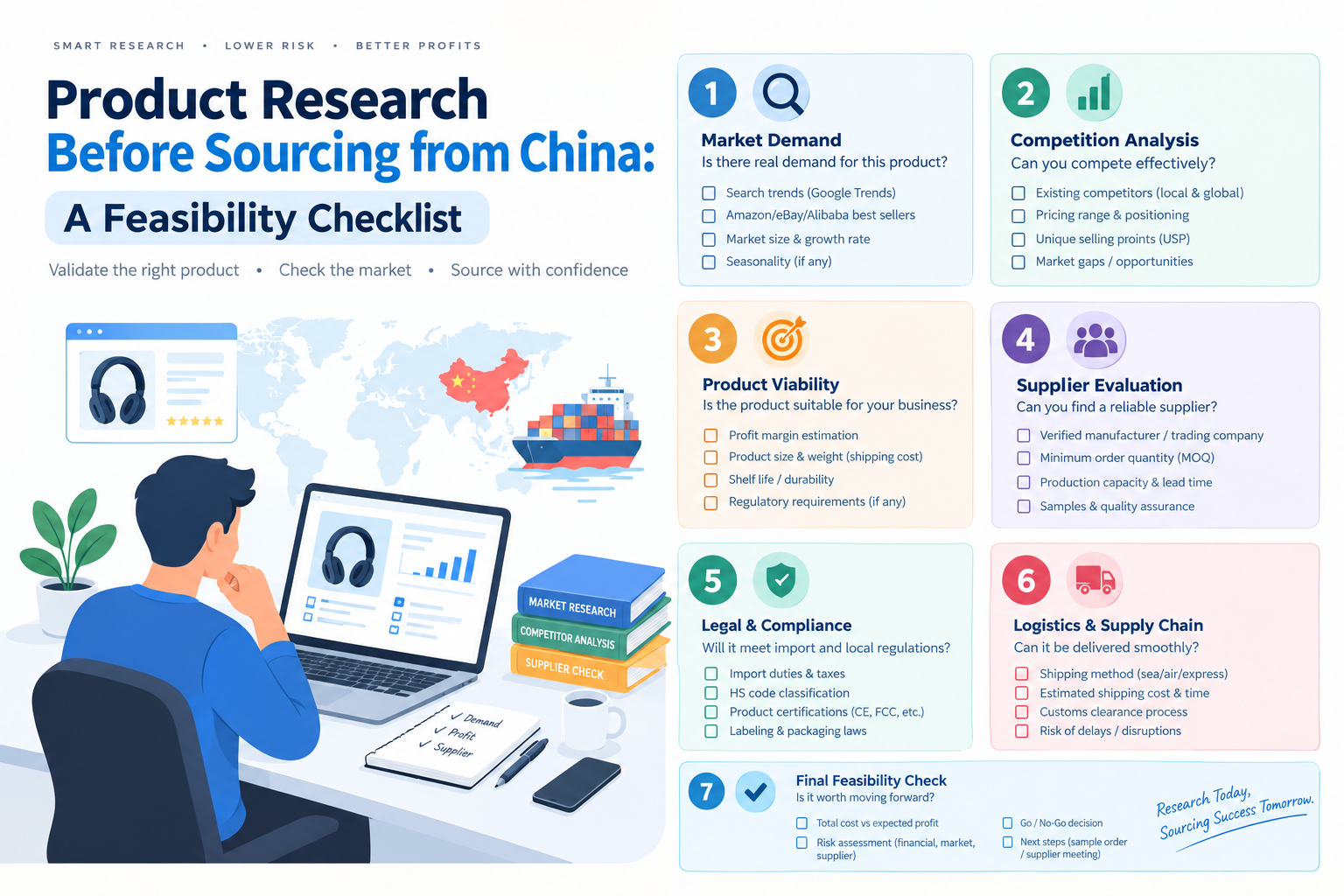
Short answer: Before sourcing a product from China, research five areas: (1) demand and market fit, (2) cost and margin, (3) compliance and import rules, (4) manufacturability and supplier landscape, and (5) logistics and operations. A product should pass all five, or have a clear fix, before you request samples or pay deposits.
This checklist sits at the very start of the journey described in our beginner’s guide to sourcing products from China. It is written for importers buying finished or customised products, not for dropshippers hunting trending items.
What product research before sourcing covers, and what it does not
Product research before sourcing answers a narrow question: if we source this product, can the whole chain work? It is different from:
- Choosing which product to import in the first place. A planned product-selection framework for Bangladesh importers covers how to compare candidate products against each other.
- Mapping suppliers in depth. Supplier landscape research is one input here, but the detailed method of mapping who makes a product, and where, is a separate planned guide.
- Commissioning a formal report. What a professional sourcing feasibility report should contain is covered in a planned guide aimed at buyers deciding whether to pay for one.
This article gives you the checklist that ties those pieces together.
The 5-group feasibility checklist
- Demand and market fit: Is there proven demand at a price you can reach, and can you differentiate?
- Cost and margin: Does the landed cost leave a margin after every selling cost?
- Compliance and import rules: Can the product be legally imported and sold in your market, and what certification or labelling does it need?
- Manufacturability and supplier landscape: Can Chinese suppliers make it to your standard, at your volume, without unplanned tooling or engineering?
- Logistics and operations: Can it be packed, shipped, stored and delivered without the freight or damage eating the margin?
Each group is broken down below into specific checks and the warning signs that should make you stop or rethink.
Group 1: Demand and market fit
| Check | How to research it | Warning sign |
|---|---|---|
| Is there existing demand? | Marketplace listings and sales indicators, search-trend tools, wholesale buyer conversations, retailer shelves | Very few sellers and no sales evidence, or demand driven by a short-lived trend |
| What do buyers pay today? | Price range of comparable products in your channel | Your target price only works at the bottom of the market |
| Who are you competing with? | Number and type of sellers; brand strength; price leaders | Market dominated by a few brands or by very low-price imports |
| Can you differentiate? | Customer reviews of competing products, complaints, missing features | No credible way to be better, only cheaper |
| Is demand seasonal? | Trend history; sales channel data | Sourcing lead time means stock arrives after the season |
Reviews of competing products are especially useful: repeated complaints about breakage, sizing or missing accessories become specification improvements. A planned guide to competitor product research will show how to turn listings and reviews into a better spec.
Group 2: Cost and margin
What margin is realistic? There is no universal figure. Margin depends on your channel, category, order volume and how much of the selling cost you carry. What you can do is calculate it honestly, with every cost included, before you commit:
| Line | What to include |
|---|---|
| Target selling price | The price your channel will realistically bear, net of any VAT or sales tax you must collect |
| − Product cost | Unit price from supplier quotes (or a should-cost estimate if you have no quotes yet) |
| − One-off costs spread per unit | Samples, tooling, custom packaging setup, inspection, divided over the expected units sold |
| − Freight and insurance | International freight, consolidation, insurance |
| − Duties, taxes and clearance | Import duty and taxes for your HS code, port and agent charges |
| − Inland delivery and storage | Port to warehouse, warehousing, handling |
| − Channel costs | Marketplace or retailer fees, payment fees, fulfilment, returns |
| − Marketing and customer acquisition | Advertising, promotions, launch costs |
| = Contribution per unit | What is left to cover overheads and profit |
Then stress-test it. Ask what happens if freight rises, the exchange rate moves against you, or you need to discount to clear stock. If a modest change pushes contribution close to zero, the product is fragile, even if the headline margin looks attractive.
Two planned guides go deeper on the cost side: should-cost estimating, for judging whether a supplier’s price is fair before you request quotes, and landed cost calculation, for building up the full cost of a product imported into Bangladesh. Live price indicators can also come from platform listings; our comparison of Alibaba and 1688 explains why prices on the two platforms differ and what each figure represents.
Remember that minimum order quantities shape cost too. A low unit price at a quantity you cannot sell is not a real price. See our guide to minimum order quantities for how MOQs interact with unit cost.
Group 3: Compliance and import rules
This is the group most often skipped and the one that most often ends a product outright. Check:
- Is the product allowed into your market at all? Some goods are prohibited or restricted, or need permits.
- Does it need certification or testing? Many electrical goods, children’s products, cosmetics, food-contact items and products with batteries or radio functions carry mandatory requirements in many markets.
- What labelling is required? Language, origin marking, warnings, importer details, quantity declarations.
- Is there a recall or safety history? Products similar to yours may have been recalled for hazards you need to design out.
- Does it raise intellectual-property issues? Designs, brands or characters you do not have rights to.
The section below explains where to check each of these.
Group 4: Manufacturability and supplier landscape
| Check | How to research it | Warning sign |
|---|---|---|
| Is it a catalogue product or a custom one? | Search Alibaba, 1688 and Yiwu Market for close matches | Nothing similar exists, meaning custom development is needed |
| Does it need tooling? | Identify parts that would need new moulds or dies | Unplanned tooling cost and lead time |
| How many capable suppliers exist? | Count credible manufacturers, not listings (one factory may appear many times) | Only one or two suppliers, or only trading companies |
| Where are the suppliers concentrated? | Note the regions and industrial clusters suppliers come from | Supply far from any established cluster for the product |
| Can quality be specified and checked? | Identify critical dimensions, materials and functions | Quality depends on subjective judgement with no measurable criteria |
| What MOQ and lead time do suppliers indicate? | Early supplier conversations | MOQ far above your realistic first order |
If the answer to “does it need tooling?” is yes, read our guide to the custom tooling process before going further: tooling adds a design-approval and trial phase that changes both budget and timeline. If your plan is to brand an existing product rather than build a new one, our guide to private label and custom products from China explains how far you can customise without new tooling.
Early supplier scanning uses the same channels as real sourcing. Our guides on how to find reliable suppliers in China and the Yiwu Market explain where to look. At the research stage you are not choosing a supplier yet; you are confirming that enough capable ones exist. Planned guides on supplier landscape research and China’s manufacturing clusters will expand this step.
Group 5: Logistics and operations
| Check | Why it matters | Warning sign |
|---|---|---|
| Weight and volume per unit | Freight is charged on weight or volume | Bulky, light products where freight cost rivals product cost |
| Fragility | Damage rates and packaging cost | Breakable items that need heavy protective packaging |
| Dangerous-goods status | Batteries, aerosols, flammables and some chemicals have shipping restrictions | Product cannot travel by your preferred mode, or only at a premium |
| Packaging needs | Retail-ready packaging, barcodes and cartons add cost and lead time | Custom packaging MOQ larger than your product order |
| Shelf life and storage | Perishable or humidity-sensitive goods | Long transit or storage risks degradation |
| Total lead time | Production, inspection, freight and clearance add up | Stock would arrive after the sales window |
Packaging is often an afterthought at research stage, but it changes cost, freight volume and damage risk. Our packaging specification checklist shows what has to be decided. For buyers shipping to Bangladesh, our overview of shipping from China to Bangladesh explains the routes and modes you will be choosing between.
How to check regulations before importing
You do not need to become a compliance specialist, but you do need to know which authority sets the rules for your product and market, and to check the current version of those rules yourself or through a qualified agent.
Importing into Bangladesh
- BSTI (Bangladesh Standards and Testing Institution) publishes the list of products that fall under its mandatory certification scheme. If your product is on that list, certification requirements apply before it can be sold. The list is updated from time to time, so check the current version on BSTI’s official site.
- Import Policy Order. Bangladesh’s Ministry of Commerce issues an Import Policy Order that sets out banned and restricted items and conditions for certain imports. Confirm your product’s status against the current order.
- HS code and duty. The National Board of Revenue (NBR) administers customs tariffs. Your product’s HS code determines the duty and tax treatment, so identify a likely HS code early and confirm it with a customs/C&F agent. A planned guide to HS codes and import duty in Bangladesh will explain how to find yours.
- Other agencies. Some categories, such as food, medicines, cosmetics or telecom and radio equipment, may involve additional regulators or permits. Ask your C&F agent which apply to your category.
Our step-by-step guide to importing from China to Bangladesh puts these checks in the context of the whole import process. A planned guide on BSTI certification and restricted items will go deeper. None of these checks guarantees clearance; they reduce the risk of discovering a problem after the goods have shipped.
Selling into export markets
If you sell into other markets, the equivalent checks differ by destination. Two public sources are useful as a first screen for safety risk:
- United States: the Consumer Product Safety Commission (CPSC) publishes product recalls and sets safety rules for many consumer products, including children’s products.
- European Union: Safety Gate (the EU rapid alert system for dangerous non-food products) publishes alerts on products found to be unsafe.
Searching those databases for products similar to yours shows which hazards regulators look for. Actual requirements, such as CE marking in the EU or specific testing standards, must be confirmed for your product and market with a qualified compliance professional or testing laboratory.
Turning research into a decision
Score each of the five groups as pass, fixable or fail:
| Result | Meaning | Action |
|---|---|---|
| All five pass | The chain works on paper | Move to supplier search, RFQs and samples |
| One or more “fixable” | A known change would make it work: a spec change, a different pack format, a different price point | Make the change and re-check that group before proceeding |
| Any “fail” on compliance | Product cannot be legally imported or sold as planned | Stop, or redesign so that the requirement can be met |
| “Fail” on margin after stress test | Product loses money under realistic conditions | Stop, or change channel, volume or specification and recalculate |
| “Fail” on manufacturability | No capable suppliers, or tooling cost unjustifiable at your volume | Stop, or simplify the design |
Write the result down, with the evidence behind each score. It makes the decision repeatable for the next product and gives you a brief to hand to suppliers or a sourcing partner if you go ahead.
Hypothetical example: A buyer researching an insulated food container finds strong demand and several capable suppliers (groups 1 and 4 pass). The margin check shows freight on the bulky packaging is a large share of cost (group 2: fixable, by nesting lids and reducing carton size). The compliance check shows food-contact material requirements in the target market (group 3: fixable, by requiring suitable material documentation from suppliers). Logistics pass once the carton is redesigned. Result: proceed, with two specification changes written into the RFQ.
When to order samples
Samples belong after research, not instead of it. A sample tells you whether one supplier can make one good unit; it does not tell you whether the product is legal to import, profitable after freight or wanted by customers. Once the checklist passes, our guide to ordering samples from China covers how to request and evaluate them.
Doing the research yourself or getting help
Much of this checklist can be done by the buyer: demand and margin research are best done by someone who knows the sales channel. The China-side checks, such as how many real manufacturers exist, what they quote at what MOQ, and whether a product needs custom tooling, are easier with people who search Chinese platforms and markets every day.
Jingxin Sourcing conducts product research for clients, working across Alibaba, 1688, Yiwu Market and its direct factory network, with a head office in Dhaka and an office in Yiwu.
If you want the China-side feasibility checks done before you commit budget, the sourcing research service for importers explains the scope. When the research says “go”, the China product sourcing service takes over supplier selection and ordering. The natural next read in this cluster is the planned landed-cost guide, which turns Group 2 of this checklist into a full worked calculation for Bangladesh imports.
FAQ
What should I research before importing a product?
Research five areas: demand and market fit, cost and margin (including landed cost), compliance and import rules, manufacturability and the supplier landscape, and logistics. Each should pass, or have a clear fix, before you pay for samples or deposits.
How do I check whether my product is regulated?
Identify the authority for your destination market and check its current rules: for Bangladesh, the BSTI mandatory certification list, the Ministry of Commerce Import Policy Order and NBR tariff information via your HS code; for the US and EU, CPSC and Safety Gate are useful first screens. Confirm the final position with a C&F agent or compliance professional.
What profit margin is realistic for imported products?
There is no single realistic margin; it depends on channel, category, volume and who carries selling costs. Calculate contribution per unit after every cost, from freight and duty to channel fees and marketing, then test it against higher freight, a weaker exchange rate and discounting.
How long does product research before sourcing take?
It depends on product complexity and how much information already exists. A simple catalogue product can be screened quickly, while custom products needing compliance checks and tooling estimates take longer. Allow enough time to get real supplier indications rather than relying on listing prices alone.
Is product research the same as a feasibility study?
They overlap. Product research gathers the evidence; a feasibility study or report organises that evidence into a decision. This checklist is a lightweight feasibility study an importer can run alone; a formal sourcing feasibility report adds supplier shortlists, cost estimates and documented findings.
The point of the checklist
The checklist is not meant to make every product look risky. It is meant to make the risks visible while they are still cheap to deal with, so that the products you do source go into sampling and production with known costs, known rules and a known market. Keep your completed checklists: by the third or fourth product, they become your own reference for which ideas are worth chasing.