
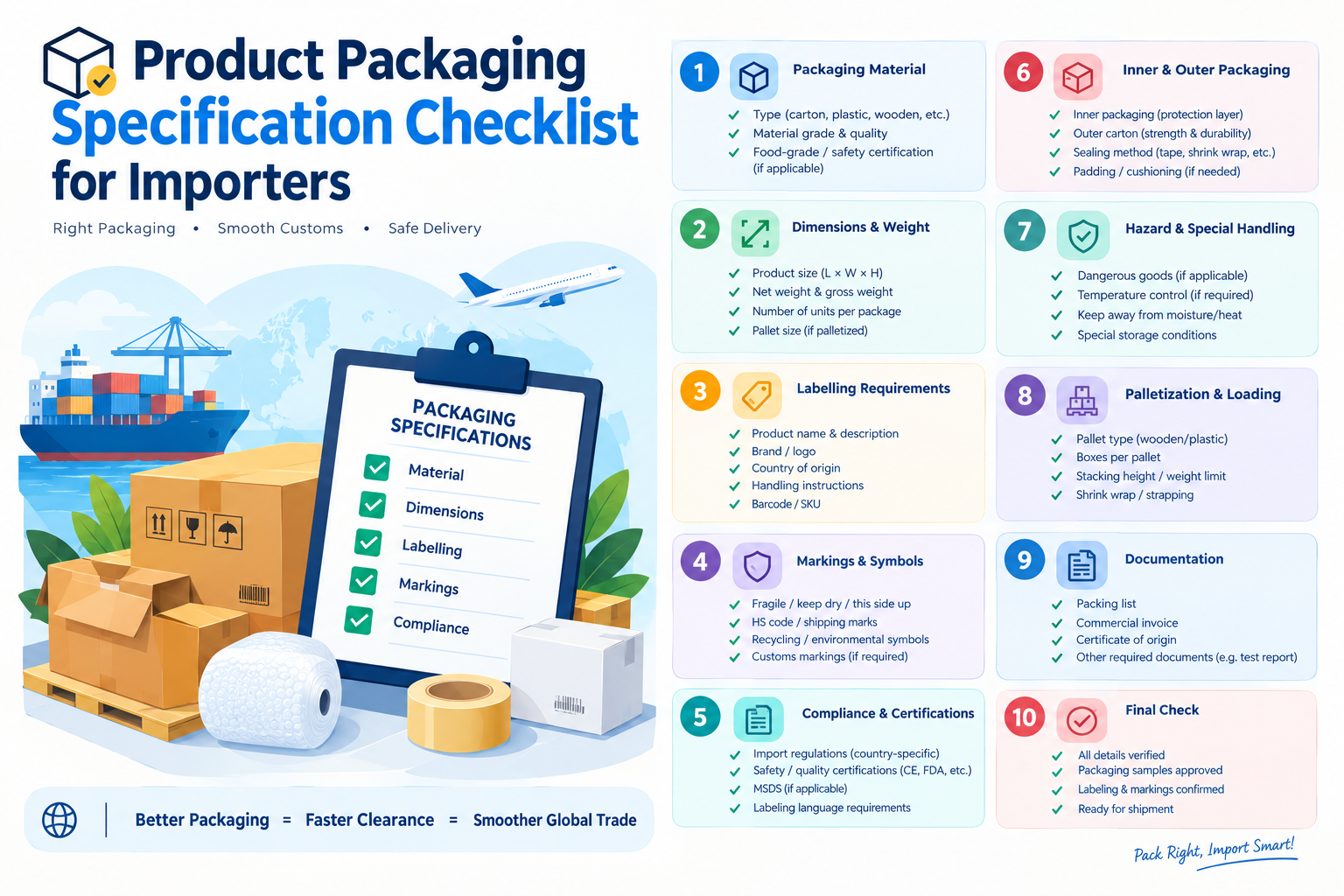
Every factory will pack your goods somehow. The only question is whether they pack them your way, or in whatever carton, polybag and label they used for the last customer. A packaging specification is how you close that gap in writing.
Quick answer: A packaging specification is a written document that tells a supplier exactly how each unit must be packed and shipped: materials, dimensions, print and finish, inserts, inner and master cartons, labels and barcodes, carton markings, strength requirements and the approved samples that define “correct”. It should be complete and signed off before mass production starts.
This guide gives you the 15 fields to include, a template you can copy, who should write each part, and when each decision needs to be locked. It sits inside the wider buying journey described in our beginner’s guide to sourcing products from China, at the point where the product is decided and the order is about to be placed.
What a packaging specification is, and what it is not
A packaging specification (often shortened to “packaging spec” or “pack spec”) is the reference document for everything that surrounds the product: the box or bag the customer sees, the protective parts inside, the cartons used to move goods, and the information printed on all of them.
It is easiest to understand by what it is not:
- It is not the product specification. The product spec defines the item itself: materials, dimensions, functions and tolerances. A separate guide on writing a product specification for a Chinese factory will cover that document in detail.
- It is not the artwork. Artwork files and dielines are inputs the packaging spec points to. The approval process for those files is a topic in its own right, covered in our planned guide to packaging artwork and dieline approval.
- It is not a shipping booking. The spec controls how cartons are built and marked; it does not choose the freight mode or route.
The packaging spec is where those pieces meet. A supplier should be able to read it and know what to buy, what to print, how to pack, and what an inspector will check.
The 15-field packaging specification checklist
Use this list as the skeleton of your packaging spec sheet. Not every product needs every field, but every field should be either filled in or deliberately marked “not applicable”.
- Product and SKU identification: product name, SKU or model number, colour or variant, and the product specification version the packaging belongs to.
- Packaging hierarchy and pack ratio: how many units go in each inner carton and how many inners (or units) go in each master carton.
- Unit packaging type and material: for example folding carton, rigid box, blister, polybag, header card or mailer box, with board or film type and thickness.
- Dimensions and tolerances: internal dimensions for boxes, flat sizes for bags and cards, and acceptable tolerance.
- Print method, colours and finishes: print process, colour references, number of colours, coatings or lamination and special finishes.
- Artwork and dieline reference: file names, version numbers and approval date of each artwork and dieline.
- Inserts and protection: trays, dividers, foam, pulp inserts or paper fill, and how the product sits inside.
- Secondary components: polybags, twist ties, desiccant sachets, manuals, warranty cards, hang tags and their positions.
- Labels, barcodes and regulatory text: barcode type and number, label size and position, warning text, origin marking and any market-specific content.
- Inner carton specification: material, construction, dimensions, closure method and inner-carton label.
- Master carton construction: board grade, wall type, dimensions, closure and reinforcement.
- Carton markings and handling symbols: main marks, side marks, carton numbering and handling pictograms.
- Strength and transit-test requirements: carton-strength values or tests the cartons must pass, and any transit-test procedure that applies.
- Weight, volume and palletisation limits: maximum gross weight per carton, stacking limits and pallet pattern if pallets are used.
- Approval samples and sign-off: which physical samples define “approved”, who signed them and when, and what counts as a deviation.
The sections below explain what to write in each group of fields and where buyers most often leave holes.
Fields 1–2: identification and pack hierarchy
Identification sounds trivial until a supplier ships the right product in the packaging of a sister SKU. Tie every packaging spec to one SKU and one product-spec version, and give the packaging spec its own version number and date.
The pack hierarchy is the structure from the single unit up to the shipping carton: unit pack → inner carton (if used) → master carton. Our planned explainer on retail boxes, inner cartons and master cartons covers the logic of each layer. For the spec, you only need to state the ratios, for example “1 unit per retail box, 6 boxes per inner, 4 inners per master (24 units per master)”. Pack ratio affects your receiving process, your marketplace or wholesale case quantity and how freight volume is calculated, so it should be decided by the buyer, not left to the packer.
Fields 3–8: the unit pack the customer sees
This is the part most buyers think about first, and where specs are often written as mood boards rather than instructions. Replace adjectives with checkable entries:
- Material: “white-back duplex board” or “rigid greyboard wrapped in printed art paper” rather than “premium box”. If you do not know the right terms, ask the supplier to propose a material and then write their proposal into your spec once you approve the sample.
- Dimensions: state internal dimensions (the space the product needs) and let the supplier confirm external dimensions. Specify the tolerance you will accept.
- Print and finish: name the print method if it matters to you, the colour standard (for example CMYK process colours or named spot colours), and finishes such as matte or gloss lamination, spot UV, foil stamping or embossing.
- Inserts: describe how the product must sit: centred, unable to rattle, accessories in a separate compartment. A photo of an approved sample with labels is clearer than paragraphs of text.
- Secondary components: list every item that goes into the box and the order it is packed. Missing manuals and misplaced desiccant sachets are common findings at inspection because nobody wrote down where they belong.
Some markets require warning text on plastic bags above certain sizes, or specific labelling on children’s products and electrical goods. Those requirements depend on the destination market and change over time, so confirm them for each market rather than copying a previous product’s bag.
Fields 9 and 12: labels, barcodes and carton markings
Labels and markings carry information that people and systems downstream rely on: retail scanners, warehouse staff, customs officers and freight handlers.
For barcodes, state the symbology (for example EAN-13 or UPC-A), the number itself, its size and quiet zone, and its position. Official GTINs (Global Trade Item Numbers) are issued through GS1 member organisations, not invented by factories. A dedicated guide to UPC, EAN, GTIN and SKU differences is planned for this cluster.
For export cartons, specify the main marks (consignee or brand, destination, PO number, carton number “x of y”) and side marks (contents, quantity, gross and net weight, dimensions). Handling pictograms such as “this way up”, “fragile” and “keep dry” are standardised in ISO 780; specify which ones apply rather than letting the packer add every symbol available. Our planned article on shipping marks and carton marking will go deeper on layout and on keeping marks consistent with the packing list.
Fields 10–11 and 13–14: cartons, strength and weight
Shipping cartons are where packaging specs are most often vague, and where damage claims start. You do not need to be a packaging engineer, but you do need to state something measurable. The section on carton strength below explains the usual terms.
Also set a maximum gross weight per master carton. Very heavy cartons are harder to handle, more likely to be dropped and may breach the limits of your forwarder, warehouse or marketplace. Agree the figure with whoever handles your goods at destination rather than assuming a number.
Field 15: approval samples and sign-off
A packaging spec without an approved physical sample leaves too much room for interpretation, especially on colour and finish. Keep one signed, dated sample of each approved packaging component (or a fully packed unit), and record in the spec which sample is the reference. The supplier should hold a matching set. That pair of samples is what your inspector compares against later, in the same way that product samples set the standard described in our guide to ordering and evaluating product samples from China.
Packaging spec sheet template
Copy the table below into a spreadsheet or document and fill one sheet per SKU. The example entries are illustrative only.
| # | Field | What to write | Hypothetical example entry | Usually supplied by |
|---|---|---|---|---|
| 1 | Product / SKU | Name, SKU, variant, product-spec version | “Ceramic mug 350 ml, SKU MUG-350-BLU, product spec v3” | Buyer |
| 2 | Pack hierarchy | Units per inner, inners per master | “1 per box, 6 boxes per inner, 4 inners per master = 24 units” | Buyer |
| 3 | Unit pack type & material | Pack format, board/film type, thickness | “Folding carton, white-back duplex board, supplier to confirm grammage” | Supplier proposes, buyer approves |
| 4 | Dimensions & tolerance | Internal size L × W × H, tolerance | “Internal size to fit product sample + insert; supplier to confirm” | Supplier proposes, buyer approves |
| 5 | Print & finish | Print method, colour standard, finish | “CMYK + 1 spot colour, matte lamination outside” | Buyer (brand) |
| 6 | Artwork & dieline | File names, versions, approval date | “Box_MUG350_v4.pdf approved [date]” | Buyer artwork, supplier dieline |
| 7 | Inserts & protection | Insert type, how product sits | “Moulded pulp tray, mug handle facing right, no movement when shaken” | Supplier proposes, buyer approves |
| 8 | Secondary components | Every item in the box and packing order | “Care card on top of tray; no polybag” | Buyer |
| 9 | Labels & barcodes | Symbology, number, size, position, required text | “EAN-13 on base panel, buyer-supplied number, origin marking per destination rules” | Buyer |
| 10 | Inner carton | Material, size, closure, label | “Single-wall carton, taped H-seal, inner label with SKU and quantity” | Supplier proposes, buyer approves |
| 11 | Master carton | Board grade/wall type, size, closure | “Double-wall carton, taped H-seal top and bottom” | Supplier proposes, buyer approves |
| 12 | Markings & symbols | Main marks, side marks, pictograms | “Main: brand, PO, destination, carton x/y. Side: SKU, qty, G.W./N.W., dims. Symbols: this way up, fragile, keep dry” | Buyer |
| 13 | Strength & transit test | Test standard or performance requirement | “Cartons to pass an agreed ISTA test procedure before first shipment” | Buyer sets, supplier or lab tests |
| 14 | Weight & pallet limits | Max gross weight per carton, stacking, pallet pattern | “Max gross weight as agreed with forwarder; floor-loaded, no pallets” | Buyer with forwarder |
| 15 | Approval & sign-off | Reference samples, signatories, date, deviation rule | “Packed reference unit signed [date]; any material or colour change needs written approval” | Buyer and supplier |
A downloadable version of this template is a natural companion to this page; until it exists, the table above is the working version.
Who creates the packaging specification?
The buyer owns the packaging specification, because the buyer carries the consequences: damaged goods, rejected deliveries, relabelling costs or a brand that looks different from batch to batch. But the buyer rarely writes every line alone.
| Party | Typical contribution |
|---|---|
| Buyer / brand owner | Brand requirements, artwork, barcode numbers, market labelling, pack ratios, carton marks, approval |
| Product supplier | Proposed pack format, current packaging options, packing method, carton sizes based on the final product |
| Packaging printer or carton maker (often subcontracted by the supplier) | Dielines, board and material options, print limits, finishing options, material lead times |
| Freight forwarder or destination warehouse | Carton weight and size limits, pallet requirements, labelling expected at receiving |
| Inspector or QC team | Feedback on whether each requirement can actually be checked |
| Sourcing partner (if used) | Compiling inputs, translating requirements, chasing samples, checking packaging against the spec |
For private-label products the brand side is heavier, because the packaging carries your identity rather than the factory’s. Our guide to private label and custom products from China explains where packaging sits in that wider process, and a planned guide on private-label packaging will cover the brand files suppliers need.
When should packaging be finalised?
Should packaging be finalised before mass production? Yes. The packaging specification, artwork and approval samples should be signed off before the supplier starts mass production, and ideally before the purchase order is confirmed. Printed packaging and cartons have their own production lead time, and changes after printing usually cost money and delay shipment.
In practice, packaging decisions are locked in stages:
| Stage | Packaging decisions to make |
|---|---|
| Supplier shortlisting and quoting | Basic pack format, pack ratio and whether custom print is needed, so quotations include the same packaging (see how to compare quotations from Chinese suppliers) |
| Sample approval | Unit-pack format, inserts and protection; carton sizes can now be calculated from the real product |
| Before purchase order | Full packaging spec signed; artwork and barcodes approved; packaging MOQs confirmed |
| Before mass production | Printed packaging proof or pre-production packaging sample approved; carton strength requirement agreed |
| During production | No changes unless formally agreed in writing, with cost and timing impact confirmed |
| Before shipment | Packaging checked against the spec during inspection |
Packaging can carry its own minimum order quantities, separate from the product. A custom-printed box may need a larger run than your first product order, which affects cost per unit. Our guide to minimum order quantities explains how MOQs work and where there is room to negotiate them.
Carton strength: what to specify without being a packaging engineer
Carton strength is the field most often written as “strong export carton”, which nobody can inspect. These are the common ways to make it measurable:
- Wall construction: single-wall, double-wall or triple-wall corrugated board. Chinese suppliers often describe cartons by the number of paper layers, for example “3-ply” for single-wall and “5-ply” for double-wall. Flute profiles (such as A, B, C, E) affect thickness and cushioning.
- Edge Crush Test (ECT): measures how much force the corrugated board withstands on its edge. It relates closely to how well a box resists stacking loads.
- Burst strength (Mullen test): measures resistance to puncture-type pressure. It is still used in some markets and specifications.
- Box Compression Test (BCT): measures how much top load a finished, empty box withstands before collapsing. It is the most direct indicator of stacking performance.
- Transit testing: the International Safe Transit Association (ISTA) publishes test procedures that simulate handling hazards such as drops, vibration and compression. The procedures range from basic integrity tests to more realistic simulations. Specifying an ISTA procedure is often more meaningful than specifying board grade alone, because it tests the whole packed unit.
What to write depends on your product’s weight, fragility, stacking height and route. If you are unsure, a practical approach is to ask the supplier to propose a carton construction, require that a packed carton passes an agreed drop test before mass production, and then record the approved construction in the spec. Humidity matters too: corrugated board loses strength when it absorbs moisture, which is relevant on long sea routes and in humid destinations. Our planned guide to export packaging for China to Bangladesh shipments will cover moisture protection, pallets and wood-packaging rules in detail.
Bangladesh importers: points to add to the spec
The checklist above applies to any destination. If your goods are going to Bangladesh, a few additions are worth considering:
- Marks that match the documents. Carton marks, quantities and weights should match the commercial invoice and packing list. Mismatches create questions at clearance. Our step-by-step guide to importing from China to Bangladesh explains where those documents fit.
- Retail labelling for the local market. Packaged goods sold in Bangladesh may be subject to labelling requirements, for example around importer details, quantity declarations or price marking. These rules can change and depend on the product category, so confirm current requirements with BSTI (Bangladesh Standards and Testing Institution) or a qualified customs/C&F agent before you approve print artwork.
- Moisture and handling. Long transit times and humid conditions argue for stronger cartons, inner polybags or desiccant for sensitive products. Our article on shipping from China to Bangladesh explains the routes and handling points your cartons will pass through.
Common gaps in packaging specifications
| Gap in the spec | What tends to happen | How to close it |
|---|---|---|
| “Standard packaging” or “export carton” with no detail | Supplier uses its cheapest default, which may not survive transit | Name the construction or require an agreed transit test |
| External box size given, not internal | Product does not fit, or rattles inside | Specify internal dimensions and confirm with a packed sample |
| Colour described in words | Batch-to-batch colour drift; disputes over “close enough” | Reference a colour standard and keep a signed printed sample |
| Barcode number sent by chat, not in the spec | Wrong or missing barcode on some SKUs | Put barcode numbers in the spec table per SKU |
| No carton weight limit | Overweight cartons, handling damage, warehouse rejections | Agree a maximum gross weight with your forwarder or warehouse |
| Packaging changed by supplier “to save cost” | Unannounced material downgrade | State that any material, supplier or construction change needs written approval |
| No reference sample | Inspector has nothing to compare against | Sign and date a packed reference unit; supplier holds a matching one |
How the specification is used at inspection
A packaging spec does its most important work after production, when someone checks whether the goods match it. An inspector can only fail packaging against a written requirement. If your spec says “double-wall carton, EAN-13 on base, care card on top of tray”, each of those becomes a checkpoint; if it says “good packaging”, nothing does.
Packaging checks are normally part of a pre-shipment inspection, alongside product quality, quantity and function. Our guide to quality-control stages in China sourcing explains where that inspection fits in the order timeline, and a dedicated guide to packaging quality checks before shipment is planned for this cluster. If you need someone on the ground to run those checks, see the China quality control and inspection service.
Getting packaging sourced, prepared and checked
Writing the spec is the buyer’s job; turning it into printed boxes and correctly packed cartons usually involves the product supplier, a packaging subcontractor and someone checking the result. Jingxin Sourcing supports custom packaging as part of its sourcing work and conducts packaging inspection, with a head office in Dhaka and a permanent team in China.
If you would like your packaging spec turned into supplier-ready requirements and checked before goods leave China, the Packaging & Prep service for importers explains how that support works. The next step in this cluster is our planned guide to custom packaging from China, which covers packaging types, the production process and the factors that drive packaging cost.
FAQ
What should a packaging specification include?
At minimum: SKU identification, pack hierarchy and ratios, unit-pack material and dimensions, print and finish, artwork references, inserts, secondary components, labels and barcodes, inner and master carton construction, carton markings, strength or transit-test requirements, weight limits and the approved reference samples. Mark any field that does not apply as “not applicable” rather than leaving it blank.
What is the difference between a packaging specification and a packaging spec sheet?
They usually mean the same thing. “Packaging specification” often refers to the full requirement, which can include drawings, artwork and samples, while “spec sheet” refers to the one-page or one-tab summary table. Many importers keep one spec sheet per SKU and attach the artwork and dielines to it.
Can I let the supplier decide the packaging?
You can let the supplier propose packaging, and that is often sensible because they know what materials and formats are available. The decision should still be yours: approve a sample, write the approved details into your spec and require written approval for any later change.
When is it too late to change packaging?
Changes are cheapest before artwork is printed and cartons are ordered. Once printing has started, changes typically mean reprinting, scrapping existing stock or delaying production, and the cost usually falls on the buyer. If a change is unavoidable, agree the cost and the new shipping date in writing before the supplier acts on it.
Do I need transit testing for every product?
Not always. Low-value, robust products in simple cartons may not justify formal testing. Fragile, heavy, high-value or ecommerce-shipped products benefit from an agreed test such as an ISTA procedure, because it checks the whole packed unit rather than just the board grade.
Before you send the purchase order
Read your packaging spec as if you were the packer on the production line: could you pack the product correctly using only this document and the reference sample? Then read it as the inspector: could you pass or fail each line? If both answers are yes, the spec is ready to sign. If either is no, fix the gap now, while the change still costs an email rather than a reprint.