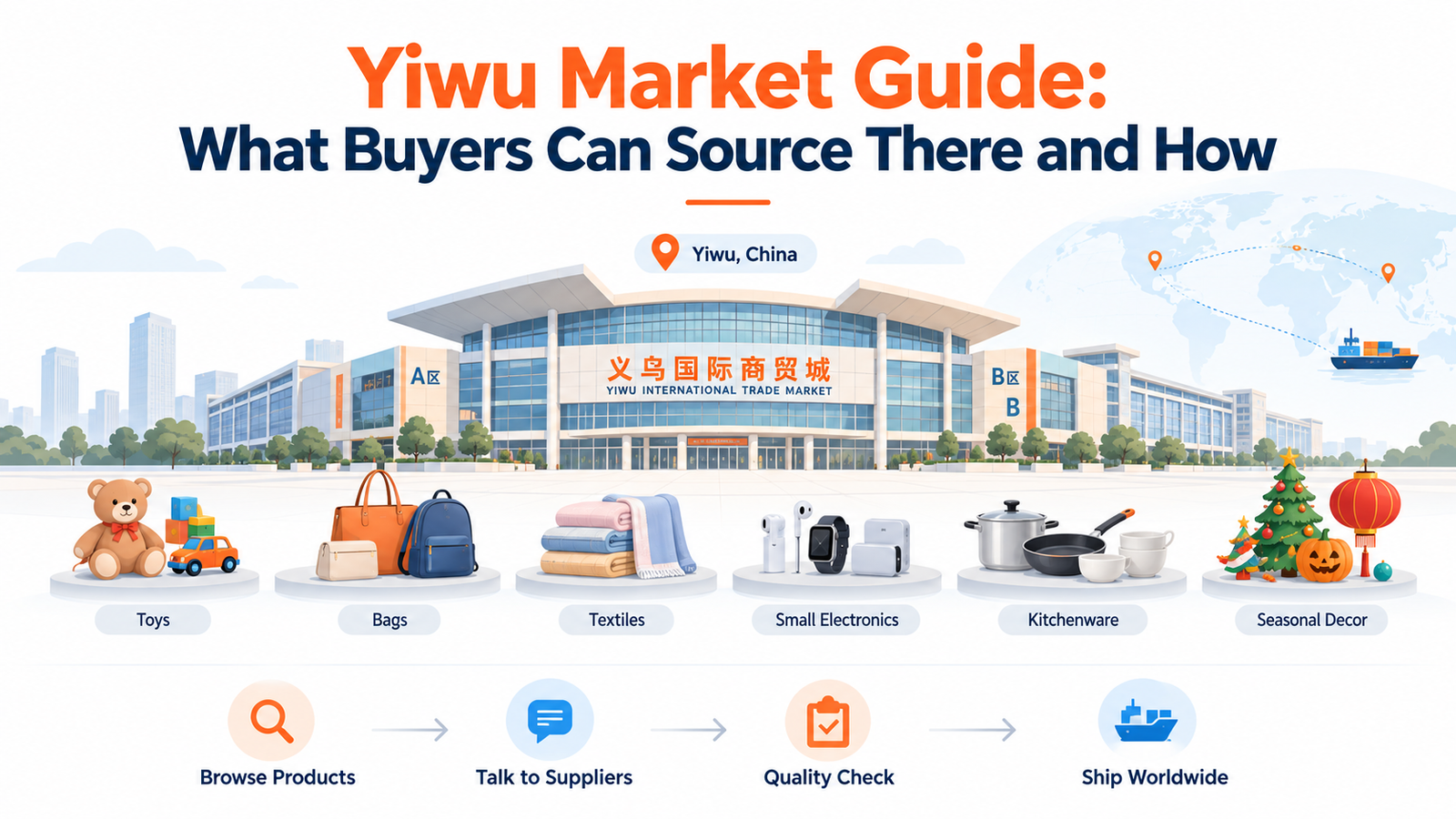
Yiwu market is the first stop for many buyers of small, low-cost consumer goods. Toys, jewellery, stationery, hardware, socks, festival decorations and household items are all sold by tens of thousands of wholesale shops in one city in Zhejiang Province, eastern China.
This guide explains what the market is, what each district sells, who you are really buying from, and how to place and ship an order with or without a visit. If you are new to importing, start with our guide on how to source products from China, then use this article to decide whether Yiwu fits your product.
What is Yiwu market?
Yiwu market, officially Yiwu International Trade City (also called China Commodities City), is a wholesale market for small commodities in Yiwu, Zhejiang. It is run by Zhejiang China Commodities City Group, which reports nearly 80,000 physical shops and more than 2.2 million products across 28 major categories. Most sellers are traders or showrooms rather than factories, and low carton-level orders are common.
The scale is large even by Chinese standards. In its 2025 annual report, the operator recorded a market transaction volume above RMB 320 billion, more than 230,000 visitors a day and over 4,000 foreign business visitors a day. Yiwu is about 270 km from Shanghai, around one and a half to two hours by high-speed train.
Yiwu market districts and what they sell
The core of the market is Yiwu International Trade City, Districts 1 to 5. The operator also runs the Huangyuan garment market, the International Production Materials Market and, since October 2025, the Global Digital Trade Center. Each building is organised by product category, often floor by floor.
| Market | Main product categories | Typical buyer fit |
|---|---|---|
| District 1 | Toys, artificial flowers, jewellery, hair accessories, handicrafts, photo frames, porcelain, festival goods | Gift, party and accessories retailers, ecommerce sellers |
| District 2 | Bags and luggage, umbrellas, hardware and tools, small appliances, electronics, clocks, lamps | Hardware stores, travel goods and electronics accessory sellers |
| District 3 | Stationery and office supplies, glasses, cosmetics, sports goods, buttons and zips | School and office suppliers, beauty and sports retailers, garment trims buyers |
| District 4 | Socks, hosiery, hats, gloves, scarves, belts, ties, knitted and cotton goods, footwear | Apparel accessory and footwear wholesalers |
| District 5 | Imported goods and food, bedding and textiles, wedding supplies, auto parts, pet products | Home textile, automotive accessory and pet product buyers |
| Huangyuan market | Men’s, women’s and children’s clothing, jeans, sleepwear, sportswear | Garment wholesalers needing small mixed quantities |
| International Production Materials Market | Raw materials and equipment, such as leather materials, lighting and food-processing machinery | Manufacturers and workshops buying inputs |
| Global Digital Trade Center | Newer categories including fashion jewellery, trend and designer toys, smart devices and drones, skincare | Buyers looking for newer, trend-led or branded products |
The Global Digital Trade Center, opened on 14 October 2025, is described by the operator as Yiwu’s sixth-generation market. Its market section covers about 410,000 square metres and focuses on newer industries, with more emphasis on own brands and online ordering than the older districts.
Are Yiwu sellers manufacturers?
Mostly not directly. A Yiwu booth is a sales point, and many are run by trading companies that buy from factories elsewhere in Zhejiang and other provinces. Some booths do belong to a manufacturer or a family-linked factory, but you cannot tell from the booth alone. Treat every seller as a trader until they show evidence of their own production. If Yiwu is only one route you are considering, compare it with the other methods in our guide on how to find reliable suppliers in China.
That is not a problem in itself. Traders are the reason Yiwu works for small buyers: they hold stock, accept small orders and let you compare many products in a day. The difference matters when your order needs things only a factory can control.
| Buying from a Yiwu trader works well when | Going to the factory is usually better when |
|---|---|
| You want many different items in small quantities | You need large, repeat volumes of one product |
| The product is standard or only needs a simple logo or label | You need custom materials, moulds, sizes or packaging |
| You are testing demand before committing | Consistent quality across reorders is critical |
| Speed and stock availability matter more than the lowest unit price | Certification, testing or factory-level traceability is required |
If you need to know who actually makes a product, ask for the business licence and follow our Chinese supplier verification checklist before payment. For larger or custom orders, a factory audit confirms whether the factory exists and can make what you ordered.
How buying at Yiwu market works
Buying in Yiwu follows a routine that most sellers know well. The details vary by product and seller, but a typical order looks like this:
- Browse and shortlist. Note the booth number, district and floor for every product you like. Take the seller’s business card and photograph the item with its price tag or code.
- Ask the key questions. Price per unit and per carton, units per carton, minimum order, lead time if the item is not in stock, and whether a logo or custom packaging is possible.
- Confirm the order in writing. Ask for a written order or proforma invoice listing item codes, quantities, prices, packing and delivery date.
- Pay the deposit. Sellers usually ask for a deposit to start the order, with the balance before delivery. Agree the terms in writing.
- Inspect before delivery. Check quantity, quality and packing before goods leave the seller, especially for items made to order. A pre-shipment inspection is far cheaper than a problem found at destination.
- Deliver to a consolidation warehouse. Each seller delivers to one warehouse, where the goods are checked, labelled and loaded together for export.
Prices in Yiwu are wholesale quotes, usually for goods collected in Yiwu, not delivered to your country. Freight, export handling and import duties come on top, so compare landed cost rather than the booth price.
Should you visit Yiwu or buy remotely?
Both work. Visiting gives you the full range of the market and direct relationships, while remote buying saves travel time and cost but depends on someone reliable on the ground.
| Factor | Visiting the market | Buying remotely |
|---|---|---|
| Product discovery | See and handle thousands of products, spot new items | Limited to what you search for or what is sent to you |
| Cost | Flights, visa, hotel and several days of time | Agent or service fees, plus samples by courier |
| Negotiation | Face-to-face, usually with an interpreter | Through a local representative, video calls or online chat |
| Order control | You still need follow-up after you leave | Depends on the representative’s checks and reporting |
| Best for | First buying trips, large mixed ranges, building supplier relationships | Repeat orders, known products, buyers who cannot travel |
If you plan a visit
- Check China’s visa and entry rules for your passport well ahead; they differ by nationality and have changed several times recently.
- Most international buyers fly into Shanghai or Hangzhou and continue to Yiwu by high-speed train or car.
- The market usually opens from about 9:00 to 17:00. Confirm hours for the buildings you plan to visit.
- Avoid the Spring Festival (Chinese New Year) period. The market closes for several weeks; in 2026 it reopened on 28 February.
- Allow at least two or three days, plus time after the visit for follow-up, inspection and consolidation.
Jingxin Sourcing has an office in Yiwu and arranges market visits for buyers, including trips timed around trade fairs and expos in China. Visits can also cover Guangzhou and Shenzhen, so one trip can combine Yiwu’s wholesale market with suppliers in southern China. A local team can plan which districts to cover, help with communication at the booths and follow up with sellers after you leave.
If you buy remotely
Remote buyers usually work in one of three ways. They send a product list to a sourcing agent or product sourcing company in Yiwu that visits sellers, collects quotes and samples, and follows the order. They search the operator’s official online platform, Chinagoods, and contact sellers directly. Or they reorder from sellers they met on an earlier trip. Jingxin’s Yiwu team can also place and follow orders with market sellers on a buyer’s behalf. Whichever route you use, ask for photos or video of the actual goods and the packed cartons before paying the balance.
How goods from many Yiwu sellers are shipped
A typical Yiwu order involves several sellers, each supplying a few cartons. Instead of shipping each one separately, the goods are consolidated: every seller delivers to one warehouse, where cartons are counted, checked against the order, marked and loaded into one container or one less-than-container-load (LCL) shipment.
China supports this with a customs arrangement called market procurement trade, first developed through Yiwu’s trade reforms from 2011. It is designed for mixed, small-batch exports bought in wholesale markets, and now accounts for more than 80% of Yiwu’s exports. Your consolidator or freight forwarder usually handles the export declaration; your job is to make sure the paperwork matches what you ordered.
Yiwu has no seaport. Containers normally travel by rail or road to Ningbo-Zhoushan Port, and some go to Shanghai, before the sea leg. Bangladesh buyers can see how that China origin leg connects into the wider route in our guide to shipping from China to Bangladesh. Jingxin can inspect goods from Yiwu sellers and consolidate them at its warehouse before export. For help planning the shipment, see our shipping and logistics service.
Checklist before you place a Yiwu order
- ☐ Seller’s company name, booth number and contact details recorded
- ☐ Item codes, photos and agreed prices saved for every product
- ☐ Units per carton, carton size and gross weight confirmed
- ☐ Written order or proforma invoice received
- ☐ Deposit and balance terms agreed in writing
- ☐ Labelling, logo and packaging requirements confirmed
- ☐ Import rules for your country checked (for example, product safety marks or restricted items)
- ☐ Inspection arranged before goods leave the seller
- ☐ Consolidation warehouse address given to every seller
- ☐ Freight method and Incoterm agreed for the full shipment
Frequently asked questions
Is Yiwu market the same as Yiwu International Trade City?
Broadly, yes. Yiwu International Trade City, or China Commodities City, is the main wholesale complex, made up of Districts 1 to 5. “Yiwu market” is often used for the wider group of markets run by the same operator, including Huangyuan and the Global Digital Trade Center.
Can I buy from Yiwu without visiting?
Yes. Many buyers order through a sourcing agent or company with people in Yiwu, through the official Chinagoods platform, or by reordering from sellers they already know. What matters is having someone you trust to check goods, follow up with sellers and manage consolidation.
What is the minimum order quantity in Yiwu?
It varies by seller and product. For items in stock, many sellers accept one or a few cartons per item. Custom colours, logos or packaging usually need a higher quantity, because the seller has to place an order with a factory.
Is Yiwu cheaper than buying from a factory?
Not always. A trader adds a margin, so a factory may be cheaper for large volumes of one item. Yiwu is often better value for small, mixed orders, because one trip or one sourcing agent can cover many products and shipping is combined.
When is Yiwu market closed?
The main closure is around the Spring Festival, when the market shuts for several weeks. The exact reopening date changes each year: it was 9 February in 2025 and 28 February in 2026. Factories supplying the market also slow down before and after the holiday.
Can Yiwu sellers make custom or branded products?
Many can arrange simple customisation, such as a printed logo, label or retail box, by passing the order to their factory. For new designs, moulds or strict specifications, it is usually safer to work with the manufacturer directly.
Conclusion
Yiwu market is at its best for small, mixed orders of everyday consumer goods. Know which district sells your category, assume most booths are traders (see trading company vs factory for how to check), put every order in writing, inspect before delivery and consolidate before shipping. When an item becomes a steady seller or needs real customisation, look for the factory behind it.
Jingxin Sourcing has its head office in Dhaka, Bangladesh, and an office in Yiwu, China, from which it arranges buyer visits, buys from market sellers on clients’ behalf, and inspects and consolidates orders before export. Need help finding and checking suppliers in Yiwu or beyond? Learn more about Jingxin Sourcing’s Product Sourcing service.