Finding a supplier in China takes minutes. Finding one that can make your product to specification, at the quantity you need, and keep doing it order after order takes a method. Most problems buyers later blame on “a bad factory” start at the search stage, when the wrong kind of supplier was put on the shortlist.
This guide compares the five main routes buyers use to find suppliers in China, explains what each one is good for and where it goes wrong, and gives a step-by-step way to turn a long search into a shortlist for a single order. Supplier search is one stage of a longer process; for the full sequence from specification to shipping, see our guide on how to source products from China. Once you have a shortlist, use the supplier quotation comparison method to put offers on the same basis.
Where can you find reliable suppliers in China?
Buyers find suppliers in China through five main routes: B2B platforms such as Alibaba.com and Made-in-China.com, trade fairs such as the Canton Fair, wholesale markets such as Yiwu, industrial clusters that specialise in one product, and local sourcing agents or companies. No route guarantees reliability. Reliability is established afterwards, by screening, supplier verification and sample evaluation.
Five routes to find suppliers in China compared
| Route | Best for | Main risk |
|---|---|---|
| B2B platforms (Alibaba.com, Made-in-China.com, Global Sources; 1688.com for domestic wholesale) | Searching many suppliers quickly from your desk, in English | Factories, traders and resellers look alike; profile claims and badges are not proof of capability |
| Trade fairs (Canton Fair, Global Sources Hong Kong shows, sector fairs) | Seeing products in person and comparing many exhibitors in a few days | Cost and timing of travel; exhibitors still need checking after the fair |
| Wholesale markets (Yiwu China Commodity City) | Small commodities, mixed ranges and lower quantities | Most booths are showrooms or traders; consistency across reorders varies |
| Industrial clusters (towns or districts specialising in one product) | Finding real manufacturers and comparing several in one area | Hard to access without Chinese-language search or local contacts |
| Sourcing agents and sourcing companies | Local search, screening and communication for buyers without staff in China | Fees, scope and independence vary; the agent’s own supplier network may be narrow |
Route 1: B2B platforms
B2B platforms are where most buyers start, because they are searchable, free to browse and built for overseas buyers. Alibaba.com is the best known. Made-in-China.com and Global Sources, a Hong Kong-based business that also runs sourcing trade shows, are the main alternatives and are worth searching in parallel because supplier listings differ.
How to search platforms well
- Search by specification, not just product name. “600D polyester backpack with laptop sleeve” returns a narrower, more relevant set than “backpack”.
- Use the material or process as a keyword. Terms such as “injection moulded”, “die cast” or “cut and sew” surface manufacturers rather than resellers.
- Check the product range on the profile. A company listing backpacks, phone cases and garden tools is very likely a trader. A narrow, deep range suggests a manufacturer.
- Compare the company name across the profile, quotations and documents. The legal name should be consistent everywhere.
- Look at what they export and where. A supplier already shipping to your market is more likely to know its labelling and testing rules.
What platform badges do and do not tell you
Platform badges are useful filters, not guarantees. On Alibaba.com, a Verified Supplier has been assessed by an independent third-party firm (Alibaba names SGS, Intertek and TÜV Rheinland as examples) covering company profile, production capability, products and process controls. Alibaba’s own disclaimer states that these assessments are conducted by third parties and that it does not guarantee the authenticity of seller information or certificates.
On Made-in-China.com, an Audited Supplier has had an on-site audit by SGS, Bureau Veritas, TÜV Rheinland or CTI, and the audit report can be read online free of charge. Reading that report is more useful than seeing the badge: check the audit date, the address audited and whether the production lines shown match your product.
1688.com: domestic wholesale prices, different rules
1688.com, founded in 1999 and owned by Alibaba Group, is China’s main domestic wholesale marketplace. It is in Chinese, priced for Chinese buyers, and many sellers do not handle export paperwork or overseas payment. It is useful for researching price levels and finding manufacturers that do not advertise abroad, but most overseas buyers need a local partner to contact sellers, consolidate goods and arrange export. For the practical differences in language, payment, protection and export support, see our Alibaba vs 1688 comparison.
Route 2: Trade fairs
The China Import and Export Fair, known as the Canton Fair, is one of China’s largest and longest-running trade fairs, first held in 1957. It is co-hosted by the Ministry of Commerce and the People’s Government of Guangdong Province, organised by the China Foreign Trade Centre, and held in Guangzhou every spring and autumn. Each session is split into three phases by product category.
| 140th Canton Fair phase | Dates | Main product categories |
|---|---|---|
| Phase 1 | 15–19 October 2026 | Machinery, hardware and tools, electronics and electrical, new energy vehicles, industrial automation |
| Phase 2 | 23–27 October 2026 | Building materials and furniture, housewares, gifts and decorations |
| Phase 3 | 31 October–4 November 2026 | Health and recreation, toys, baby and maternity, fashion |
Organisers expect more than 30,000 exhibitors for the 140th session, and the previous session reported 314,000 overseas buyers from 220 countries and regions. Global Sources runs separate sourcing shows in Hong Kong, and many product sectors have their own specialist fairs in China.
Are trade fairs still worth it?
Trade fairs are worth the trip when you need to handle products, compare finish and materials side by side, or meet several manufacturers in one category within days. They are less useful for a single low-value item, or when your product falls in a phase you cannot attend. To get value from a fair:
- Pick the phase that matches your category and pre-select exhibitors before you arrive.
- Bring a one-page specification and target price so every conversation covers the same points.
- Photograph each booth sign and business card, and note who you spoke to and what they quoted.
- Treat every exhibitor as unverified. A booth shows that a company paid to exhibit, not that it owns a factory.
Route 3: Wholesale markets
Yiwu, in Zhejiang Province, is home to China Commodity City, one of the world’s largest wholesale markets for small commodities such as accessories, stationery, toys, household goods and seasonal items. The market is operated by Zhejiang China Commodities City Group, which also runs an online version called Chinagoods. Our Yiwu Market guide explains the districts, product categories, seller types and buying process in detail.
Wholesale markets suit buyers who need variety: many product lines at moderate quantities, often with stock or semi-stock designs. The trade-off is that most booths are showrooms for factories elsewhere or trading companies, so the person at the booth may not control production. For repeat orders with fixed specifications, buyers often use the market to find a product and then trace and assess the factory behind it.
Route 4: Industrial clusters
Much of China’s manufacturing is concentrated in towns or districts that specialise in one product family, with raw material suppliers, component makers and finishing workshops nearby. Two well-documented examples:
- Datang, Zhuji (Zhejiang): produces more than 25 billion pairs of socks a year, according to Xinhua (October 2025).
- Danyang (Jiangsu): produces more than 400 million pairs of spectacle lenses a year, roughly half of global output, with over 1,600 eyewear businesses, according to China Daily (February 2025).
Clusters matter because you can compare several genuine manufacturers in one area, check component suppliers, and often find factories that do not advertise in English. To identify the cluster for your product, look at where trade fair exhibitors and platform suppliers in your category are registered, and search in Chinese for the product name together with 产业带 (industrial belt) or 产业基地 (industrial base). Visiting a cluster usually needs a Chinese speaker and some local knowledge.
Route 5: Sourcing agents and sourcing companies
A sourcing agent or sourcing company searches on your behalf, screens candidates, communicates in Chinese and can visit suppliers. This route makes sense when you have no staff in China, need suppliers that only work in Chinese, or are buying several product lines at once. It does not replace your own judgement. For the task-level detail, see what a China sourcing agent does and how to choose a sourcing company. Ask any agent:
- How they are paid: a service fee, a commission on order value, or payments from suppliers.
- Whether they will share supplier names and documents with you, so you can check them independently.
- Which services are included (search, verification, sample handling, inspection, shipping coordination) and which are extra.
- Whether they have worked with your product category before.
Use the same questions to compare any sourcing partner, including the scope described on Jingxin Sourcing’s Product Sourcing page.
Other useful signals: trade data and referrals
Two supplementary routes help confirm or extend a search. In the United States, information from inbound vessel manifests can be published under 19 CFR 103.31, which is why commercial trade-data services can show which Chinese shippers send which goods to which importers. These records can confirm that a supplier really exports your type of product. Shippers and importers can request confidential treatment, so a missing record proves nothing. Referrals from non-competing buyers, freight forwarders and inspection firms are the other signal, especially in niche categories.
How to build a shortlist for one order
A shortlist is built for a specific order, not for “China” in general. A supplier that suits 300 promotional pieces is rarely the right choice for 20,000 retail units with custom packaging. Use these steps:
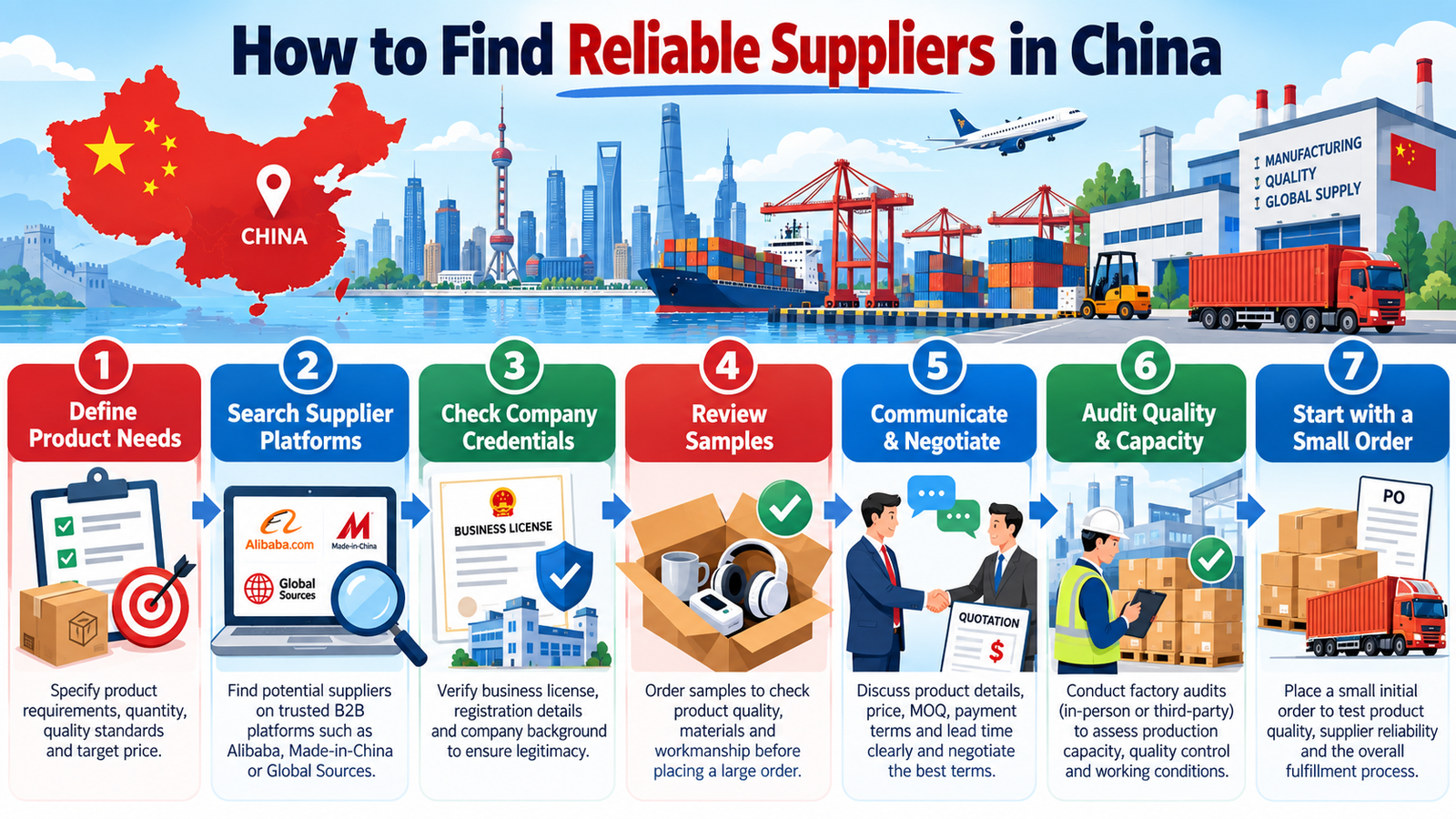
- Write a one-page requirement. Include specification, materials, quantity, target price, packaging, destination market and the compliance rules that apply. If you are still testing demand or cost, do the product research first.
- Search at least two routes. For example, a B2B platform plus a trade fair exhibitor list, or a platform plus the main industrial cluster for the product.
- Build a longlist of five to ten candidates. Remove anyone whose range, materials or export markets clearly do not fit.
- Send every candidate the same request for information. Ask for the legal company name, factory address, main products, export markets, MOQ, sample cost and lead time, and the price basis (for example FOB with the named port).
- Score the replies. Use the scorecard below so the decision rests on the same criteria for everyone.
- Cut to three to five for verification and samples. Check registration, ownership of production and capability before any payment, and consider a factory audit for larger or custom orders.
Supplier screening scorecard
| Criterion | What a good answer looks like | Score (1–5) |
|---|---|---|
| Product fit | Already makes the same product type in the same material | |
| Supplier type | Clear about whether it is the manufacturer or a trader, and names the factory if a trader | |
| Export experience | Ships to your market and can name the standards or tests usually required there | |
| Response quality | Answers every question in the request, in writing, without vague ranges | |
| Commercial fit | MOQ, lead time and price basis match your order | |
| Consistency | Company name and address match across profile, quotation and documents |
How many suppliers should you contact?
For a single product, contacting five to ten suppliers is usually enough to see the realistic price range and identify the serious ones. Fewer than three gives you no basis for comparison. Many more than ten creates a comparison workload without improving the result, because the same price levels and answers start to repeat.
Warning signs during the search
- A price far below every other quote for the same specification.
- Product photos that also appear on many unrelated profiles.
- Reluctance to give the legal company name or factory address.
- Claims to manufacture an unusually wide, unrelated range of products.
- Pressure to pay quickly before samples or written terms.
None of these alone proves a supplier is unreliable, but each one is a reason to check further before the candidate moves onto your shortlist.
Frequently asked questions
What is the best website to find suppliers in China?
There is no single best site. Alibaba.com has the largest range for overseas buyers, Made-in-China.com publishes third-party audit reports for its Audited Suppliers, and Global Sources is known for electronics and also runs sourcing shows in Hong Kong. Searching two platforms for the same product gives a fuller picture.
Is an Alibaba Verified Supplier reliable?
The badge means an independent firm has assessed the company, which is a useful starting filter. It does not guarantee product quality or that every profile claim is true, and Alibaba states it does not guarantee seller information. You still need your own checks and samples.
Can overseas buyers buy directly on 1688?
Some can, but 1688 is built for China’s domestic market. It is in Chinese, many sellers only accept domestic payment and delivery within China, and few handle export. Most overseas buyers use a local partner to order, consolidate and ship.
When is the next Canton Fair?
The 140th Canton Fair runs in Guangzhou in three phases between 15 October and 4 November 2026. The fair is held every spring and autumn, so check the official Canton Fair website for the following session’s dates.
How do I know if I am dealing with a factory or a trading company?
Ask directly, then compare the answer with the registered business scope, the factory address, the breadth of the product range and, where possible, a live video or on-site visit of production. Trading companies are not a problem in themselves, but you should know which factory makes your goods.
Do I need to visit China to find a good supplier?
Not always. Many buyers find and screen suppliers remotely, then use an audit or inspection firm, or a sourcing partner in China, for on-site checks. A visit is most valuable for custom products, large orders or long-term supply.
Conclusion
Reliable suppliers are rarely found through one search. They come from using more than one route, asking every candidate the same questions, scoring the answers consistently and verifying the few that remain. The route you start with matters less than the discipline you apply to the results.
Jingxin Sourcing has its head office in Dhaka, Bangladesh, and an office in Yiwu, China. Once you have a shortlist, run a business-licence lookup on each supplier and put the pre-deposit questions to them before paying. Need help finding and shortlisting suppliers for a specific order? Learn more about Jingxin Sourcing’s Product Sourcing service.