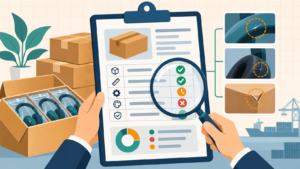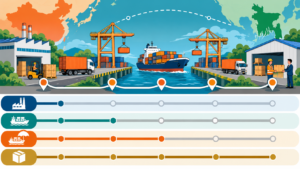
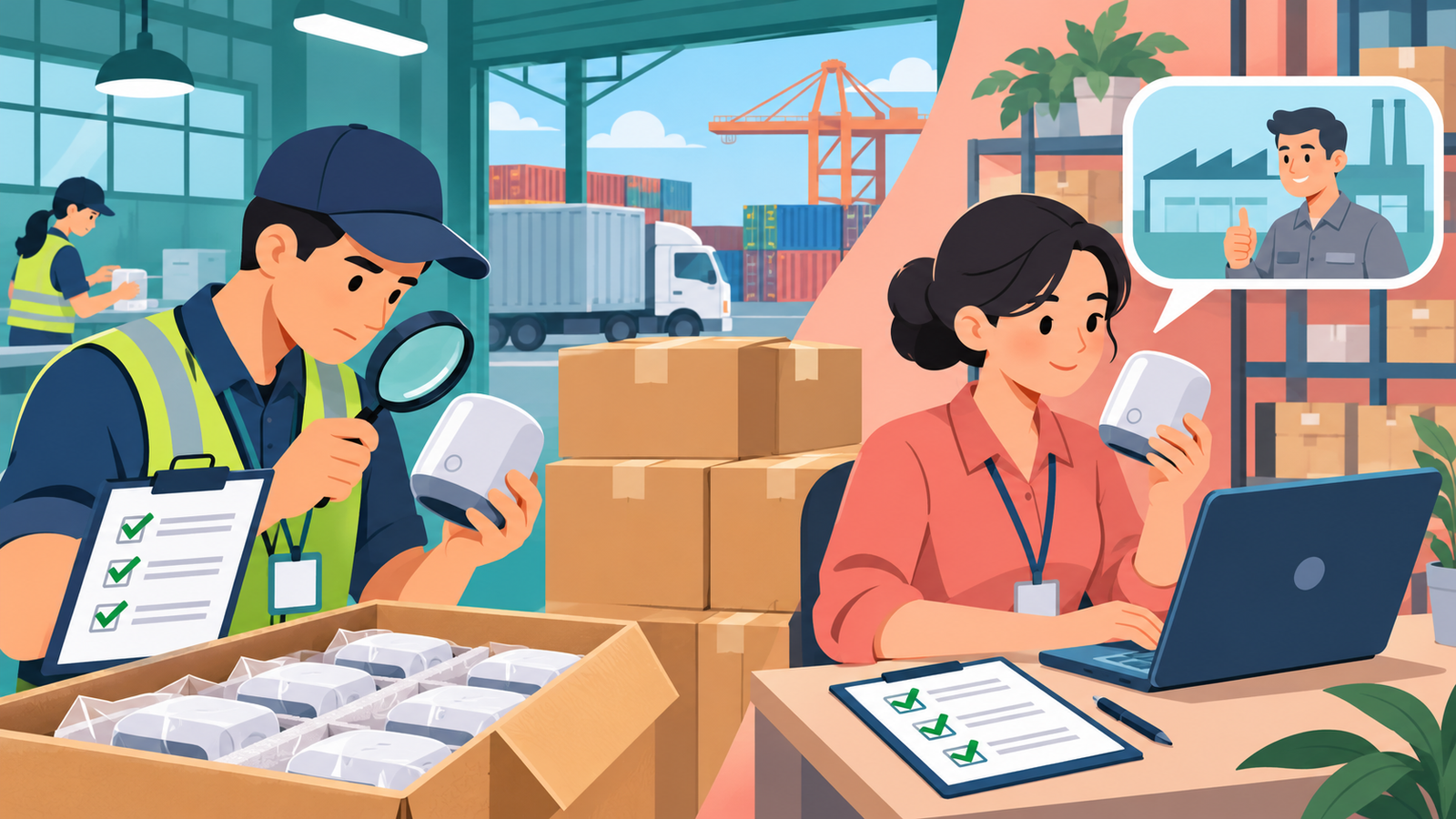
If you already work with a sourcing company that offers inspections, a fair question follows: should the people who found the supplier also be the people who check its goods? Sometimes the answer is yes, sometimes you want an independent inspector, and often the best arrangement uses both.
Third-party inspection vs sourcing-company QC, in short: A third-party inspection company is engaged only to check goods and report, so its main strength is independence. A sourcing company’s quality checks are part of a wider service, so their strength is continuity: knowing the order history and following up with the factory. Buyers with high-risk or high-value orders often combine them.
Both can carry out the same inspection stages, from pre-production checks to final inspection, which are described in our guide to quality-control inspection stages in China. The difference lies in who they work for, what they know and what happens after the report.
What each option actually is
Third-party inspection
A third-party inspection (TPI) company is an independent business hired, usually by the buyer, to inspect goods or audit factories and issue a report. It is not party to the purchase contract, does not choose the supplier and is not paid by the factory. Larger testing, inspection and certification firms may be members of the TIC Council, the international association representing independent testing, inspection and certification companies, and many work to recognised management-system standards. Smaller independent inspectors also operate in the main manufacturing regions of China.
Sourcing-company quality checks
A sourcing company or sourcing agent finds and verifies suppliers, negotiates terms, follows production and often inspects goods as part of that service. Its inspectors may be in-house staff or contracted. Because the same organisation is involved before, during and after production, inspections are linked to everything else it knows about the order. If you are new to how these providers work, our explainer on what a China sourcing agent does and where its responsibilities end is a useful starting point, and a planned comparison of sourcing agents and sourcing companies looks at the differences between those provider types.
Comparison table: third-party inspection vs sourcing-company QC
| Factor | Third-party inspection company | Sourcing-company quality checks |
|---|---|---|
| Relationship to the supplier | None; hired only to inspect | Selected or manages the supplier on the buyer’s behalf |
| Independence | Structurally independent of the order | Depends on how the company is paid and organised; must be checked |
| Knowledge of the order | Limited to the documents you send | Usually knows the specification, samples, history and negotiation |
| Scope | Defined per booking: PSI, DUPRO, loading checks, audits, lab tests | Often continuous: pre-production, in-line, final and packaging checks |
| Follow-up after a fail | Reports findings; follow-up is the buyer’s job unless separately booked | Usually pushes the factory on rework, re-inspection and timelines |
| Cost structure | Commonly priced per inspection or per man-day, plus travel where applicable | May be bundled into service fees or charged per inspection |
| Report format | Standardised templates, often widely recognised | Varies by company; check the template |
| Scheduling | Booked case by case; capacity varies by region | Planned alongside production follow-up |
| Accountability | Limited to the inspection performed, under its terms | Broader, because quality reflects on the sourcing work |
| Best suited to | Independent verification, contractual or customer-required certificates, disputes | Day-to-day quality management across multiple orders and suppliers |
Neither column is "better" in every case. Independence and continuity are different strengths, and the right choice depends on your order, your risk and who you need to convince.
Is a sourcing company’s QC independent?
Not in the same structural sense as a third-party inspector, and an honest sourcing company should say so. It has a commercial relationship with the buyer and a working relationship with the supplier, and it benefits when orders complete. That does not make its inspections unreliable, but it means independence has to be demonstrated rather than assumed.
Ask any sourcing company these questions:
- Do you receive commission or any payment from suppliers? If a supplier pays the agent, the agent’s interest in passing goods is obvious. A buyer-paid model reduces that conflict.
- Are inspectors separate from the people who chose and negotiated with the supplier? Separation makes it easier to report bad news.
- What sampling standard do you use? Inspections based on ISO 2859-1 and your AQL values are easier to verify than "random checks".
- What does a report look like? Ask for a sample report and check it against our guide to reading a product inspection report.
- Will you fail goods from a supplier you recommended? Ask for an anonymised example of a failed result and what happened next.
- Can I appoint an independent inspector at any time? A confident provider will cooperate rather than resist.
These sit alongside the wider criteria in our buyer’s checklist for choosing a sourcing company.
When should you hire a third-party inspector?
A third-party inspection is worth considering when:
- Someone else requires it. A customer, a retailer, an insurer or the terms of a letter of credit may require an inspection certificate from a named or independent body. Check the exact wording before booking.
- The product is high-risk or regulated. Children’s products, electrical goods, food-contact items and similar categories, where an independent report carries more weight.
- The order value is high relative to your business, so an independent second check is cheap insurance.
- You are in a dispute. If you and the supplier, or you and your agent, disagree about quality, an independent report is more persuasive to both sides.
- You want to verify your sourcing partner. Periodic independent checks show whether your sourcing company’s reports match reality.
- You buy directly from factories without an agent, and have no one in China to inspect for you.
When sourcing-company QC is the practical choice
- Many small or medium orders, where separate third-party bookings for each would add cost and coordination.
- Several suppliers in the same region, inspected as part of an ongoing programme.
- Custom products under development, where the inspector needs to know the sample history and every agreed change.
- Fast follow-up matters. When an inspection fails, someone has to sit with the factory, agree rework and re-inspect quickly. Our guide on what to do when a shipment fails inspection shows how much of the value lies in that follow-up.
- Packaging and labelling checks tied to retail or marketplace requirements that the sourcing team already manages.
Can you use both? When combining them makes sense
Yes, and many buyers do. Common combinations:
- Sourcing company for in-process, third party for final. Your sourcing partner handles pre-production checks and during-production follow-up; an independent inspector performs the pre-shipment inspection on high-value orders.
- Sourcing company as default, third party as spot check. Use the sourcing company’s QC routinely and book an independent inspection on, say, a share of orders chosen at random, comparing the results.
- Third party for audits, sourcing company for inspections. An independent factory audit at onboarding, with routine product inspections by your sourcing partner. The difference between the two activities is explained in factory audit vs product inspection.
- Third party when required, sourcing company otherwise. Independent certificates only where a customer or bank demands them.
To make a combined approach work, give both parties the same quality specification, the same defect classification and access to the same sealed golden sample. Otherwise you are comparing two inspections against two different standards.
Cost: what drives the price of each option
Exact prices depend on location, product, inspection type and provider, so compare written quotes rather than published averages. The main drivers are:
- Inspection time: larger samples, more tests and more SKUs take longer.
- Location and travel: factories far from an inspector’s base add travel cost and time.
- Scope: a final inspection alone costs less than a programme of pre-production, in-line and final checks.
- Re-inspections: who pays after a fail depends on your agreement with the supplier.
- Bundling: a sourcing company may include some quality checks in its service fee, while a third party typically charges per booking.
Our upcoming guide to sourcing agent fee models explains how inspection costs are sometimes bundled into commission, fixed-fee or retainer arrangements.
Common mistakes when choosing who inspects
- Assuming "independent" automatically means "more thorough". Independence and competence are separate qualities.
- Assuming your sourcing company’s QC is independent without asking how it is paid.
- Sending a third-party inspector into a factory without the specification, samples or defect list.
- Using a third party only after problems appear, when a pre-production check would have prevented them.
- Letting the supplier choose or pay the inspector.
- Treating the report as the end of the job. Repeated findings call for a supplier corrective action plan, which our next guide on root cause and CAPA covers.
Bangladesh importers
For importers in Bangladesh, the deciding factor is often distance: you cannot easily visit the factory, so someone in China has to inspect before goods leave. If your letter of credit or buyer requires an inspection certificate, confirm with your bank exactly which document and issuer is acceptable before shipment is booked. A planned guide to using a China sourcing agent as a Bangladeshi importer covers how quality checks fit into that wider relationship.
Where Jingxin Sourcing fits
Jingxin Sourcing is a sourcing company, not an independent third-party inspection body, and this guide should be read with that in mind. Jingxin carries out product inspections, packaging inspections and physical factory audits, with staff working in Yiwu, Shenzhen and Guangzhou, and coordinates these alongside supplier sourcing and negotiation. Its head office is in Dhaka and it has a permanent team in China.
On the independence questions above:
You can see how inspections are scoped on the Jingxin Quality Control service page, and how on-site supplier checks work on the factory audits page. If you want to discuss whether your order needs our checks, an independent inspector or both, contact the Jingxin team with your product and order details.
Frequently Asked Questions
Bottom line
The choice is less "independent versus not independent" and more "which job needs doing". Use an independent inspector when you need a report others will trust without question; use your sourcing company’s QC when you need continuous oversight and someone to make the factory act on the findings; and combine them when the stakes justify both. Whichever you choose, ask how they are paid and what their reports look like before you rely on them.