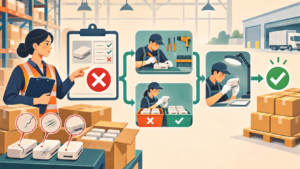

A pre-shipment inspection tells you whether finished goods are acceptable. By then, every unit has been made. A during production inspection exists for a different reason: to find a problem while most of the order is still unmade, so the outcome can still be changed rather than only measured.
Direct answer: A during production inspection (DUPRO, also called DPI or an in-process inspection) is a quality check carried out while an order is being manufactured, usually once the first finished units are available. It checks early output, materials and production progress against the specification so that defects and delays are corrected before the rest of the order is made.
What is a during production inspection?
A DUPRO is one of the four classic inspection stages — pre-production, during production, pre-shipment and container loading — that our guide to quality control stages when sourcing from China sets out. It is carried out at the factory, by an inspector working for the buyer, while the production line is running.
A note on terms: "in-process inspection" is also used for the factory’s own in-line checks by its quality staff (often called IPQC). That internal control is valuable, but it is not the same as an independent DUPRO commissioned by the buyer. When you discuss "in-process inspection" with a supplier, make clear which one you mean.
What does a DUPRO check?
A DUPRO looks at the order from several angles at once:
- Production status — how many units are finished, in progress and not started, compared with the agreed schedule.
- Materials and components — whether the materials, colours, components and accessories on the line match the specification and approved sample.
- Early finished units — a random sample of completed products checked for workmanship, appearance and function, with defects recorded by class.
- Dimensions — key measurements against stated tolerances.
- Semi-finished goods — sub-assemblies or parts at intermediate stages, where a problem can be seen before it is hidden inside the product.
- Packaging materials — whether retail boxes, labels, inserts and cartons have arrived and match approved artwork.
- Process observations — anything on the line likely to cause defects later, such as inconsistent assembly methods or poorly maintained tooling.
Defects are recorded using the same critical, major and minor classes you would use at final inspection — see our guide to how critical, major and minor defects are classified — so that results at both stages are directly comparable. Use the same product inspection checklist and golden sample at both stages; this helps prevent a failed final inspection.
When should a DUPRO be scheduled?
Timing rule: schedule a DUPRO once the first finished units are coming off the line and well before half the order is complete. Practice varies between buyers and inspection providers, but the principle is the same: late enough that representative output exists, early enough that a correction still affects most of the order.
On longer production runs, some buyers book more than one DUPRO — for example one at the start and one around mid-run.
Book a DUPRO when…
- the supplier is new to you, or this is the first production run after sample approval;
- the product is new or customised, with new moulds, materials or a modified design;
- the order value is high enough that remaking a portion would be a serious loss;
- the product has many components or assembly steps, where a defect can be hidden inside the finished unit;
- you have a fixed shipping date — a seasonal launch, a retail slot, or a payment deadline — that leaves no time for rework after a final inspection;
- previous orders from this factory had defects or delays;
- production spans a holiday or shutdown period, when staffing changes can affect quality;
- the supplier’s capacity looks tight relative to your volume and lead time.
If none of these apply, a pre-shipment inspection on its own may be enough.
DUPRO vs pre-shipment inspection
| Factor | During production inspection (DUPRO) | Pre-shipment inspection (PSI) |
|---|---|---|
| When | While production is running, after first finished units | When production is complete and most goods are packed |
| Main purpose | Detect problems early and correct the rest of the run | Decide whether to accept the finished lot |
| What is checked | Early output, materials, semi-finished goods, schedule, packaging materials | Finished, packed goods: quantity, conformity, workmanship, function, dimensions, packaging, labelling |
| Sample basis | Units available at the time; indicative of the process | Random sample from the complete lot under ISO 2859-1 |
| Result | Findings and required corrections; not a lot acceptance | Pass / fail / pending against acceptance limits |
| Effect on payment | Rarely linked to payment directly | Commonly linked to the balance payment |
| Can it replace the other? | No — it cannot judge goods not yet made | No — it cannot prevent defects already built in |
For the scope, timing and booking of the final stage, see our article on pre-shipment inspection and when to book it.
Is a DUPRO needed if I already book a PSI?
Not always. The two answer different questions. A PSI asks: "Is this finished lot acceptable?" A DUPRO asks: "Is this production run heading in the right direction?"
A PSI alone is usually adequate when:
- the product is a stable catalogue item the supplier has made many times;
- you have ordered from this factory before without significant problems;
- the order is small, or rework after a fail would be quick and cheap;
- your schedule has room for rework and a re-inspection.
A DUPRO plus a PSI is usually worth it when one or more of the "Book a DUPRO when…" conditions apply. In those cases, the DUPRO protects your timeline and the PSI protects your payment decision. A DUPRO does not replace the PSI: goods made after the DUPRO still need to be checked before you accept the lot.
How sampling works at a DUPRO
Formal acceptance sampling assumes a complete lot. At a DUPRO the lot is incomplete, so the inspector samples from what is available — finished units and, where relevant, semi-finished parts. Many buyers still use the same inspection level and acceptance values as for the final inspection, applied to the output so far, so that findings are easy to compare. The results are indicative of the process rather than a formal acceptance of goods. How sample sizes and acceptance numbers work is set out in our explainer on what AQL is and how sample sizes are chosen.
What happens when a DUPRO finds problems?
Because the order is not finished, a DUPRO finding is a chance to correct course rather than a failed lot. A sensible response:
- Confirm the facts. Review the report and photos; separate one-off defects from repeating ones.
- Tell the supplier immediately, in writing, with the affected units, defects and quantities.
- Agree what happens to units already made — rework, sorting or replacement — and what changes on the line for the remainder.
- Ask for a root cause for repeating defects, not just a promise to "be careful". A structured corrective action is the topic of our guide to corrective and preventive action with suppliers.
- Re-check — either a follow-up DUPRO or extra attention to the issue at the pre-shipment inspection.
- Review the schedule. If corrections will delay completion, decide early whether to adjust shipping bookings.
If the problem cannot be fixed and the finished lot later fails, the options for that situation — rework, re-inspection, negotiation or refusal — are covered in our article on what to do when a shipment fails inspection.
DUPRO and production follow-up
A DUPRO is a single physical check; production follow-up is the ongoing tracking of milestones — material arrival, first output, mid-run progress and packing — between the purchase order and shipment. The two support each other: regular follow-up tells you when the first output is ready, which is exactly when a DUPRO should be booked. Our guide to production follow-up with Chinese factories covers the tracking routine in detail.
Schedule pressure is a frequent trigger. If a factory’s capacity is uncertain, the checks described in our article on assessing a Chinese factory’s capability — capacity, equipment and realistic lead time — are best done before the order. A DUPRO then confirms whether the promised schedule is actually being met.
A note for Bangladesh importers
When payment is made by letter of credit, the L/C normally states a latest shipment date and an expiry date. A DUPRO that reveals a delay early gives you time to discuss options with the supplier and your bank before those dates become a problem, rather than discovering the delay at the final inspection. Any amendment is a matter between you, your bank and the supplier; check current bank procedures and charges before relying on one.
Early warning also helps with freight. If completion is going to slip, you can adjust vessel or flight bookings in advance — see our overview of routes and transit planning from China to Bangladesh.
Who can carry out a DUPRO?
The options are the same as for any inspection: your own staff, an independent third-party inspection company, or a sourcing company managing the order on your behalf. What matters most for a DUPRO is speed of follow-up — someone must take the findings to the factory and check that corrections are made.
Jingxin Sourcing carries out quality-control and product inspections in China, with staff inspection activity in Yiwu, Shenzhen and Guangzhou, and can negotiate lead times and terms with suppliers as part of managing an order.
Frequently Asked Questions
What does DUPRO stand for?
DUPRO is short for "during production" inspection. It is also written DPI or described as an in-process inspection, though the last term can also refer to a factory’s own in-line quality checks.
What percentage of production should be complete for a DUPRO?
There is no single required figure. The usual principle is to inspect once representative finished units exist and while most of the order is still to be made, so that corrections affect the majority of production.
Can a DUPRO fail?
A DUPRO reports findings rather than accepting or rejecting a lot, because the lot is not complete. Many reports still give a pass or fail indication against agreed limits, which signals whether corrective action is needed before production continues.
How much does a during production inspection cost compared with a PSI?
Costs depend on the provider, location, number of inspector-days and scope, so there is no fixed comparison. Many providers price both inspection types per inspector-day, so the real question is whether the risk reduction for your order justifies an extra visit.
Should the factory know a DUPRO is coming?
Usually yes, so that production is running and staff can assist. The inspector should still choose which units and areas to examine.
Conclusion
A DUPRO earns its place when a mistake would be expensive to discover late: a new supplier, a new or customised product, a tight shipping date, or a history of problems. For a familiar item from a proven factory with time in the schedule, a pre-shipment inspection may be enough. The useful habit is to make the decision deliberately when you place the order — not after the goods are finished and the only remaining choice is accept or argue.
To have production checked part-way through a run, as well as at the end, see how Jingxin Sourcing organises on-site inspections through its China quality control service; lead-time and order-term negotiation sits within its product sourcing service.