Two Chinese suppliers quote the same product: one at EXW, one at FOB. The EXW figure is lower, and it is tempting to stop there. For an importer sitting in Dhaka or Chattogram, though, the real question is who will do the work between the factory gate and the ship, and what that work costs.
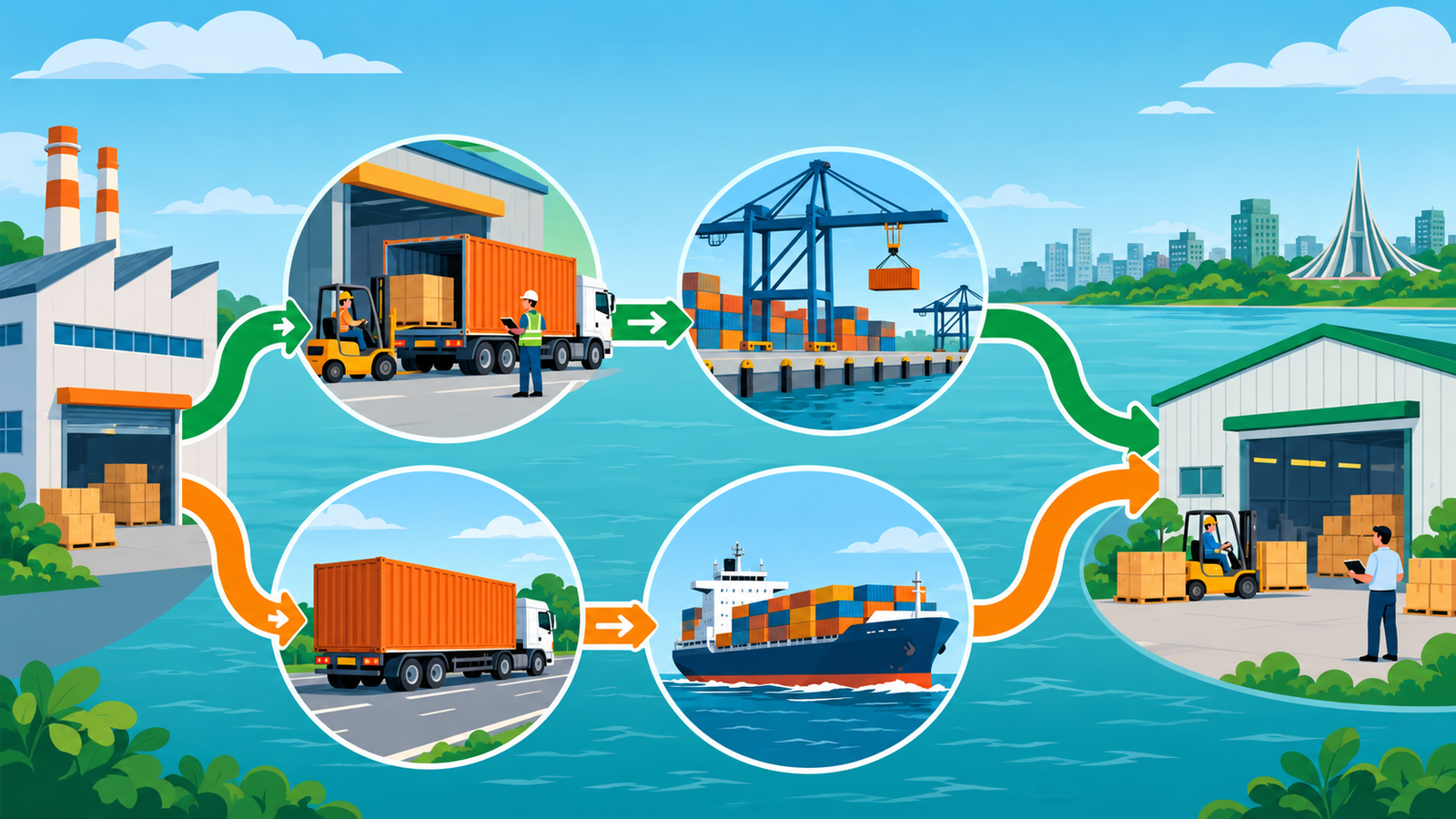
Short answer: Under EXW (Ex Works), the buyer collects goods at the supplier’s premises and handles loading, trucking, Chinese export clearance and origin port charges. Under FOB (Free On Board), the supplier does all of that and delivers the goods on board the vessel at a named Chinese port. For most Bangladesh importers without a team in China, FOB is the safer, more transparent choice for factory orders.
FOB vs EXW: the difference in one table
Both terms come from the ICC’s Incoterms® 2020 rules. If you need the basics of all the terms first, start with our Incoterms explained chart for importers.
| Point of comparison | EXW (Ex Works) | FOB (Free On Board) |
|---|---|---|
| Where the seller delivers | At its own premises (factory, warehouse, shop) | On board the vessel at a named Chinese port |
| Loading onto the first truck | Buyer (seller not obliged) | Seller |
| Trucking to the port | Buyer | Seller |
| Chinese export customs declaration | Buyer | Seller |
| Origin terminal and port handling up to loading | Buyer | Seller |
| Ocean freight | Buyer | Buyer |
| Cargo insurance | Buyer’s choice | Buyer’s choice |
| Risk passes to buyer | When goods are placed at buyer’s disposal at seller’s premises | When goods are on board the vessel |
| Transport modes | Any mode | Sea and inland waterway only |
| Quoted price looks | Lowest | Higher (includes origin work) |
| Work for an importer with no China presence | High | Low |
Is EXW cheaper than FOB?
No, not usually in total. EXW gives the lowest product price on paper, but the buyer must add every China-side cost the FOB price already includes: loading, trucking to the port, export declaration and origin handling. A buyer who has to hire a forwarder to do those tasks from abroad often pays as much as, or more than, the supplier’s own FOB margin for the same work.
EXW can work out cheaper when the buyer already has a forwarder or agent in China who handles many shipments from the same area, or when goods from several suppliers are being collected into one consolidated load.
Who handles Chinese export clearance?
Under FOB, the seller does. Under EXW, the buyer is responsible in principle.
The practical difficulty is that a Chinese export declaration is normally lodged by a party registered with China Customs, typically the manufacturer, a trading company or a licensed customs broker. A Bangladeshi buyer cannot easily act as the exporter. So under EXW, the buyer’s forwarder usually arranges a customs broker to declare the export, and sometimes asks the supplier to provide its export documents anyway. That arrangement must be agreed clearly, because the supplier has no obligation to help under a strict EXW contract.
There is also a commercial angle. Chinese manufacturers that appear as the exporter on the declaration may be able to claim export tax rebates, depending on the product and the current rules. Some suppliers reflect this in their FOB price. Ask your supplier whether the choice of term changes their price for that reason rather than assuming it does or does not.
What "FOB Shanghai" means
"FOB Shanghai" means the supplier’s price includes all costs and risks until the goods are loaded on board the ship at Shanghai port, cleared for export. From that point, the buyer pays ocean freight to Chattogram, insurance, destination charges, import duties and inland delivery.
The same logic applies to FOB Ningbo, FOB Shenzhen, FOB Guangzhou, FOB Xiamen or FOB Qingdao. What matters is that:
- the port named is the one your goods will actually leave from;
- the supplier is close enough to that port for the FOB price to be realistic;
- the term is written with its edition, for example "FOB Ningbo, Incoterms® 2020".
A Yiwu supplier quoting "FOB Shenzhen", for instance, is including a much longer truck journey than one quoting "FOB Ningbo". That affects price and timing. The routes from these ports to Bangladesh are covered in our China-to-Bangladesh shipping routes overview.
The grey zone: origin terminal charges
In theory, FOB puts origin costs up to loading on the seller. In practice, terminal handling charges at the Chinese port and documentation fees are sometimes billed to the buyer by the buyer’s forwarder or shipping line. To avoid paying twice or arguing later, write down in the purchase order which party pays:
- origin terminal handling charges (THC);
- export declaration and document fees;
- container loading or LCL warehouse receiving fees.
Freight-side surcharges and how they move are explained in the planned guide to what determines China-to-Bangladesh shipping cost.
Converting an EXW quote into an FOB-equivalent figure
To compare the two quotes fairly, rebuild the EXW price up to the same point as FOB.
- Start with the EXW unit price multiplied by order quantity.
- Add loading at the supplier’s premises if the supplier will not do it for free.
- Add trucking from the supplier to the named port.
- Add the export declaration or customs broker fee.
- Add origin port handling up to loading on board.
- Compare that total with the FOB total for the same quantity and port.
Hypothetical example: Supplier A quotes EXW Dongguan; Supplier B quotes FOB Shenzhen for the same 1,200 units of kitchen storage boxes. The buyer’s forwarder quotes separate figures for collection, export declaration and terminal handling. Only after adding those figures to Supplier A’s price can the buyer see which offer is lower. The answer can go either way; the point is that the EXW figure alone cannot be compared with the FOB figure.
This rebuild is one step of the wider method in our guide to comparing Chinese supplier quotations on equal terms.
When EXW makes sense
EXW is not a bad term; it is a term for buyers with resources in China. It makes sense when:
- You have a forwarder or agent in China that already collects from that area and handles export declarations routinely.
- You are consolidating goods from several suppliers. Each supplier hands goods over locally, and one consolidator ships the combined load. This is common for small orders from Yiwu Market and 1688 sellers.
- The supplier is a domestic seller that does not export. Many 1688 sellers sell only within China; their price is effectively a domestic delivered or ex-warehouse price. Our comparison of Alibaba vs 1688 for different buyers explains why.
- You want to control the whole chain and accept the extra risk from the factory gate.
For small multi-supplier orders, many buyers use FCA (Free Carrier) at the consolidator’s warehouse rather than pure EXW, so that each supplier still handles its own loading and hands over export-ready goods. The workflow behind that is the subject of the planned guide to freight consolidation in China.
When FOB makes sense
FOB is usually the better default when:
- You buy a full or substantial order from one factory that exports regularly.
- You have no staff in China to supervise loading, trucking or export paperwork.
- You want your own forwarder to quote and book the ocean freight, so you can see what you pay for shipping.
- Your bank or letter of credit requires a clear transport document showing goods shipped on board from a named Chinese port.
One limitation: FOB is designed for goods loaded directly onto a ship. If your full container is loaded and sealed at the factory, the supplier loses control of it long before it is on board. The ICC suggests FCA for containerised goods in that situation; many Chinese suppliers and Bangladeshi banks still use FOB, so if you keep FOB, agree in writing when the supplier’s responsibility ends.
Decision guide for Bangladesh importers
| Your situation | Better fit | Reason |
|---|---|---|
| First import, single factory, sea freight | FOB | Supplier handles China export; you control freight |
| Several small Yiwu or 1688 suppliers | EXW or FCA to consolidation warehouse | Goods must be combined before export |
| Importing under a letter of credit | FOB (or CFR) | Clear on-board transport document and named port; confirm with bank |
| You have a trusted forwarder with a China-side team | EXW can work | Forwarder can handle collection and export declaration |
| Full container sealed at factory | FCA (or FOB with written handover point) | Risk and cost split match the real handover |
| Air shipment | FCA (not FOB) | FOB applies to sea and inland waterway only |
If insurance and freight control are your main concern rather than export clearance, the next comparison to read is CIF vs FOB for imports into Bangladesh (planned), which looks at who books the freight and how this interacts with L/C terms.
Bangladesh-specific points to check
- L/C wording: if you pay by letter of credit, the Incoterm and port in the L/C must match the proforma invoice and the bill of lading. An EXW-based L/C can create practical problems with transport documents, because the supplier is not the party shipping the goods. Discuss with your bank before opening. The planned guide to L/C for China imports covers document matching in detail.
- Who appears as shipper: under FOB the supplier normally appears as shipper on the bill of lading. Under EXW it may be your forwarder or a third party. Make sure the commercial invoice, packing list and shipper details remain consistent, because your C&F agent will rely on them at Chattogram or Dhaka.
- Import clearance and duty: neither FOB nor EXW changes your import duty obligations. Duties and taxes are assessed on the declared value and HS code under current National Board of Revenue (NBR) rules; check current rates with your C&F agent or NBR.
The full import sequence, from registration to release, is set out in our Bangladesh import step-by-step guide.
Mistakes to avoid
- Comparing an EXW price with an FOB price directly. Rebuild to the same point first.
- Accepting EXW from a supplier far from any port without a forwarder already working in that area.
- Leaving the port unnamed. "FOB China" is not a usable term.
- Assuming the supplier will help with export under EXW. Put any agreed help in writing.
- Forgetting that FOB origin charges can be disputed. Name who pays THC and document fees.
Where a China-side team helps
The EXW-versus-FOB decision is mostly about who does the work in China. Jingxin Sourcing has a permanent team in China, an office in Yiwu and a head office in Dhaka. It can negotiate price, lead time and payment terms with suppliers, place Alibaba and 1688 orders on a buyer’s behalf, and help coordinate Bangladesh import documentation such as the commercial invoice, packing list and HS-code information.
If you would rather not manage the China leg yourself, review how Jingxin’s China-to-Bangladesh shipping support is set up before you decide which term to ask suppliers for. For supplier shortlisting and price negotiation, see the product sourcing service.
Frequently Asked Questions
Choosing your term
Choose the term that matches who will physically do the work in China. If that is the supplier, ask for FOB at the port your goods will actually use and fix the origin charges in writing. If it is your own forwarder or consolidator, EXW or FCA can be efficient, provided you add every China-side cost before comparing it with an FOB offer.