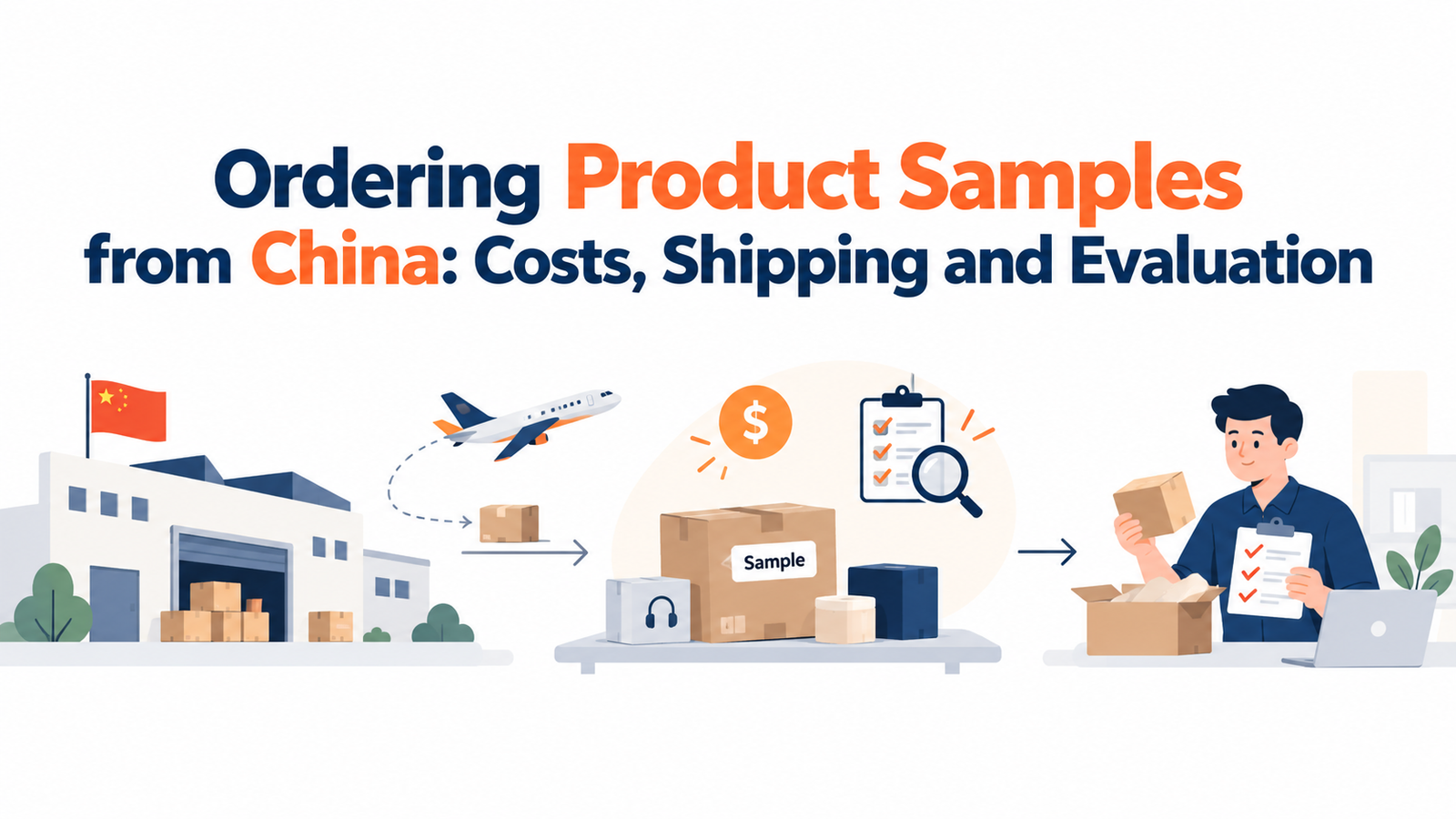
To order samples from China, send the supplier a clear specification, ask for a sample quotation (unit price, sample fee, lead time and shipping), pay the agreed amount, and evaluate the sample against your specification when it arrives. Most suppliers charge for samples, at least for freight, and a sample proves only what the supplier made that day, not what bulk production will look like.
This guide covers who normally pays, what drives sample cost, how samples travel, and a checklist for judging them. For the full workflow around supplier selection and purchasing, see our beginner’s guide to sourcing products from China.
Do Chinese suppliers charge for samples?
Usually yes, at least in part. Chinese suppliers commonly charge for the sample, for freight, or for both. Stock items are often cheaper to sample than custom items, and some suppliers refund or credit the sample fee against a confirmed bulk order. Policies vary by supplier, product and relationship, so confirm the terms in writing before paying.
What decides the answer:
- Stock item or custom item. A catalogue product already on the shelf costs the supplier little to send. A custom item may need new materials, set-up time or a hand-made prototype.
- Product value. A low-value item may be sent for freight only; an expensive or complex item is rarely free.
- Your credibility. A clear brief and a realistic order plan make a supplier more willing to spend time on you.
- Whether the fee is refundable. Some suppliers credit the sample fee against a later order. Ask rather than assume.
A free sample is not automatically a good sign, and a paid sample is not automatically a bad one. Judge the supplier on how precisely it answers your questions, not on the fee.
What affects sample cost
Sample cost is more than the item’s price. A realistic budget has four parts:
| Cost element | What it covers | Notes |
|---|---|---|
| Sample price | The item itself, often quoted above the bulk unit price | Small quantities cost more per piece to produce |
| Sample or set-up fee | Labour, materials, pattern or prototype work | More likely on custom items |
| Packaging for dispatch | Protective packing for transit | Fragile or irregular items need more |
| Shipping | Courier or other freight to your address | Depends on weight, size, destination and speed |
Two practical points. First, ask the supplier whether the sample price is the same as the bulk price or higher, and whether any fee is deducted from a later order. Second, shipping a heavy or bulky sample can cost more than the sample itself, so check weight and dimensions before you approve it.
How to order samples from China, step by step
- Write a specification. Include dimensions, materials, colours, finish, packaging and any standards or markings you need. A vague brief produces a vague sample.
- Shortlist suppliers. Ask two or three suppliers for samples rather than one, so you have a comparison. See how to compare quotations from Chinese suppliers.
- Request a sample quotation. Ask for sample price, sample fee, refund or credit terms, production time for the sample, and shipping cost.
- Agree what the sample represents. Is it a stock item, a modified item or a made-to-spec prototype? Is it made on the same line and from the same materials as bulk?
- Pay and keep records. Keep the quotation, payment confirmation and tracking number in one place.
- Receive and evaluate against the specification. Use a written checklist (below), not impressions.
- Record the decision. Approve, request changes or reject, and tell the supplier clearly which.
Samples can be found through B2B platforms or markets. If you are still choosing where to look, see how to find reliable suppliers in China.
How are samples shipped from China?
Samples are usually sent by international courier because they are small and urgent. Courier is generally faster and easier for a single parcel, while slower cargo routes can suit bulky or heavy samples. The sender, weight, dimensions, destination and product type all affect the price and the clearance requirements.
Things to settle before shipping:
- Who pays freight. Supplier, buyer, or split. State it in the quotation.
- Collect or prepaid. Freight-collect shipments can create surprise charges at delivery.
- Declared value and description. Customs documents should describe the goods accurately. Under-declaring value to reduce charges can cause delays and problems at clearance.
- Restricted or regulated goods. Batteries, liquids, food, cosmetics, electronics and some other categories can face carrier or customs restrictions. Check with the carrier before the supplier ships.
- Packaging. Samples that arrive damaged cannot be evaluated fairly.
Receiving samples in Bangladesh
For Bangladesh importers, a sample parcel is still an import and can be subject to customs handling at the destination. Rules on duty, value thresholds and documentation change over time, so check the current requirements with the National Board of Revenue (NBR) or your customs/C&F agent rather than relying on memory. For commercial imports, keep the commercial invoice and packing list for the sample shipment.
Jingxin Sourcing can help coordinate Bangladesh import documentation, including commercial invoice, packing list, HS code and customs/C&F agent coordination, through its Dhaka Head Office.
How to evaluate a sample: a checklist
A sample evaluation should answer one question: does this sample match what you asked for, and could the supplier repeat it in bulk? Use a written checklist and test the sample the way your customers will use it.
| Area | Questions to ask |
|---|---|
| Specification match | Do dimensions, weight, colour, material and finish match the specification? |
| Workmanship | Are seams, edges, joints, printing and surface finish clean and consistent? |
| Function | Does it work as intended, repeatedly, under normal use? |
| Safety and compliance | Are required markings, labels and safety features present? Are any legal or customer requirements for your market met? |
| Packaging | Is it protected for transit? Does the retail packaging match your brief? |
| Documentation | Are manuals, labels, barcodes and inserts correct and in the right language? |
| Consistency | If you ordered more than one piece, are they identical? |
| Supplier behaviour | Did the supplier answer questions, meet the sample deadline and communicate problems? |
Take photographs, measure and weigh the sample, and write down every difference from the specification. For custom products, document each revision round and approve only the final version that matches the written specification.
From sample to golden sample to inspection
A sample is the first piece you evaluate. Once you are satisfied, many buyers keep an approved sample as the reference for bulk production. This is often called a golden sample. Inspectors can then compare production goods against that reference and against the written specification.
The relationship is: sample (evaluated) → approved or golden sample (kept as the reference) → inspection (production checked against the reference and specification).
Two cautions:
- A sample can be better than production. Suppliers sometimes make samples by hand or from better materials than they will use in bulk. Ask directly whether the sample was made on the production line and from production materials.
- An approved sample should be documented: date, approved version, signatories and any permitted tolerances.
Keep the final approved sample as a documented reference for production and inspection.
Common sample mistakes
- Approving a sample on appearance only, without testing function or measuring.
- Skipping the bulk comparison. Not asking whether bulk will match the sample.
- Paying sample fees to unverified suppliers. A sample fee is still money sent to a company you may not have checked. See how to verify a Chinese supplier before you pay.
- Not recording approval. A verbal “looks good” is hard to enforce later.
- Ordering one sample. One sample from one supplier gives you nothing to compare.
- Ignoring shipping and customs costs when budgeting the sample round.
Where Jingxin Sourcing fits
Jingxin Sourcing has a Head Office in Dhaka and a China Office in Yiwu, with a permanent team in China. Its confirmed sourcing channels are Alibaba, 1688, Yiwu Market and a direct factory network, and it can place Alibaba and 1688 orders on behalf of customers. Its confirmed services also include negotiating product price, MOQ, lead time and payment terms, and supporting samples and prototypes as part of custom product development.
For buyers who want help running the sample stage, Jingxin’s China product sourcing services page describes how to start a sourcing enquiry.
FAQ
Do suppliers in China give free samples?
Sometimes, mostly for low-value stock items, but it varies. Many suppliers charge for the sample, the freight or both. Some credit the fee against a bulk order. Confirm the terms in writing before paying.
How much does it cost to order samples from China?
There is no standard price. Cost depends on the item, whether it is stock or custom, the sample fee, packaging and shipping. Ask each supplier for a sample quotation that lists these separately.
How long do samples take?
It depends on whether the item is in stock or has to be made, and on the shipping method. Ask for the sample production time and the shipping time as separate figures in the quotation.
How many samples should I order?
Order from at least two or three suppliers so you can compare. For each supplier, request enough pieces to test function and consistency, and check whether the supplier will keep a matching reference sample.
Is an approved sample a guarantee that bulk goods will match?
No. A sample shows what the supplier can make in that instance. Bulk quality has to be controlled through a written specification, an approved reference sample and inspection.
Do I need to check my samples for customs in Bangladesh?
Sample parcels can be subject to customs handling and documentation requirements. Check current rules with the National Board of Revenue or your customs/C&F agent before the supplier ships.
Once a sample is approved, the next step is the deposit: see what to ask the supplier before paying, and inspections that check bulk goods against the sample.