
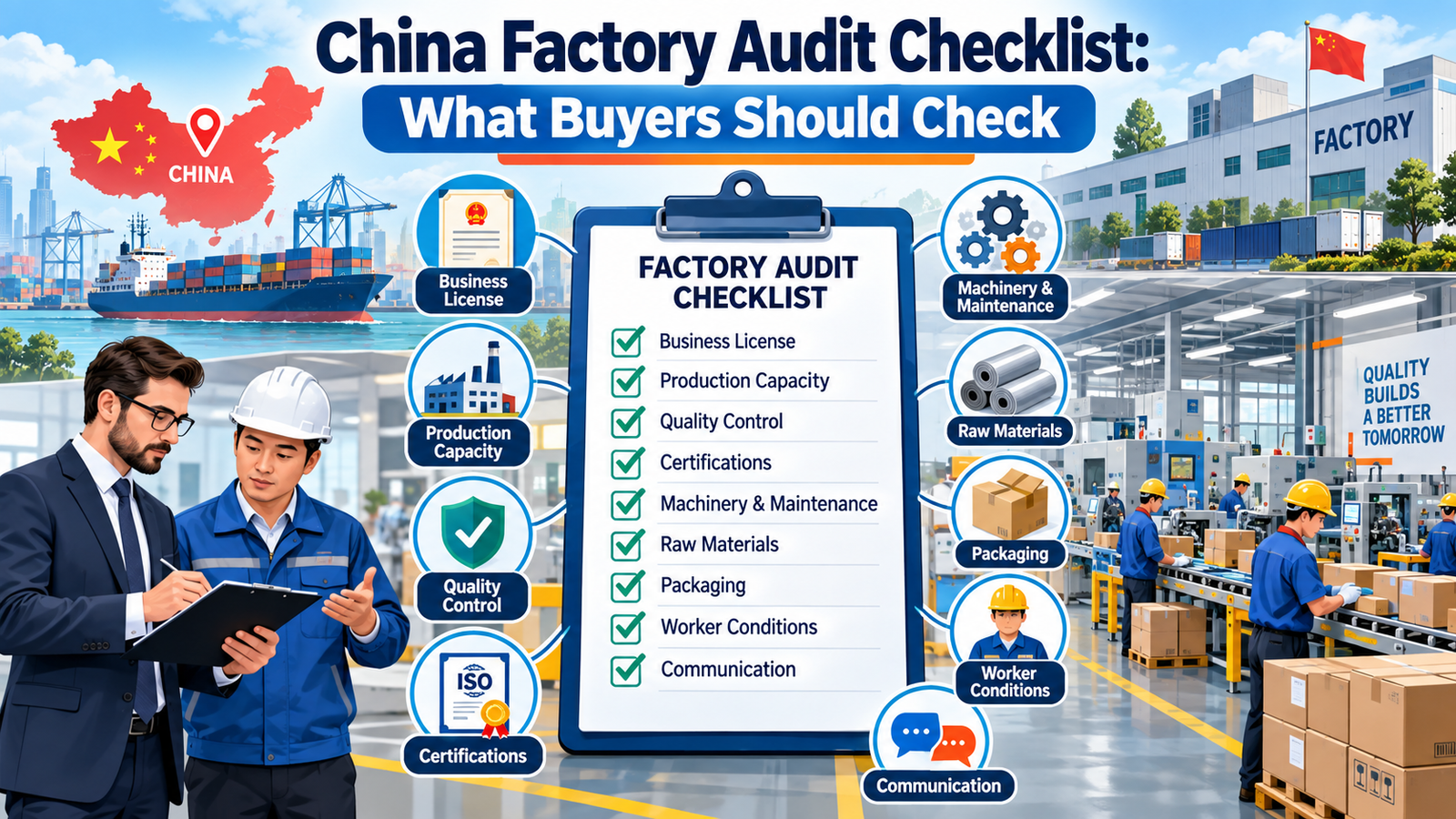
A factory audit is only as useful as the checklist behind it. A tour of a clean workshop and a framed ISO certificate tell you very little; production records, calibration logs, attendance sheets and an honest look at who actually makes each component tell you a great deal.
This China factory audit checklist covers seven areas a buyer should check on site, the evidence to collect for each, how long an audit usually takes and what to do if the factory fails. It is written for importers, procurement teams and brand owners who have already confirmed a supplier is registered and now need to know whether it can make their product properly. Auditing is one stage of a wider process, covered in our guide on how to source products from China.
What does a China factory audit check?
A China factory audit checks whether a supplier can make your product to specification, in the quantity you need, under acceptable conditions. A complete audit covers seven areas: legal status and ownership, production capacity, equipment and maintenance, materials and subcontracting, the quality management system, workforce and labour practices, and health, safety and environment. For each area, the auditor collects documents, records and photos as evidence.
- Legal status and ownership: the site belongs to the company you are contracting with.
- Production capacity: the lines, shifts and current workload can absorb your order.
- Equipment and maintenance: machines, tooling and measuring equipment are suitable and maintained.
- Materials and subcontracting: inputs are controlled and outsourced processes are disclosed.
- Quality management system: inspections, nonconforming product and corrective actions are handled in practice.
- Workforce and labour practices: headcount, skills, hours, pay and age records are consistent and lawful.
- Health, safety and environment: fire safety, machine safety, chemicals and waste are under control.
Before the audit: set the scope
An audit without a defined scope tends to become a general tour. Agree these points with the auditor and the factory beforehand:
- The product and order: specification, materials, expected annual and per-order volumes, and target delivery dates.
- The audit type: a technical or manufacturing capability audit, a social compliance audit, or both. Retail customers may require a specific social audit scheme.
- The exact site: the registered address and the production address, which are not always the same. The audit should take place where your goods will be made.
- Documents to prepare: send the factory a list (see the evidence column below) so records are available on the day rather than “with the boss”.
- Announcement: announced audits give the factory time to gather records; semi-announced audits, where only a date window is given, make it harder to stage the site.
Registry checks such as the business licence on GSXT, China’s official company register, should already be done before an audit is booked. Our Chinese supplier verification checklist covers those pre-audit document, remote and pre-payment checks in detail. The audit then confirms on site what the documents claimed.
The checklist at a glance
| Area | Key question | Evidence to collect |
|---|---|---|
| 1. Legal status and ownership | Is this the registered company, and does it control the site? | Original business licence, lease or property certificate, site signage photos |
| 2. Production capacity | Can it make your volume on time alongside existing orders? | Line list, shift pattern, output records, current order schedule |
| 3. Equipment and maintenance | Is the equipment suitable, owned and maintained? | Equipment list, maintenance logs, calibration records, tooling ownership |
| 4. Materials and subcontracting | Are inputs controlled and outsourced steps disclosed? | Approved supplier list, incoming inspection records, subcontractor list |
| 5. Quality management system | Does quality control work in practice, not just on paper? | Inspection records, nonconforming product log, corrective actions, certificates |
| 6. Workforce and labour practices | Are staffing, skills, hours, pay and ages consistent and lawful? | Headcount, sampled attendance and payroll records, ID copies, training records |
| 7. Health, safety and environment | Is the site safe and are hazards controlled? | Photos of exits and fire equipment, drill records, chemical storage, permits |
The area-by-area audit checklist
1. Legal status and ownership
The first question is whether the site in front of you belongs to the company that will sign your contract and receive your payment. Trading companies sometimes show buyers a partner’s factory, and some groups run several legal entities from one address. For how to tell a factory from a trading company, see trading company vs factory.
- The original business licence is displayed or produced, and its name and Unified Social Credit Code match the registry record and your draft contract.
- The production address matches the licence, or the factory can show a registered branch or a documented reason for the difference.
- The company owns or leases the premises, and the lease is current and in its own name.
- The business scope covers manufacturing of your product type, not only trading or services.
- Any related export or Hong Kong invoicing company is identified and its link to the factory is documented.
Evidence: photos of the licence and the gate or building signage, a copy of the lease or property certificate, and a note of any company names that differ between documents.
2. Production capacity
Capacity is where many supplier problems start. A factory can be capable and honest but still too busy, so check both maximum output and how much of it is already committed.
- Number of production lines or workstations used for your product type.
- Shift pattern and working days, checked against attendance records rather than taken verbally.
- Recent daily output records for a comparable product.
- Current and confirmed orders for the period when your order would run, including peak-season commitments.
- The bottleneck process, such as moulding, sewing, printing or curing, which limits real output more than the headline figure.
A simple way to test a capacity claim is: output per hour at the bottleneck × working hours per shift × shifts per day × working days × an efficiency factor. For example, with illustrative figures, a line producing 120 units per hour, running one 8-hour shift for 24 days at 85% efficiency, gives about 19,600 units a month. If the factory claims 50,000 units on that line, ask how.
Evidence: a line and process list, photos of the bottleneck process running, sampled output records and the factory’s order schedule for your production window.
3. Equipment and maintenance
- Key machines for your product are on site, working and owned or leased by the factory, not borrowed for the day.
- Maintenance schedules exist and recent entries match the condition of the machines.
- Measuring and test equipment (gauges, scales, testers) is labelled with a calibration or verification status and is in date.
- Moulds and tooling are identified by owner, stored properly and recorded, especially if you will pay for custom tooling.
- In-house testing equipment matches the tests the factory claims to perform.
Tooling ownership deserves particular attention, because a mould paid for by the buyer but undocumented can be hard to recover. If your product needs custom moulds, see how tooling and mould management fits into the project.
Evidence: an equipment list with photos of key machines and nameplates, sample maintenance records, calibration labels or certificates, and a tooling register.
4. Materials, suppliers and subcontracting
Many quality failures begin before production: a substituted material, an unapproved component supplier or an undisclosed subcontractor doing plating, printing or assembly.
- The factory keeps an approved list of material and component suppliers and evaluates them.
- Incoming materials are inspected and the results recorded, with rejected material segregated.
- Batches can be traced from raw material through to finished goods.
- Any process that is done outside the factory is named, along with the subcontractor.
- Material storage protects inputs from damage, moisture and mix-ups.
Evidence: the approved supplier list, a sample of incoming inspection reports, a traceability walk-through for one recent batch, and the subcontractor list.
5. Quality management system
An ISO 9001 certificate shows that a certification body found a quality management system in place at a point in time. It does not show that the system controls your product. Check the certificate with the issuing body or through IAF CertSearch, then test whether the system works on the floor.
- Inspections happen at incoming, in-process and final stages, with written criteria and recorded results.
- Nonconforming product is labelled, separated and recorded, not quietly reworked or shipped.
- Customer complaints and returns lead to corrective actions with a root cause, not only a replacement.
- Golden samples or approved references are kept at the line and inspection points.
- Quality staff are trained, and their independence from production targets is clear.
- Internal audits and management reviews take place and lead to actions.
Experienced auditors often use ISO 9001 as a reference even when a factory is not certified. The table maps the checks above to the relevant clauses of ISO 9001:2015, the edition most current certificates were issued against. ISO 9001:2026 was published on 16 September 2026 and keeps the same clause 4 to 10 structure, so certificates issued under the 2015 edition stay valid during the transition period.
| What to check | ISO 9001:2015 clause | Record to ask for |
|---|---|---|
| Measuring equipment gives reliable results | 7.1.5 Monitoring and measuring resources | Calibration or verification records |
| Staff are competent for their tasks | 7.2 Competence | Training records, skills matrix |
| Material and component suppliers are controlled | 8.4 Control of externally provided processes, products and services | Approved supplier list, supplier evaluations |
| Batches can be identified and traced | 8.5.2 Identification and traceability | Batch or lot records |
| Defective product is controlled | 8.7 Control of nonconforming outputs | Nonconforming product log, rework records |
| The system is checked internally | 9.2 Internal audit | Internal audit plan and reports |
| Management reviews performance | 9.3 Management review | Review minutes and actions |
| Problems are fixed at the root | 10.2 Nonconformity and corrective action | Corrective action reports |
Evidence: a copy of any certificate with its number and scope, sample inspection reports, the nonconforming product log, two or three recent corrective actions, and photos of inspection stations and labelled quarantine areas.
6. Workforce and labour practices
Workforce checks matter for two reasons. They confirm the factory has enough skilled people to deliver your order, and they show whether labour practices could create legal, reputational or delivery risk. China’s Labour Law sets the reference points an auditor will test against:
- Standard working hours of no more than 8 hours a day and an average of 44 hours a week (Article 36), with at least one day off a week (Article 38).
- Overtime generally no more than 1 hour a day, up to 3 hours a day for special reasons, and no more than 36 hours a month (Article 41).
- No recruitment of minors under 16 (Article 15).
- Wages not lower than the local minimum wage, which is set by regional governments (Article 48).
Checks to make on site:
- Headcount on the floor is consistent with the payroll and with the capacity claimed.
- Attendance records, payroll and production records tell the same story about hours worked.
- Personnel files hold ID copies that confirm workers’ ages, and young workers aged 16 to 17 are not on hazardous tasks.
- Workers have written employment contracts and are paid on time.
- Key operators and inspectors have documented training for their roles.
- Short, private worker interviews support what the records show.
Two sets of attendance records, timesheets that show identical hours for every worker, or payroll that cannot be produced are common warning signs.
Evidence: headcount by department, a sample of attendance and payroll records for recent months, a sample of personnel files, and notes from worker interviews.
7. Health, safety and environment
- Emergency exits are marked, unlocked and clear, and evacuation routes are posted.
- Fire extinguishers and alarms are present, in date and accessible, and fire drills are recorded.
- Machines have guards, and workers use the protective equipment their tasks require.
- Chemicals are labelled, stored separately with containment, and have safety data sheets.
- Production, storage and any dormitory areas are separated.
- Waste and wastewater are handled under the permits the site needs.
Evidence: photos of exits, fire equipment, machine guarding and chemical storage, fire drill records, and copies of relevant permits.
ISO 9001, amfori BSCI and SMETA: which framework covers what?
Buyers often see these names on supplier profiles. They are reference frameworks with different purposes, and none of them replaces a check of whether a factory can make your specific product.
| Framework | What it covers | Typical output | What it does not tell you |
|---|---|---|---|
| ISO 9001 | Quality management system requirements | Certificate from a certification body, with a defined scope | Whether the factory can make your product, or its capacity |
| amfori BSCI | Social performance across 13 areas, including fair pay, working hours, health and safety, child labour, forced labour and environment | Audit report with an overall A to E rating; valid two years for A or B, one year for C or below | Product quality or technical capability |
| Sedex SMETA | Ethical trade audit based on the ETI Base Code: labour standards and health and safety (2-pillar), plus environment and business ethics (4-pillar) | Audit report and corrective action plan shared through Sedex; SMETA 7.0 has applied since September 2024 | Product quality or technical capability |
If a supplier holds a recent BSCI or SMETA report, ask to see the full report and its corrective action plan, not only the summary page. A buyer’s own technical audit can then focus on capacity, equipment, materials and quality.
Factory audit checklist template
Copy this template into your own audit form or download the Factory Audit Checklist (.xlsx). Record each item as Yes, No or Partial, and note the evidence reference (photo number or document name) so findings can be checked later.
| Area | Check | Evidence reference | Result (Yes / No / Partial) | Notes |
|---|---|---|---|---|
| Legal | Licence name and USCC match registry and contract | |||
| Legal | Production address matches licence or branch registration | |||
| Legal | Premises owned or leased in the company’s name | |||
| Capacity | Lines and bottleneck process identified for your product | |||
| Capacity | Output records support the capacity claimed | |||
| Capacity | Order schedule leaves room for your order | |||
| Equipment | Key machines on site, working and maintained | |||
| Equipment | Measuring equipment calibrated and in date | |||
| Equipment | Tooling ownership recorded | |||
| Materials | Approved supplier list and incoming inspection records | |||
| Materials | One batch traced from material to finished goods | |||
| Materials | Subcontracted processes disclosed | |||
| Quality | Certificates checked with the issuing body | |||
| Quality | Incoming, in-process and final inspections recorded | |||
| Quality | Nonconforming product labelled and segregated | |||
| Quality | Corrective actions show root cause | |||
| Workforce | Headcount consistent with payroll and capacity | |||
| Workforce | Hours and overtime within legal limits | |||
| Workforce | Age records confirm no workers under 16 | |||
| Workforce | Pay at or above local minimum wage, paid on time | |||
| Safety | Exits clear, fire equipment in date, drills recorded | |||
| Safety | Machine guarding and protective equipment in use | |||
| Safety | Chemicals labelled and stored safely |
How long does a factory audit take?
A technical audit of a small or mid-sized factory is often completed in one day on site, with more time for large sites, several buildings or a combined quality and social scope. Social audit schemes scale with headcount: SMETA’s best practice guidance (version 6.1) suggested one auditor-day for sites with up to 100 workers, two for 101 to 500 and three for 501 to 1,000, as guidelines rather than fixed rules. Allow extra time for writing and reviewing the report, and agree the report date with your audit provider in advance.
How to read the audit result
Most audit reports grade findings by severity. Labels vary between providers, but the logic is similar:
| Finding level | Examples | Usual buyer response |
|---|---|---|
| Critical (zero tolerance) | Child or forced labour, falsified records, a site that is not the contracting company, locked emergency exits | Stop, and do not place the order unless the issue is fully resolved and verified |
| Major | No control of nonconforming product, undisclosed subcontracting, capacity far below the claim, excessive overtime | Hold the order until a corrective action plan is agreed and evidence is provided |
| Minor | Incomplete records, an expired calibration label, untidy storage | Proceed, with corrections confirmed before or during production |
What happens after a failed audit?
A failed audit is not always the end of the relationship. It is a list of problems that the factory either can or cannot fix. Work through it in this order:
- Sort the findings by severity. Separate critical issues from those that can be corrected.
- Decide on critical findings first. Falsified records, child or forced labour, or a site that is not the company you are paying are usually grounds to stop.
- Request a corrective action plan. For each finding, ask for the root cause, the action, a responsible person and a completion date.
- Verify the corrections. Accept photos and documents for minor points; arrange a follow-up audit for major ones.
- Adjust the order terms. Consider a smaller trial order, stricter specifications, and inspections during and before shipment.
- Keep alternatives open. Continue qualifying a second supplier until the first has shown sustained improvement.
Even a factory that passes needs ongoing control. An audit is a snapshot of the site; quality control inspections during and after production check the goods themselves.
Frequently asked questions
What documents should a factory prepare for an audit?
The business licence, lease or property certificate, equipment and maintenance records, calibration records, approved supplier list, inspection and nonconforming product records, corrective action reports, any certificates, and recent attendance and payroll records. Sending this list beforehand keeps the audit focused on checking, not searching.
Does an ISO 9001 certificate replace a factory audit?
No. A valid certificate shows a quality management system was assessed within its stated scope. It does not confirm capacity, equipment for your product, or how the factory performs on your order. Check the certificate with the issuing body, then audit the points that matter to your product.
Can a factory audit be done remotely?
Partly. Document reviews and live video walkthroughs can cover legal status and some quality records. Capacity, equipment condition, labour records and safety are much harder to judge on camera, so remote audits suit low-risk orders, while large, custom or regulated orders justify an on-site factory audit.
Is a factory audit the same as a product inspection?
No. A factory audit assesses the supplier: its site, systems, people and capacity, usually before you place an order. A product inspection checks the goods themselves, during production or before shipment. Most buyers need both.
How often should a supplier be re-audited?
It depends on risk and on what changes. Re-audit when the factory moves, changes ownership, adds a new product line or has repeated quality problems. Social audit schemes set their own cycles; amfori BSCI audits, for example, are valid for two years for sites rated A or B and one year for C or below.
Should the buyer or the factory choose the auditor?
The buyer. An auditor appointed and paid by the buyer reports to the buyer. Reports supplied by the factory can still be useful, but check who commissioned them, the date, the site address and the full findings.
Conclusion
A useful China factory audit checklist does more than list topics. It asks, for each of the seven areas, what evidence proves the answer: the licence and lease, output records, calibration logs, traced batches, nonconforming product records, attendance and payroll, and the condition of exits and machines. Collect that evidence before the deposit, act on what it shows, and keep checking the goods once production starts.
Jingxin Sourcing has its head office in Dhaka, Bangladesh, and an office in Yiwu, China. Need an independent view of a supplier before you order? For the paper check that should come before any audit, see how to check a Chinese business licence online. New to audits? Read what a factory audit is and which type you need and how an audit differs from a product inspection. Learn more about Jingxin Sourcing’s Factory Audits service, or see how our Quality Control service checks goods during and after production.
