
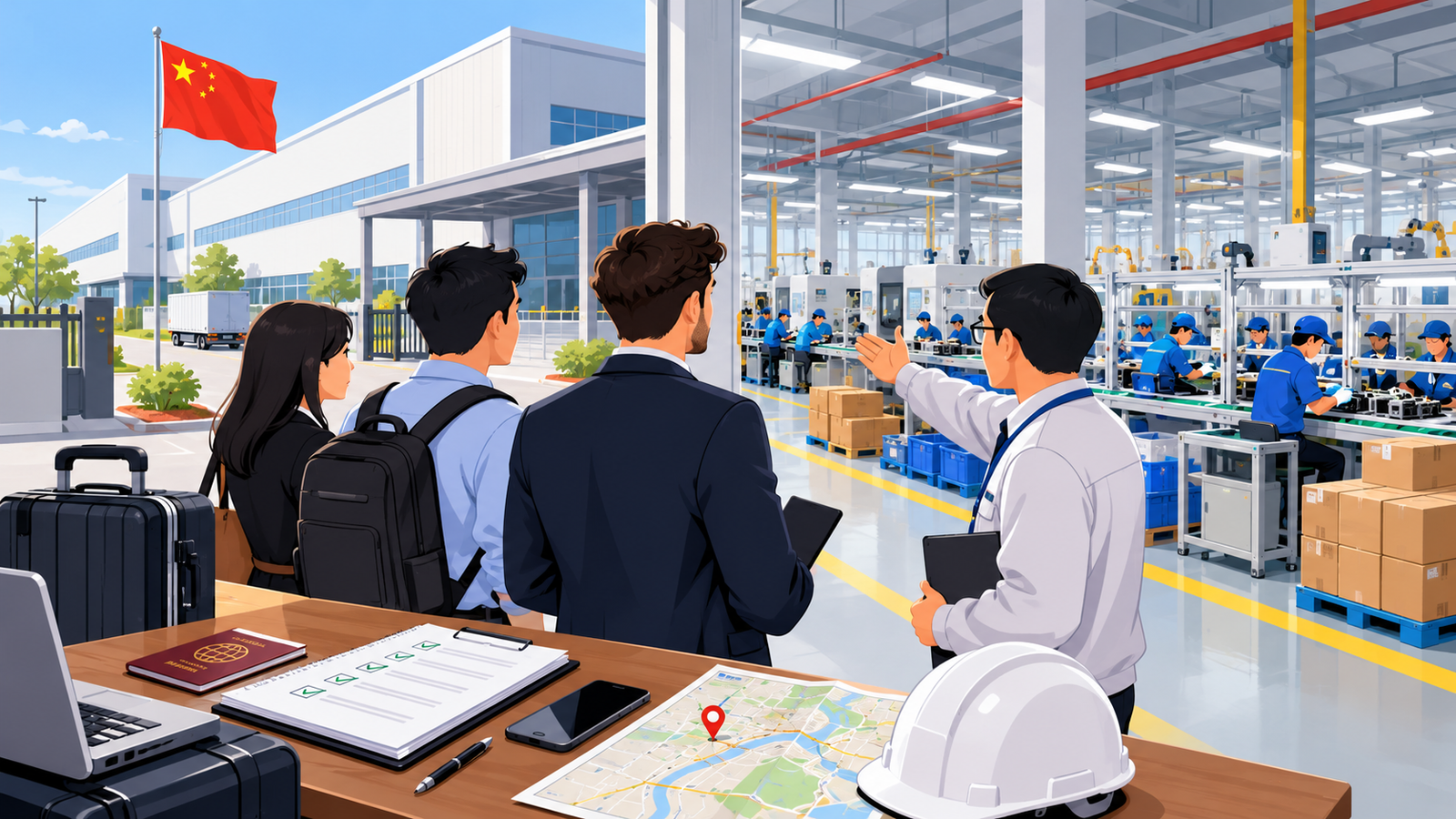
A factory visit is one of the most expensive hours in a sourcing project once flights, hotels and time away from the business are counted. Most of its value is decided before you land: by what you request in advance, which sites you choose and what you plan to inspect.
The factory visit checklist at a glance
A good visit has three stages. Before: confirm the supplier’s identity, request documents and samples, set objectives and plan the route. During: verify the site, follow your product through production, check quality controls, meet decision-makers and photograph agreed areas. After: write up findings within a day, confirm agreements in writing and close open questions before ordering.
Before the visit
1. Decide what the visit must achieve
Write down two or three questions the visit must answer: Is this a factory or a trader? Can it hold the required tolerance at your volume? Can its packing area handle your retail packaging? Clear objectives determine which areas you need to see and how long to spend on site. If a remote check may answer your main question, read our guide to when video supplier verification works and when it does not.
2. Do the desk checks first
Do not travel to a supplier you have not checked on paper. Start with our pillar on verifying a Chinese supplier before you pay. Confirm the business licence, registered address and business scope. Our guide to checking a Chinese business licence online explains the document check. Understand any difference between the registered address and the factory address before arrival.
3. Request documents in advance
- Original business licence to inspect on site.
- Certificates, with issuer and expiry date.
- Relevant production-equipment list.
- Names of production and quality leads you will meet.
- Catalogue, previous test reports and specification sheets for similar products.
- Standard price basis, MOQ, payment terms and typical lead time.
- Approved or latest sample, if one exists.
4. Send information carefully
Share drawings, specifications or a tech pack so the factory can prepare. If the design is commercially sensitive, consider an appropriate confidentiality agreement for China before sharing details.
5. Plan the route and timing
Group suppliers by manufacturing area. Yiwu and other Zhejiang cities are commonly visited together, as are Guangzhou, Shenzhen and Dongguan in Guangdong. Allow travel time to industrial zones outside city centres. If visiting wholesale markets too, our Yiwu market guide explains what buyers can source there and why many stallholders are traders rather than manufacturers. Avoid planning around Chinese New Year closures.
6. Sort travel documents and logistics
Check current visa requirements with the official Chinese embassy, consulate or visa application centre for your nationality. Confirm whether an invitation letter is required. Arrange an interpreter if needed, get the factory address in Chinese characters, check your phone and payment arrangements, and bring business cards, specifications, measuring tools and spare power.
7. Prepare your question list
Group questions by capability, quality, commercial terms and communication. Our list of questions to ask a Chinese supplier before paying a deposit is a useful starting point. Mark which answers you want to verify by observation rather than accepting a salesperson’s explanation.
During the visit
8. Verify the site on arrival
Compare the gate signage and building with the company name and address on the licence. Ask to see the original licence and note whether the site is one company’s operation or shared with others. Our comparison of trading companies and factories lists useful on-site signals.
9. Follow your product through the process
Walk the route from raw-material receipt and storage through production, quality checkpoints, packing and finished-goods storage. Note which machines would run your product, how many operators work on the line, whether steps are outsourced and whether the area is organised and adequately lit. If capacity is important, record machine count, cycle times, shifts and current workload; our guide to assessing a Chinese factory’s capability shows how to turn those observations into a realistic lead-time estimate.
10. Look at quality control in practice
- Where are incoming materials checked, and are records kept?
- Are there written in-process checks?
- Is measuring and test equipment calibrated?
- How are rejected parts marked and separated?
- How does final inspection work before packing?
For wider legal, workforce and safety checks, use our China factory audit checklist.
11. Meet the people who will run your order
Spend time with the production manager, quality lead and, for custom products, the engineer. Ask how they would handle a material shortage or failed inspection. Their answers reveal more than a sales presentation.
12. Review samples on site
Review samples with the technical team at the line where bulk production would take place. Agree changes and identify who will update the specification. Our guide to ordering and evaluating samples from China covers what to look for.
13. Photograph with permission
Ask before taking photos and respect restrictions, especially around other customers’ products. Useful records include the gate and signage, original business licence, machine nameplates, your product’s production line, material and finished-goods storage, quality stations, packing area and your sample beside the line. Label every photo with date, site and area.
14. Close the visit with a summary
Before leaving, summarise next steps, open questions, who will send what and by when. Ask the supplier to confirm the summary in writing the same day.
After the visit
15. Write up findings within 24 hours
Record observations while fresh. Separate what you saw from what you were told. A simple strong / acceptable / concern score makes suppliers easier to compare.
16. Confirm agreements in writing
Confirm specification changes, sample revisions, price basis and lead-time commitments in writing, then reflect them in the purchase contract.
17. Close open questions before committing
Chase missing documents and answers. Slow or incomplete follow-up after a visit can indicate how communication may work during production.
18. Compare and decide
Compare suppliers using the same criteria and quotations. Our method for comparing quotations from Chinese suppliers keeps the commercial comparison like-for-like.
19. Plan product inspections
A visit reduces supplier risk but does not inspect your goods. Plan product inspections for the order itself. Our explainer on the difference between a factory audit and a product inspection explains how the two fit together.
Visit or delegate?
A personal visit builds relationships and gives first-hand judgement, especially for long-term or custom-product suppliers. It also costs time and money, and an inexperienced visitor can miss issues. Many buyers visit their most important suppliers and use a China-based team for other checks. To understand the difference between a buyer’s visit and a professional assessment, see what a factory audit is.
For Bangladesh importers
Many Bangladeshi buyers combine supplier visits with wholesale markets in Yiwu or Guangzhou. Plan time for both without letting market browsing crowd out factory visits. Start visa preparation early using official channels. Keep supplier notes and documents organised for the commercial invoice, packing list and HS-code work with your C&F agent; see our guide to importing from China to Bangladesh.
Support on the ground
Jingxin Sourcing has an office in Yiwu and a permanent team in China, with staff inspection and audit activity in Yiwu, Shenzhen and Guangzhou. It carries out physical factory audits and supplier verification, including checks of licences, registration, factory-versus-trading status, address, certifications, bank account and production capability. For an on-site assessment, see our factory audit service. If you have not yet shortlisted suppliers, start with supplier search and product sourcing.
Frequently Asked Questions
What should I check during a factory visit in China?
Confirm the site matches the licence, follow your product through production, review quality checks and test equipment, note machines and staffing, ask about subcontracting, and meet production and quality leads.
What should I ask the factory to prepare?
Request the original business licence, certificates, equipment list, key contacts, catalogues, test reports, commercial terms and current samples.
Can I take photos inside a Chinese factory?
Usually with permission. Agree what may be photographed and avoid other customers’ products or confidential areas.
How many factories can I visit in one day?
It depends on distance and the depth of each visit. Plan by manufacturing cluster and leave enough time for a proper walk-through.
Is a factory visit the same as a factory audit?
No. A visit is shaped by the buyer’s objectives and relationship-building; an audit follows a defined scope and produces a structured report.
Before you book the flight
A productive supplier visit needs a clear purpose, desk checks, requested documents, a route grouped by area and a plan for what to inspect. Treat the written follow-up as part of the visit itself; without it, what you learned on the factory floor can fade before the purchase order is signed. After production, use our pre-shipment inspection guide to plan the finished-goods check.