
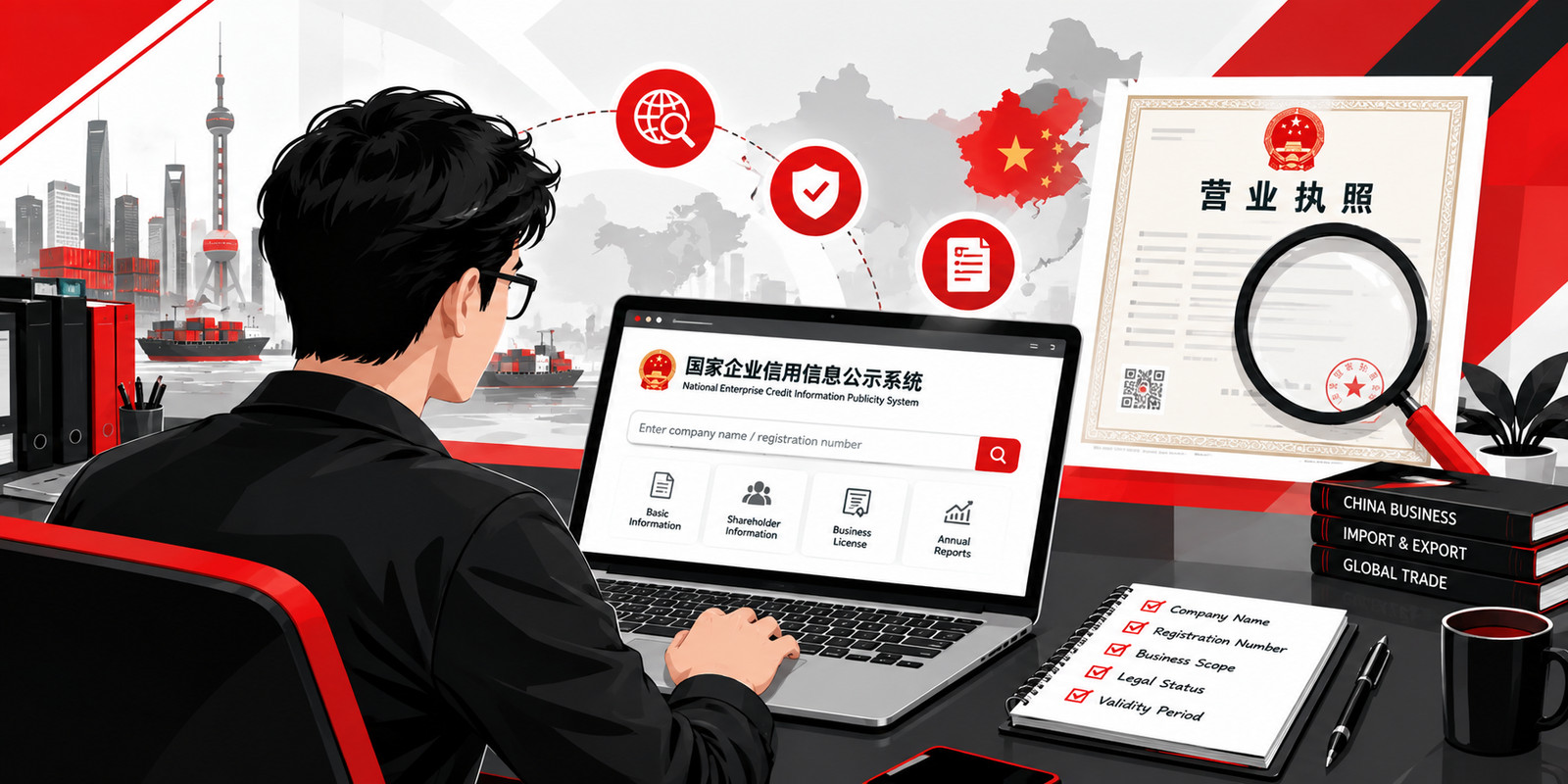
A supplier has sent you a photo of its business licence. It looks official, it has a red seal and a QR code — but an image proves very little on its own. The useful step is to take the details from that image and confirm them on China’s official company registry, which anyone can search for free.
Quick answer: Yes, you can verify a Chinese business license online. Take the 18-character Unified Social Credit Code (or the company’s full Chinese name) from the licence, search it on the National Enterprise Credit Information Publicity System (GSXT, gsxt.gov.cn), and check that the name, legal representative, address, business scope and registration status in the official record match the document and the company you are paying.
What a Chinese business licence is
A business licence (营业执照) is the registration certificate issued to a company by the local market-regulation authority. In China, company registration falls under the State Administration for Market Regulation (SAMR) and its local bureaus. The licence confirms that a legal entity exists, under a specific name, with a specific registered scope of activity.
It is the starting point of supplier verification before you pay, not the end. A valid licence tells you a company is real; it does not tell you whether that company can make your product well.
The fields on a Chinese business licence, explained
Licences issued under the current format follow a standard layout. The fields are in Chinese; this table gives the English meaning and what to look for.
| Field (Chinese) | English meaning | What to check |
|---|---|---|
| 名称 | Company name | The full registered Chinese name. English names used on websites and platforms are not registered; match on the Chinese name. |
| 统一社会信用代码 | Unified Social Credit Code (USCC) | 18 characters. Use it as the search key on GSXT. |
| 类型 | Company type | For example, limited liability company, sole proprietorship or individual business. Tells you the legal form. |
| 法定代表人 | Legal representative | The person legally authorised to act for the company. Useful for matching contracts and checking who signs. |
| 经营范围 | Business scope | The registered activities. Production wording suggests a manufacturer; sales or import-export wording suggests a trader. |
| 注册资本 | Registered capital | The capital shareholders have committed (subscribed). It is not the same as paid-in capital or cash in the bank. |
| 成立日期 | Date of establishment | How long the entity has existed. A very recent date for a supplier claiming long experience deserves a question. |
| 营业期限 | Business term | The period the company is registered to operate; often “long-term” (长期). |
| 住所 / 经营场所 | Registered address / place of business | Should be consistent with what the supplier says. Compare against the claimed production address. |
| 登记机关 | Registration authority | The local market-regulation bureau that issued the licence. |
| QR code | Link to the public record | Convenient, but type the code into GSXT yourself rather than relying on a QR code on an image you were sent. |
If you are trying to work out whether a supplier makes its products or resells them, the business-scope field is the most useful line on the page; our comparison of trading companies and manufacturers explains how to read it alongside other evidence.
What is a Unified Social Credit Code?
The Unified Social Credit Code (统一社会信用代码) is the single 18-character identifier assigned to every registered organisation in China. It replaced the older separate business registration number, organisation code and tax registration number, which is why it appears on the licence as one code. The structure is defined in the Chinese national standard GB 32100-2015.
The 18 characters break down as follows:
| Position | Meaning | Example of what you might see |
|---|---|---|
| 1 | Registration authority category | “9” for organisations registered with the market-regulation (industry and commerce) system |
| 2 | Organisation type within that category | “1” for an enterprise; “2” for an individual business (个体工商户) |
| 3–8 | Administrative-division code | Six digits identifying the province, city and district of registration |
| 9–17 | Organisation identification code | Nine characters identifying the entity |
| 18 | Check character | Calculated from the other 17 to catch typing errors |
In practice, most companies you will deal with have a code beginning “91”. A code beginning “92” indicates an individual business, which is a much smaller legal form than a company — worth knowing if the supplier describes itself as a large factory. The code uses digits and capital letters but excludes I, O, Z, S and V, so a code containing those letters has been mistyped or altered.
How to verify a Chinese business license on GSXT: 7 steps
GSXT — the National Enterprise Credit Information Publicity System (国家企业信用信息公示系统) — is China’s official public database of registered market entities. Searching it is free.
- Get a clear, complete copy of the licence. Ask for a scan or photo showing every field, and ask the supplier to confirm its full Chinese company name in text so you can copy it accurately.
- Go to the official site. Type gsxt.gov.cn into your browser rather than following a link from the supplier, and make sure the domain ends in .gov.cn. Look-alike sites exist.
- Search by the USCC or the full Chinese name. Paste the 18-character code into the search box. The site will usually ask you to complete a verification puzzle before showing results.
- Open the matching company record. Confirm that exactly one entity appears for the code and that its name matches the licence character for character.
- Compare every field. Check company type, legal representative, registered capital, date of establishment, address and business scope against the licence image. Any difference — even a changed address — is a question to raise with the supplier.
- Check registration status and listings. Look at the status (for example, 存续 or 在业 indicate an active registration; 注销 means deregistered; 吊销 means the licence was revoked). Also review the sections on administrative penalties, the list of enterprises with abnormal operations (经营异常名录) and the list of seriously illegal and dishonest enterprises (严重违法失信名单), and glance at whether annual reports have been filed.
- Record the result. Save a dated screenshot or PDF of the record. If you later pay this supplier, the beneficiary on the bank details and the seller on the proforma invoice should be this same legal entity.
The interface is mainly in Chinese. Browser translation works reasonably well for field names, but keep the Chinese company name in its original characters when searching. The site can be slow or difficult to load from outside mainland China, and its layout changes from time to time, so if a step looks different, look for the equivalent search box and record sections.
What the licence check confirms — and what it does not
| A GSXT check can confirm | A GSXT check cannot confirm |
|---|---|
| The company legally exists and is active | That the person you are emailing works for that company |
| Its registered name, address and legal representative | That production happens at the registered address |
| Its registered business scope | Production capacity, equipment or quality systems |
| Any listed penalties or abnormal-operation records | The supplier’s export experience or product compliance |
| How long the entity has been registered | The financial health of the company today |
Two gaps matter most. First, impersonation: a fraudster can send a genuine licence belonging to a real company they have no connection with. The defence is matching the licence entity to the payment beneficiary, the company email domain and contact details that you obtain independently. Second, capability: a licence says nothing about whether the factory can produce to your standard. That needs a capability assessment, a factory audit checklist applied on site, or both. Remote verification by video can narrow both gaps for lower-risk orders, though it has blind spots of its own.
Registered capital: how to read it
Registered capital is often misread as a measure of company size or cash. It is the amount shareholders have subscribed to contribute, and for many years Chinese law allowed this to be paid in over a long period, so a high figure did not necessarily mean the money had been paid. China’s revised Company Law, in force from July 2024, tightened the deadlines for contributing subscribed capital in limited liability companies. Treat registered capital as one signal among several, look for paid-in information in the company’s annual reports on GSXT where disclosed, and check current rules with a qualified adviser if capital matters to your contract.
A very low registered capital is not automatically a problem for a small trading company. It becomes a question when the supplier presents itself as a large manufacturer.
Suppliers registered in Hong Kong or elsewhere
Some Chinese suppliers invoice through a company registered in Hong Kong. Hong Kong companies are not on GSXT; they are registered with the Hong Kong Companies Registry, which has its own online search. If your invoice comes from a Hong Kong entity while production is in mainland China, ask how the two companies are related and check both registrations. The same principle applies to any offshore invoicing entity.
Commercial databases and platform verification
Third-party business-information services in China aggregate GSXT data with court records, trademark filings and other public sources. They can be easier to read, but they are not the official record, may need an account, and can lag behind changes. Use them to explore, then confirm critical details on GSXT.
B2B platforms also show their own verification badges. These reflect each platform’s criteria at the time of checking — see our Alibaba vs 1688 comparison for how each platform presents suppliers — and they do not replace your own registry lookup.
Using the licence check as a Bangladesh importer
For Bangladeshi buyers, the licence check has a practical paperwork benefit. The supplier name on the proforma invoice, the commercial invoice and the bank beneficiary details should match the registered entity, because banks handling the remittance or letter of credit, and customs at clearance, work from these documents. Our step-by-step import guide for Bangladesh shows where the proforma invoice fits; confirm current documentation requirements with your bank and C&F agent.
When an online check is not enough
An online lookup is a fast, free filter. It should be followed by deeper checks when:
- The order value is significant, or a deposit is large relative to your business.
- The product is custom, needs tooling, or is subject to safety rules.
- The supplier claims to be a factory but the scope, address or answers are inconsistent.
- The registry shows penalties, abnormal-operation listings or a very recent registration date that the supplier has not explained.
Before any of these steps, a structured set of questions to ask a supplier before paying a deposit will often surface the inconsistencies worth investigating.
At that point, an independent on-site audit confirms what the registry cannot: that the company at the registered address is the one producing your goods. Jingxin Sourcing — established in 2022, with a head office in Dhaka, an office in Yiwu and a permanent team in China — includes business licence and company registration checks in its supplier verification, together with factory address, factory vs trading-company status, certifications, bank-account verification and production capability. Learn how an on-site supplier audit in China extends the paper check, or use the Jingxin product sourcing service if you still need to find suppliers worth checking.
Frequently asked questions
Can I verify a Chinese business licence online for free?
Yes. The GSXT system at gsxt.gov.cn is the official public registry and is free to search. You need the company’s Unified Social Credit Code or its full Chinese name.
Can I search GSXT in English?
Not reliably. The system is designed in Chinese and company names are registered in Chinese characters. Search with the 18-character code, which avoids name-translation problems, and use browser translation to read the field labels.
What should I do if the licence details do not match GSXT?
Stop before paying and ask the supplier to explain the difference in writing. Minor issues such as an updated address can have innocent explanations, but a different legal representative, company name or code suggests the document has been altered or belongs to another company.
Does a valid business licence mean the supplier is safe to pay?
No. It shows the company exists and is registered. You still need to confirm that the person you deal with represents that company, that the bank account belongs to it and that it can make your product.
What does business scope show on a Chinese licence?
It lists the activities the company is registered to carry out, such as production, wholesale or import-export. It helps indicate whether a supplier is a manufacturer or a trader, but registered scope alone does not prove production happens on site.
Conclusion
A business-licence lookup takes a few minutes and turns a supplier’s image into an official record you can rely on. Read the fields, decode the credit code, confirm the entry on GSXT and keep a dated copy. If the record and the supplier’s story line up, move on to the next layer of checks; if they do not, you have found the problem before any money has moved. The next thing to watch for is the pattern of warning signs in communication, pricing and payment requests that a clean licence will not reveal.
