
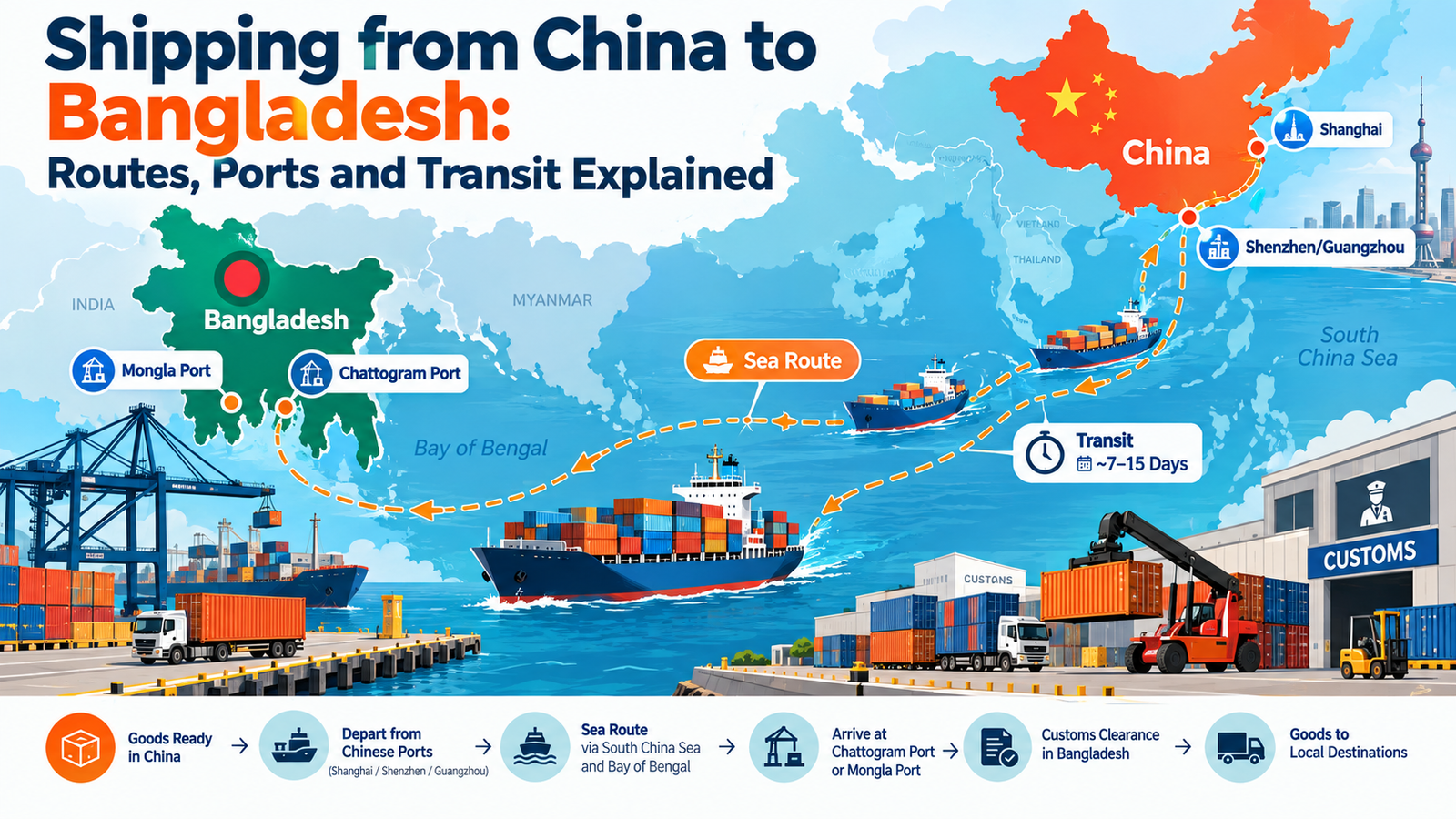
China is Bangladesh’s largest source of imports, and by 2024 it accounted for close to 60% of the containers arriving in the country. For an importer, the order is only half the plan. The other half is how the goods physically get from a factory or market in China to a warehouse in Dhaka or Chattogram, and why one shipment takes far longer than another.
This guide explains the main routes for shipping from China to Bangladesh, the ports and airports involved, the difference between direct and transhipment sea services, and the factors that actually decide transit time. For the complete registration, payment, shipping, customs and release workflow, see our step-by-step guide to importing from China to Bangladesh.
How are goods shipped from China to Bangladesh?
Most commercial cargo from China to Bangladesh travels by sea from ports such as Shanghai, Ningbo, Shenzhen or Guangzhou to Chattogram Port. Many services change ship at a hub like Singapore, Colombo or Port Klang, though some direct services now run. Urgent or high-value goods fly into Hazrat Shahjalal International Airport in Dhaka, and samples usually go by express courier.
China to Bangladesh shipping routes at a glance
| Mode | Typical route | Factors affecting time and cost |
|---|---|---|
| Sea freight, transhipment service | Chinese port (Shanghai, Ningbo, Shekou, Nansha and others) to a hub such as Singapore, Colombo, Port Klang or Tanjung Pelepas, then a feeder vessel to Chattogram | Waiting time for the feeder connection at the hub, number of port calls, season and congestion |
| Sea freight, direct service | Chinese port straight to Chattogram on a vessel small enough to enter the port | Weekly sailing frequency, which Chinese ports the service calls at, space availability |
| Air cargo | Chinese airport (for example Guangzhou or Kunming, or a hub such as Hong Kong) to Hazrat Shahjalal International Airport, Dhaka | Direct or connecting flight, chargeable weight, cargo village handling and clearance in Dhaka |
| Express courier | Integrator network from the supplier’s door to the buyer’s door in Bangladesh | Parcel size and value, courier clearance rules, last-mile delivery |
In practice, commercial cargo between the two countries moves by sea or air. There is no established direct road or rail freight route used for routine shipments.
Where do shipments leave China?
The departure port is usually the major port nearest your supplier, not a choice you make freely. Inland trucking or rail to a distant port adds time and cost, so freight forwarders route goods to the closest gateway with a good connection to Bangladesh.
| Supplier region | Usual sea gateway | Notes |
|---|---|---|
| Zhejiang (including Yiwu, Hangzhou, Ningbo) | Ningbo-Zhoushan | Third port in the world to pass 40 million TEUs in a year (December 2025) |
| Shanghai, Jiangsu | Shanghai | Wide choice of sailings on most trade lanes |
| Guangdong (Shenzhen, Dongguan, Guangzhou, Foshan) | Shenzhen (Shekou, Yantian) or Guangzhou (Nansha) | Serves the Pearl River Delta manufacturing region |
| Shandong and northern China | Qingdao, Tianjin | Often longer routing to South Asia than southern ports |
| Fujian | Xiamen | Serves Fujian manufacturers |
For air cargo, goods usually leave from Guangzhou Baiyun, Shanghai Pudong, Shenzhen Bao’an or Hong Kong. Guangzhou and Kunming had scheduled direct passenger flights to Dhaka in 2026, and those aircraft also carry cargo in the hold. Flights from other cities normally connect through a hub.
Shipping from Yiwu
Yiwu is a common starting point for buyers of small commodities, often because orders from several market suppliers are collected and packed together before export. Yiwu has no seaport. Containers normally travel by truck or by sea-rail service to Ningbo-Zhoushan Port, where they are loaded onto the vessel. Freight trains from Yiwu run to the Beilun rail terminal at Ningbo-Zhoushan, so the inland leg is short and well established.
If you are still choosing suppliers and markets, our guide on how to source products from China covers that stage before shipping.
Which port in Bangladesh receives goods from China?
Chattogram Port (also spelled Chittagong) receives almost all sea freight from China. It handled 3.3 million TEUs in the 2024–25 financial year and nearly 99% of Bangladesh’s container trade. Containers are handled at several terminals: the New Mooring Container Terminal (the largest), the General Cargo Berth, the Chattogram Container Terminal and the Patenga Container Terminal, which a Saudi operator, Red Sea Gateway Terminal, runs under a 22-year concession. A further terminal at Laldia is being developed by APM Terminals.
Mongla Port, in the southwest, handles most of the remaining container traffic and can suit cargo bound for Khulna and nearby regions. Your bill of lading should name the correct port of discharge, because moving a container between Bangladeshi ports after arrival adds cost and delay.
Air cargo arrives at Hazrat Shahjalal International Airport (DAC) in Dhaka, managed by the Civil Aviation Authority of Bangladesh. Biman Bangladesh Airlines handles cargo on the ground and moves it to the import Cargo Village for customs clearance.
Why most sea freight to Chattogram is transhipped
Chattogram is a river port with a shallow approach. Port rules limit vessels to a maximum draft of 9.5 metres and a length of 190 metres. The large container ships that sail between East Asia and Europe or the Middle East cannot enter, so their cargo for Bangladesh is unloaded at a transhipment hub and reloaded onto smaller feeder vessels for the final leg.
The main hubs for Bangladesh are Singapore, Colombo in Sri Lanka, and Port Klang and Tanjung Pelepas in Malaysia. Bangladesh’s shipping ministry notes that this dependence adds logistics cost, delivery time and pressure on supply chains. Each transfer is also an extra handling point, which is one reason export cartons need to be strong and well marked. Learn more about packaging and shipment preparation.
Direct China to Chattogram services
Because China is Bangladesh’s biggest import source, several carriers have launched direct services using vessels sized for Chattogram. In August 2024, Pacific International Lines started a weekly China Chittagong Express calling at Ningbo, Shanghai and Shekou. The carrier reported 9 to 14 days to Chattogram, compared with 20 to 22 days via Singapore or Colombo. Other lines, including MSC, have also run direct China to Chattogram services, with calls at ports such as Qingdao.
Direct services can save time, but they sail less often than the combined transhipment network and may not call at your nearest Chinese port. A weekly direct sailing you just missed can be slower than the next transhipment connection. Ask your forwarder to compare both for each shipment.
What will change with Matarbari
Bangladesh is building a deep seaport at Matarbari in Cox’s Bazar, with a 16-metre navigation channel designed for container ships of around 8,200 TEUs. In July 2026, the shipping minister said it is scheduled to begin operations by 2029. Once running, it should allow larger vessels to call directly and reduce the need for transhipment. Until then, plan around Chattogram’s limits.
How long does sea freight from China to Chattogram take?
There is no fixed answer. The time at sea is only one part of the journey, and the vessel schedule a forwarder quotes is usually port to port. The total time from the supplier’s warehouse to yours runs through these stages:
- Cargo ready and booked. Production finished, inspection passed and space booked on a sailing.
- Origin handling. Trucking to the port or a consolidation warehouse, export customs in China, and the vessel’s cargo cut-off.
- Ocean voyage. Direct to Chattogram, or to a hub with a wait for the feeder connection.
- Arrival at Chattogram. Berthing, unloading and, for shared containers, unpacking at the port.
- Customs clearance. Bill of entry, assessment, duty payment and release.
- Inland delivery. Road, rail or river transport to your warehouse.
Delays most often come from stages 1, 2 and 5 rather than the voyage. A missed cut-off pushes cargo to the next sailing, often a week later. A late inspection holds the booking, so schedule pre-shipment inspection with the sailing date in mind. At destination, incomplete documents are the usual cause of slow clearance.
Shared container (LCL) cargo usually takes longer than a full container (FCL), because it waits to be consolidated in China and unpacked at Chattogram before release.
When is air freight from China to Dhaka the better choice?
Air freight makes sense when speed matters more than freight cost: urgent replenishment, product launches, spare parts that stop a production line, or small, high-value goods such as electronics components. Because airlines charge by chargeable weight (the greater of actual weight and volume weight), bulky or heavy cargo becomes expensive quickly.
Air is fast in the air but not always on the ground. Import cargo in Dhaka goes through the airport’s Cargo Village, which has faced congestion, and in June 2026 the government ordered round-the-clock clearance after shipments were left uncleared over weekends. Have your documents ready before the flight lands.
Getting goods from Chattogram to Dhaka
Many importers are based in or around Dhaka, a long road journey from the port, so the inland leg matters. There are three options:
- Road: the most common choice. Goods are cleared at Chattogram and trucked to the warehouse.
- Rail to Kamalapur ICD: containers move by train to the inland container depot in Dhaka, where they can be cleared.
- River to Pangaon: the Pangaon Inland Container Terminal near Dhaka receives containers by inland vessel. The port authority has been trying to make it more competitive, as importers have found it more expensive than road or rail.
Decide the final destination when you book, because a container bound for an inland depot is documented differently from one cleared at the seaport.
Questions to ask your forwarder before booking
- ☐ Is this sailing direct to Chattogram or transhipped, and through which hub?
- ☐ How often does the service sail, and what is the cargo cut-off date?
- ☐ Is the quoted transit time port to port or door to door?
- ☐ For LCL, where is the cargo consolidated and how long does it wait for a full container?
- ☐ Which charges are paid in China and which at Chattogram or Dhaka?
- ☐ Which documents do you need from my supplier, and by when?
- ☐ How will I receive tracking updates, including at the transhipment hub?
Frequently asked questions
Is there direct shipping from China to Chittagong?
Yes. Since 2024 several carriers have run direct services from Chinese ports such as Ningbo, Shanghai, Shekou and Qingdao to Chattogram. Many shipments still go via Singapore, Colombo or Malaysian hubs, depending on the origin port and sailing dates. Services change, so check the current schedule when you book.
Are Chittagong and Chattogram the same port?
Yes. Chattogram is the official spelling adopted by Bangladesh in 2018. Chittagong is the older spelling and is still widely used by carriers and in shipping documents. The UN/LOCODE is BDCGP.
Can goods be shipped from China to Bangladesh by land?
Not as a regular commercial option. The two countries do not share a border, and there is no established road or rail freight route for routine cargo. Shipments go by sea, air or express courier.
Who books the shipping, the supplier or the buyer?
It depends on the Incoterm in your contract. Under FOB or FCA, the buyer books the main freight. Under CFR or CIF, the supplier books it to the named port, such as Chattogram. Agree this before the proforma invoice is issued.
Should I use a courier or cargo for small orders?
Express courier is usually simplest for samples and small parcels because it is door to door. As volume grows, air cargo or sea LCL usually becomes better value, although you then need customs clearance through an agent. Compare the full delivered cost, not just the freight.
Conclusion
Shipping from China to Bangladesh mostly means sea freight into Chattogram, shaped by one physical fact: the port’s draft limit, which makes transhipment the norm. Direct services have shortened some routes, and Matarbari may change the picture later this decade. For now, transit time depends less on distance than on your origin port, the service you choose, how well the cut-off is planned and how ready your documents are on arrival.
Jingxin Sourcing has its head office in Dhaka, Bangladesh, and an office in Yiwu, China. Need help coordinating shipments from Chinese suppliers to Bangladesh? Learn more about Jingxin Sourcing’s Shipping & Logistics service.
