A Chinese supplier’s quotation rarely says "price including everything". It says "USD X per unit, FOB Shenzhen" or "EXW Yiwu", and those three or four letters decide how much more you will pay before the goods reach your warehouse. This guide explains the terms importers meet most often and shows exactly where the seller’s job ends.
Short answer: Incoterms are standard trade rules published by the International Chamber of Commerce (ICC) that define which party, seller or buyer, pays for each part of the journey, carries the risk of loss or damage at each point, and handles export and import clearance. The current edition is Incoterms® 2020, which contains 11 rules.
What are Incoterms?
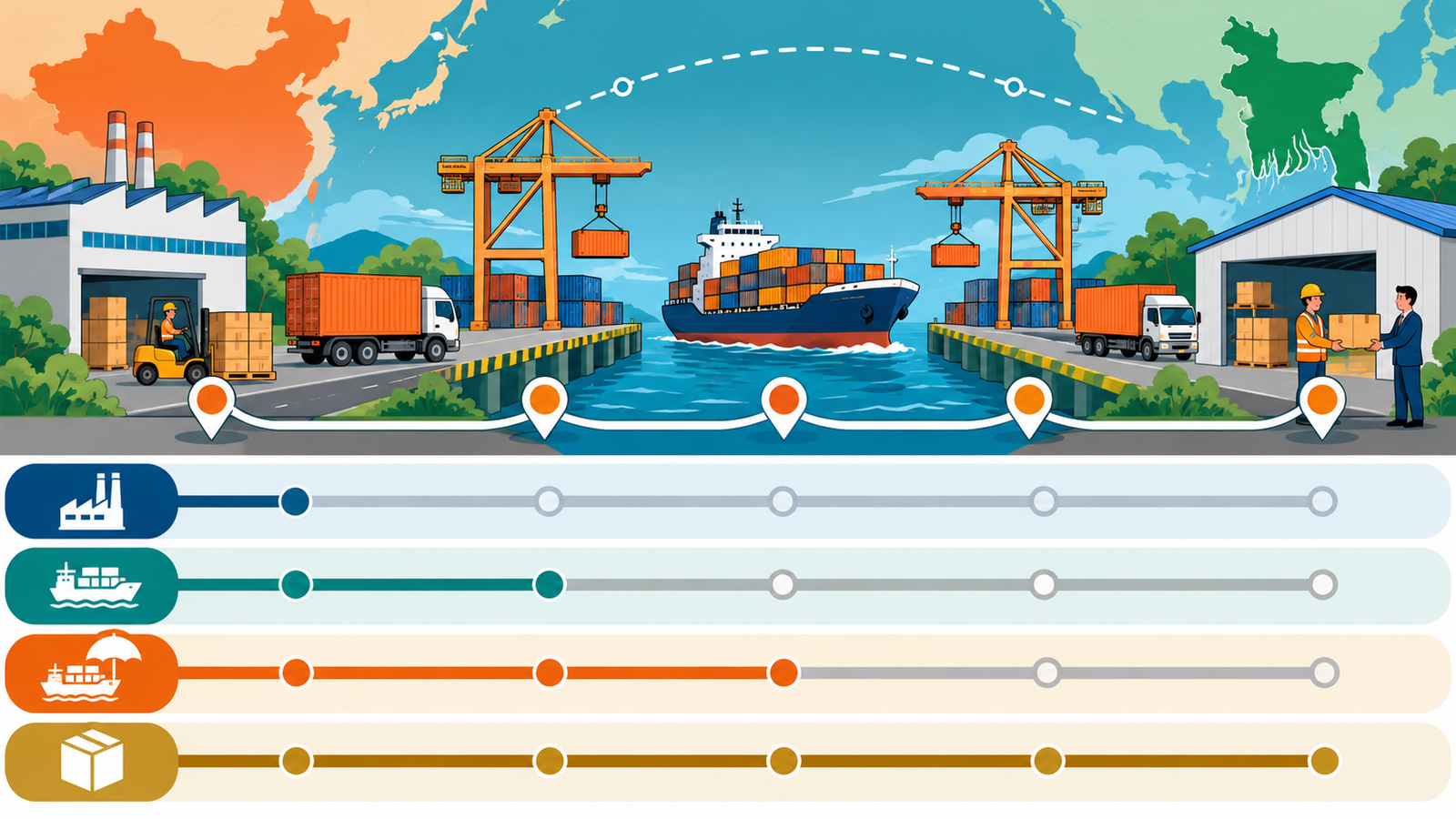
Incoterms (International Commercial Terms) are three-letter trade terms written into a sales contract or quotation. Each one allocates three things between seller and buyer:
- Costs — who pays for loading, export clearance, main freight, insurance, unloading, import clearance, duties and taxes.
- Risk — the point at which responsibility for loss or damage to the goods passes from seller to buyer.
- Tasks and documents — who books transport, who clears customs at each end, and which documents the seller must provide.
An Incoterm only works properly when it is followed by a named place and the edition, for example "FOB Ningbo, Incoterms® 2020" or "DAP Dhaka warehouse, Incoterms® 2020". "FOB China" is too vague to settle a dispute.
What Incoterms do not cover
Incoterms are often expected to do more than they do. They do not decide:
- when ownership (title) of the goods passes;
- the price, payment method or payment timing;
- what happens if the goods are defective;
- which law governs the contract or how disputes are resolved.
Those points belong in your purchase contract, purchase order or payment instrument. Payment structures are covered separately in the planned guide to paying Chinese suppliers, and quality protection belongs to your inspection plan.
Incoterms 2020: the 11 rules at a glance
The ICC groups the 2020 rules by transport mode. Four are designed only for sea and inland waterway transport; seven can be used for any mode, including air, rail, road and multimodal container shipments.
| Group | Rules | Typical China-import use |
|---|---|---|
| Any mode of transport | EXW, FCA, CPT, CIP, DAP, DPU, DDP | Air freight, courier-style shipments, containers handed over at an inland depot, door-delivery quotes |
| Sea and inland waterway only | FAS, FOB, CFR, CIF | Ocean shipments from ports such as Shanghai, Ningbo, Shenzhen or Guangzhou |
The ICC revises the rules periodically, so check the edition named in your contract. A contract that names Incoterms 2010 is still valid if both parties agree, but the obligations differ in places (insurance cover under CIP, for example).
Incoterms chart: cost, risk and paperwork under the common terms
This responsibility matrix covers the four terms Chinese suppliers quote most often for buyers: EXW, FOB, CIF and DDP, plus FCA and DAP because they are the most common alternatives.
| Responsibility | EXW | FCA | FOB | CIF | DAP | DDP |
|---|---|---|---|---|---|---|
| Packing for export | Seller | Seller | Seller | Seller | Seller | Seller |
| Loading at seller’s premises | Buyer | Seller (if delivery is at seller’s premises) | Seller | Seller | Seller | Seller |
| China export clearance | Buyer | Seller | Seller | Seller | Seller | Seller |
| Origin transport to port/airport | Buyer | Depends on named place | Seller | Seller | Seller | Seller |
| Origin terminal charges | Buyer | Usually buyer after delivery | Seller (to on board) | Seller | Seller | Seller |
| Main freight | Buyer | Buyer | Buyer | Seller | Seller | Seller |
| Cargo insurance | Not required (buyer’s choice) | Not required (buyer’s choice) | Not required (buyer’s choice) | Seller must buy minimum cover | Not required (seller carries risk) | Not required (seller carries risk) |
| Risk passes to buyer | When goods are made available at seller’s premises | When goods are handed to buyer’s carrier at named place | When goods are on board the vessel at origin port | When goods are on board the vessel at origin port | When goods arrive at named place, ready for unloading | When goods arrive at named place, ready for unloading |
| Destination terminal and unloading | Buyer | Buyer | Buyer | Buyer (unless included in seller’s freight contract) | Buyer (unloading) | Buyer (unloading) |
| Import clearance, duties and taxes | Buyer | Buyer | Buyer | Buyer | Buyer | Seller |
Two rows deserve a second look. Under CIF, the seller pays freight to your port, but risk passed to you when the goods were loaded in China. Under FOB, "seller pays to the ship" does not mean the seller pays the freight; you do.
Each common Incoterm in 40 words
EXW (Ex Works)
EXW means the seller simply makes the goods available at its own premises. The buyer arranges and pays for loading, China export clearance, all transport, insurance and import clearance. It is the lowest quoted price but places the most work and risk on the buyer.
FCA (Free Carrier)
FCA means the seller hands export-cleared goods to the carrier the buyer has nominated at a named place, such as the factory or a forwarder’s warehouse. Risk passes at that handover. The ICC treats FCA as the better choice for containerised goods than FOB.
FOB (Free On Board)
FOB means the seller clears the goods for export and loads them on board the vessel the buyer nominated at a named Chinese port. Risk passes once the goods are on board. The buyer pays ocean freight, insurance, destination charges, duties and taxes.
CFR (Cost and Freight)
CFR means the seller books and pays ocean freight to the named destination port, but risk transfers to the buyer when the goods are loaded at origin. The seller is not required to insure. The buyer handles destination charges, import clearance, duties and onward delivery.
CIF (Cost, Insurance and Freight)
CIF is CFR plus insurance. The seller pays ocean freight to the named destination port and must buy cargo insurance for the buyer’s benefit. Risk still passes at loading in China, so the buyer relies on that policy if goods are lost at sea.
DAP (Delivered at Place)
DAP means the seller arranges and pays for transport to a named destination, such as the buyer’s warehouse, and carries the risk until the goods arrive ready for unloading. The buyer unloads, clears import customs and pays duties and taxes.
DDP (Delivered Duty Paid)
DDP means the seller delivers the goods to the named destination cleared for import, with duties and taxes paid, ready for unloading. It places maximum obligation on the seller. It only works when the seller can lawfully act as importer, or arrange it, in the buyer’s country.
Who pays insurance under CIF?
Under CIF the seller buys and pays for the insurance policy, but the buyer is the party it protects, because risk has already passed to the buyer when the goods were loaded on board in China. The policy must allow the buyer (or another person with an insurable interest) to claim directly from the insurer.
Under Incoterms 2020, CIF requires only minimum cover, in line with the Institute Cargo Clauses (C) or similar clauses, for at least 110% of the contract price. Clauses (C) cover named major perils rather than "all risks", so it may not cover, for example, many types of handling damage. If you need broader cover, you can negotiate it with the seller or buy additional insurance yourself. Under CIP (the any-mode equivalent), the 2020 rules raised the default to the broader Institute Cargo Clauses (A).
Bangladesh note: many Bangladeshi banks ask for a marine insurance cover note from a locally registered insurer when an import letter of credit (L/C) is opened, and Bangladesh import rules have historically required import cargo to be insured locally. In practice, this is one reason Bangladesh L/Cs are frequently opened on CFR or FOB terms rather than CIF. Confirm the current requirement with your bank and the current Import Policy Order before you agree a term. The CIF-versus-FOB decision for Bangladesh imports is the subject of a dedicated comparison guide.
What DDP really means for importers
"DDP meaning" is one of the most searched Incoterm questions because DDP sounds like the simplest option: one price, delivered. In the Incoterms sense, DDP requires the seller to complete import clearance and pay import duties and taxes in the buyer’s country. That raises three practical issues for importers buying from China:
- Who is the importer of record? Customs authorities generally need a locally registered importer. In Bangladesh, for example, commercial imports normally require the importer to hold an Import Registration Certificate (IRC). A Chinese seller rarely holds one.
- What has actually been paid? If a supplier offers "DDP Bangladesh" but uses a third party to clear goods, you may have no documents in your own name showing that duty and VAT were paid. That can matter for your accounts, VAT records and any later customs query.
- Is it really DDP? Many "door-to-door" or "DDP" offers on marketplaces are freight-forwarder packages rather than Incoterms DDP. Ask the seller to confirm the named place, the edition and who appears as importer on the customs declaration.
DDP can work when the seller, or its logistics partner, can lawfully clear goods into your country. For many commercial importers, especially those who need clear import records, DAP or a "C" term with buyer-side clearance is more transparent.
Which Incoterm is best for beginners?
There is no single best Incoterm. The right one depends on how much of the logistics chain you can control. For most first-time importers buying from a Chinese factory by sea, FOB at a named Chinese port is a sensible starting point, for three reasons:
- the supplier handles China export clearance, which a foreign buyer usually cannot do easily;
- you choose and pay your own forwarder, so you can see and compare the freight cost;
- risk passes at a clear, well-understood point.
EXW looks cheaper on paper but leaves you responsible for loading and Chinese export formalities. CIF and CFR look convenient but hide the freight cost inside the product price and leave destination charges for you to discover on arrival. DDP can be useful for small, simple shipments where the seller’s logistics partner can genuinely clear goods in your country.
| Your situation | Terms worth considering | Why |
|---|---|---|
| First sea order, you have or can appoint a forwarder | FOB (or FCA for containers) | Supplier clears export; you control freight cost and booking |
| Buying from multiple Yiwu or 1688 suppliers to consolidate | EXW or FCA to a consolidation warehouse | Each supplier delivers locally; one forwarder ships the combined load |
| Bank L/C requires local insurance | FOB or CFR | Insurance arranged in the buyer’s country |
| Small air or express shipment, no local forwarder | DAP, or DDP only if lawful importer status is clear | Seller-side logistics to your door, with clearance roles stated |
| Supplier has strong freight contracts and you want one invoice | CFR or CIF | Seller books freight; check destination charges carefully |
The full trade-off between the two most common origin terms is covered in the upcoming comparison of FOB vs EXW for Bangladesh importers.
How Incoterms change a China supplier’s price
The same product can be quoted under several terms, and the numbers are not comparable until you add what each term leaves out. Here is how the cost build-up moves along the chain.
Hypothetical example: a buyer receives two quotes for the same LED desk lamp. Supplier A quotes EXW Yiwu; Supplier B quotes FOB Ningbo. Supplier A’s unit price is lower, but the buyer must add trucking from Yiwu to the port, loading, export customs declaration and origin terminal charges. Once those are added, the gap may close or reverse. Only then are the two quotes comparable on product cost.
This normalisation step is the core of our method for comparing quotations from Chinese suppliers like for like. Freight itself is then a separate calculation; what drives it (mode, volume, surcharges, origin and destination charges) is explained in the planned guide to China to Bangladesh shipping cost, and the full cost through to your warehouse belongs in a landed-cost calculation.
Cost elements that are easy to miss
- Origin local charges under EXW and FCA: trucking, loading, export declaration, terminal handling.
- Destination local charges under CFR and CIF: destination terminal handling, delivery order fees and port storage if clearance is slow.
- Insurance top-up when CIF minimum cover is not enough for your goods.
- Duties and taxes, which remain the buyer’s cost under every term except DDP.
Incoterms, documents and payment
The Incoterm you agree should match every other document in the deal: the proforma invoice, the purchase contract, the commercial invoice, the bill of lading and, if used, the letter of credit. A mismatch, for example a contract on FOB but an L/C requiring an insurance certificate from the seller, is a common source of delays and bank discrepancies.
Under the "C" terms, the seller must provide the usual transport document; under CIF it must also provide the insurance document. Under FOB and EXW, the transport document comes from the buyer’s carrier, so the buyer’s forwarder must work closely with the supplier. The planned shipping documents checklist will list each document and who issues it.
Incoterms and risk: what happens if goods are damaged?
Risk transfer decides who absorbs, or claims for, loss or damage after a given point. It does not decide whether the supplier made the goods correctly.
- If cartons are crushed on the ship under FOB or CIF, the risk was already yours; you claim on the cargo insurance policy.
- If goods are defective because of a production fault, that is a quality issue under your contract, whatever Incoterm applies. This is why a pre-shipment inspection before goods leave the factory matters most under EXW, FCA and FOB: once risk passes, your leverage over the supplier depends on contract terms, not the Incoterm.
Common mistakes with Incoterms in China orders
- Leaving out the named place. "FOB" alone could mean any port. Name the port or address.
- Using FOB for containers loaded inland. If the container is sealed at the factory or a depot, the seller loses control long before the goods are on board. The ICC suggests FCA in that case.
- Assuming CIF includes destination charges. It usually does not.
- Accepting DDP without asking who is the importer. Clarify importer of record and documents in your name.
- Changing the Incoterm late. A switch from FOB to EXW after the order is placed changes cost and export responsibility. Fix the term before deposit; it is one of the points worth settling in the questions to ask a Chinese supplier before paying a deposit.
Incoterms for Bangladesh importers
For Bangladeshi importers, the Incoterm interacts with three local realities:
- Bank and L/C practice: the L/C typically names the Incoterm and the documents the supplier must present. Insurance arrangements in particular should be confirmed with your bank.
- Ports and airports: most sea cargo from China arrives at Chattogram; air cargo usually lands at Dhaka. Your named place should reflect where clearance will happen. Routes are explained in our overview of shipping routes and ports from China to Bangladesh.
- Customs clearance: under every term except DDP, you or your clearing and forwarding (C&F) agent clear the goods at destination. Duties depend on the HS code, so check current rates with the National Board of Revenue (NBR) or your C&F agent rather than relying on old figures.
The wider import sequence, from IRC and payment to release, is laid out in our step-by-step guide to importing from China to Bangladesh.
Getting help with terms and shipments
Incoterms are simple once you see them as a split of cost, risk and paperwork, but the practical work sits around them: matching documents, booking freight and preparing for clearance. Jingxin Sourcing can negotiate price, lead time and payment terms with suppliers and help coordinate Bangladesh import documentation, including the commercial invoice, packing list, HS-code information and work with your customs/C&F agent.
If you want one team to handle the China-to-Bangladesh leg from supplier handover onward, see how Jingxin’s shipping and logistics coordination works. If you are still choosing suppliers, the China product sourcing service covers the steps before the Incoterm is agreed.
Frequently Asked Questions
The practical takeaway
Treat every Incoterm on a quotation as an incomplete price. Write down where risk passes, which costs are still yours, and which customs steps fall on you, then compare suppliers only after adding those items. If you are new to importing, start with FOB or FCA at a named Chinese location, keep insurance and clearance in your own hands, and only move to DDP when the importer-of-record question has a clear, documented answer.