
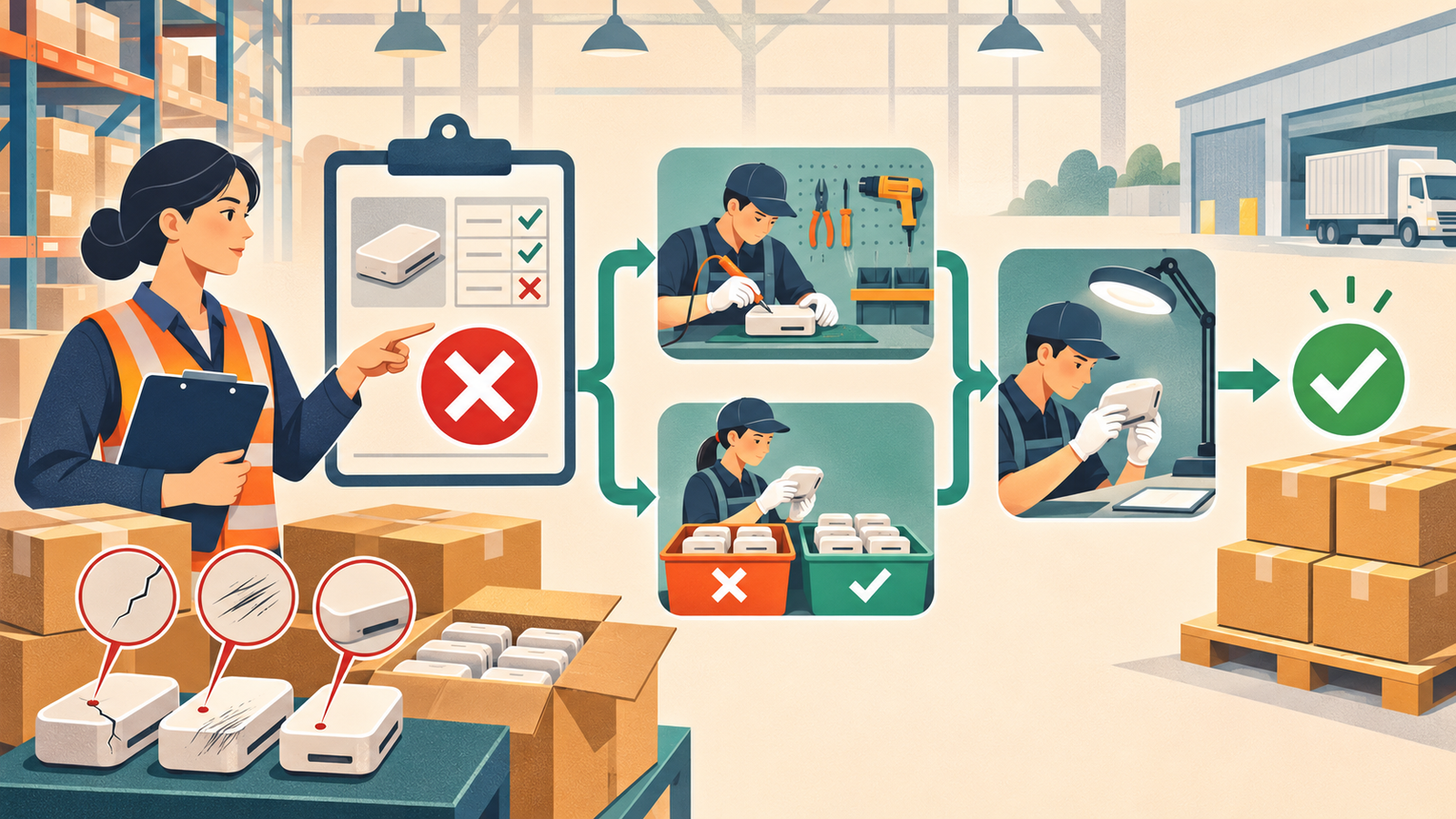
An inspection report marked “fail” is not a verdict on the whole order. It is a signal that the sample drawn from your goods exceeded the limits you agreed, and it arrives while the goods are still at the factory, which is exactly when you have the most options.
What should you do when an order fails inspection? Hold the balance payment, confirm what failed and why, and ask the factory for a written explanation. Then choose a remedy (rework, 100% sorting, replacement, a negotiated discount or refusal) based on defect severity, your deadline and your contract, and book a re-inspection before anything ships.
This guide sets out the immediate steps, the options and their trade-offs, a decision tree, and the contract points that decide who pays.
The first steps after a failed inspection
- Do not pay the balance or release shipment. Your leverage is highest while money and goods are still in your control.
- Read the report properly. Identify which defects caused the fail, their classification and how far the result was over the limit. Our upcoming guide to reading an inspection report explains each section.
- Check the evidence. Ask for photos of each defect type, measurements and, if needed, a defective unit or video. Compare against your sealed golden sample and specification.
- Send the report to the factory and ask for its response in writing. Ask what caused the defects, how many units are likely affected and what it proposes.
- Choose a remedy using the decision tree below.
- Agree costs and dates in writing: who pays for rework, sorting and re-inspection, and the new ready date.
- Book a re-inspection once the factory confirms the remedy is complete.
- Request a corrective action so the same defect does not return on the next order.
Understand what “failed” actually means
Inspection results are usually based on statistical sampling under ISO 2859-1, with an Acceptable Quality Limit (AQL) set for each defect class. A “fail” usually means one of these:
- Too many major or minor defects in the sample compared with the accept/reject numbers for your AQL. See how AQL sample sizes and limits work.
- Any critical defect, which many buyers set at zero tolerance. The distinction between critical, major and minor defects drives most of the decisions below.
- A failed test or check, such as a function test, measurement, carton drop test or barcode scan.
- Quantity or packaging problems, such as goods not finished, wrong carton marks or missing labels.
Some reports show “pending” rather than “fail”. That usually means the inspector could not decide without the buyer, for example because the specification was unclear or a reference sample was missing. Treat “pending” as a question to answer quickly, not a pass.
Remember that sampling describes probability. A fail does not mean every unit is bad; it means the lot as a whole is unlikely to meet your limit, which is why sorting or rework is often possible.
Your options after a failed inspection
| Option | What it involves | When it fits | Main risk |
|---|---|---|---|
| Rework | Factory repairs or reprocesses affected units (re-stitching, cleaning, re-labelling, re-packing) | Defects are cosmetic or correctable without weakening the product | Reworked units may show signs of repair; delays |
| 100% sorting | Factory checks every unit and removes defectives | Defects are easy to see and separate; the lot is mixed | Sorting fatigue lets defects through; shortfall in quantity |
| Replacement / remake | Factory produces new units to replace rejected ones | Defects cannot be repaired, or materials are wrong | Longest delay; factory may resist cost |
| Re-inspection | A new inspection after rework or sorting | Almost always, after any remedy | Extra cost and time |
| Accept with a discount | Ship as-is with a price reduction or credit | Defects are minor, don’t affect function or safety, and you can still sell the goods | Customer complaints and returns; discount may not cover them |
| Accept as-is (concession) | Ship without changes | Only when the “defect” turns out to be within your real requirements, or the spec was wrong | Sets a precedent for future orders |
| Partial shipment | Ship conforming units now, the rest after remedy | Deadline matters and good units can be separated | Two shipments and extra freight |
| Refuse / cancel | Reject the order and seek a refund under the contract | Critical defects that cannot be fixed, or repeated failure after remedy | Refund recovery is hard if you prepaid in full |
Rework and sorting followed by re-inspection are the most common outcomes. Refusal is a last resort and is most realistic when you still hold a meaningful balance.
A decision tree for a failed inspection
Work through these questions in order:
- Is there a critical or safety-related defect?
- Yes → do not accept as-is or at a discount. Go to question 2.
- No → go to question 3.
- Can the critical defect be reliably detected and removed or repaired in every unit?
- Yes → 100% sorting or rework, then a full re-inspection with zero tolerance for that defect.
- No → replacement or remake; if the factory cannot or will not, refuse and pursue a refund under the contract.
- Is the failure caused by one identifiable, correctable issue? (for example, one stitching station, one batch of labels)
- Yes → targeted rework and re-inspection.
- No, defects are scattered → 100% sorting plus a root-cause request before re-inspection.
- Does your deadline allow the remedy?
- Yes → complete the remedy and re-inspect before shipping.
- No → consider a partial shipment of conforming units, or accept minor defects with a written discount, never critical ones.
- Can you still sell the goods to your customers at the quality found?
- Yes, with minor defects only → accepting with a discount may be commercially sensible.
- No → rework, replace or refuse.
- Has this factory already failed once on this order?
- Yes → escalate: tighter re-inspection, consider whether to continue with this supplier, and require a formal corrective action plan.
Who pays for re-inspection?
It depends on what you agreed. A common commercial practice is:
- The buyer pays for the first inspection, as part of their own quality-control cost.
- The supplier pays for re-inspection when the first inspection failed because of the supplier’s workmanship or materials, often by deducting the cost from the balance payment.
- Rework, sorting and replacement costs fall on the supplier where goods do not meet the agreed specification.
None of this is automatic. If your purchase order or contract does not mention inspection, re-inspection costs or the right to reject, you will be negotiating from scratch. Factories are more willing to accept re-inspection costs when the specification and AQL levels were in writing before production. If the fail was caused by an unclear or changed requirement on your side, expect to share the cost.
Can you refuse the goods?
In principle, if goods do not meet the agreed specification, the buyer can usually refuse them under the contract. In practice, your ability to enforce that depends on three things:
- Your payment position. If you paid a deposit and still hold the balance, refusing or renegotiating is realistic. If you paid 100% upfront, recovering money from an overseas supplier can be slow and uncertain. How deposit and balance structures affect this is covered in our planned guide to paying Chinese suppliers.
- Your written terms. A clear specification, agreed AQL levels and an inspection clause make a refusal defensible. Vague requirements make it a dispute.
- The platform or payment method. If you ordered through a marketplace with buyer-protection or trade-assurance terms, those platform rules usually set the dispute procedure and deadlines. Check the current platform policy before shipping is confirmed.
Incoterms® 2020 do not settle this question: they allocate delivery, costs and risk between buyer and seller, not acceptance of quality or transfer of ownership. This article is general guidance, not legal advice; for significant amounts, take advice from a qualified professional before cancelling.
Negotiating with the factory after a fail
A failed inspection is a negotiation, but a short one. Keep it factual:
- Lead with the report. Share the photos, defect counts and the clauses or specification points that were not met.
- Ask for the factory’s proposal first. Factories often offer rework because it is cheaper than a remake.
- Fix the timeline. Agree a date when rework is finished and the goods are ready for re-inspection.
- Put cost allocation in writing. Rework, sorting, re-inspection, any extra freight and the impact on the shipment date.
- Keep a discount separate from a remedy. A discount on goods that still contain critical defects does not solve the problem; it transfers it to your customers.
Our upcoming guide on negotiating with Chinese suppliers covers wider levers such as payment terms and lead time.
Contract points that make a failed inspection easier to handle
Not legal advice, but these points are commonly included in purchase orders with Chinese suppliers:
- The product specification and approved golden sample are the acceptance standard.
- Inspection level and AQL values per defect class, with critical defects at zero.
- The buyer’s right to inspect before balance payment, and balance release only after a pass.
- Who pays for re-inspection after a fail, and how it is deducted.
- Maximum time allowed for rework, and what happens if the new ready date is missed.
- The buyer’s right to reject or cancel if a re-inspection also fails.
If you are about to place a deposit, our list of questions to ask a Chinese supplier before paying a deposit helps you raise these points early.
Re-inspection: what to check the second time
A re-inspection should not simply repeat the first one. Ask the inspector to:
- draw a fresh random sample from the whole lot, not only the reworked cartons;
- pay extra attention to the defect types that caused the fail;
- confirm that reworked units do not show new damage from the repair;
- recount quantity, because sorting often leaves the order short;
- recheck packaging and carton marks if cartons were opened.
Stop it happening again
One failed inspection is an incident. Two is a pattern. After the immediate issue is settled:
- ask the factory for a root-cause explanation and a corrective and preventive action plan; a dedicated guide on supplier corrective action and CAPA is coming next in this series;
- add a during-production inspection on the next order so problems surface while they can still be fixed cheaply;
- tighten the specification where the inspector found ambiguity.
Bangladesh importers: points to check
If you import into Bangladesh, a delay from rework affects more than the factory schedule. Check any shipment-date and expiry dates in your letter of credit with your bank, because amendments take time; confirm whether an inspection certificate is one of the required documents; and tell your freight forwarder and C&F agent about revised ready dates early. Rules and bank requirements change, so confirm current practice with your bank and agent rather than relying on a previous shipment.
Getting support with a failed order
When an order fails, the hardest part is often moving the factory from discussion to action within a few days. Jingxin Sourcing’s inspection and re-inspection support in China covers product and packaging checks in Yiwu, Shenzhen and Guangzhou, and our product sourcing team can negotiate price, lead time and payment terms with suppliers on your behalf. For how failure fits into the full inspection sequence, see our guide to QC stages when sourcing from China and the pre-shipment inspection explainer.
Frequently Asked Questions
What happens if my order fails a pre-shipment inspection?
The goods stay at the factory while you decide on a remedy. Usually the factory reworks or sorts the goods, then a re-inspection is carried out. Shipment and balance payment normally wait until the re-inspection passes or you agree a different outcome in writing.
Who pays for re-inspection after a failed inspection?
Commonly the supplier, when the failure was caused by its workmanship or materials, but only if your contract or purchase order says so or the supplier agrees. If requirements were unclear or changed by the buyer, the cost is often shared.
Can I refuse goods that failed inspection?
Usually yes, if the goods do not meet the agreed specification, but enforcing it depends on your payment position, your written terms and any platform rules. Refusal is easier when you still hold the balance payment.
Should I accept a discount instead of rework?
Only for minor defects that do not affect safety or function, and only if you can still sell the goods. Never accept a discount on critical defects.
How long does rework take?
It depends on the defect, the order size and the factory’s schedule, so ask the factory for a written ready date and plan the re-inspection around it.
The takeaway
A failed inspection gives you a choice that disappears once goods are loaded. Use it: keep the balance, confirm the facts, pick the remedy that matches the severity of the defect, put costs and dates in writing, and re-inspect. Then fix the cause so the next order passes first time.
Need an independent check before shipment? See Jingxin Sourcing’s quality-control support in China.