
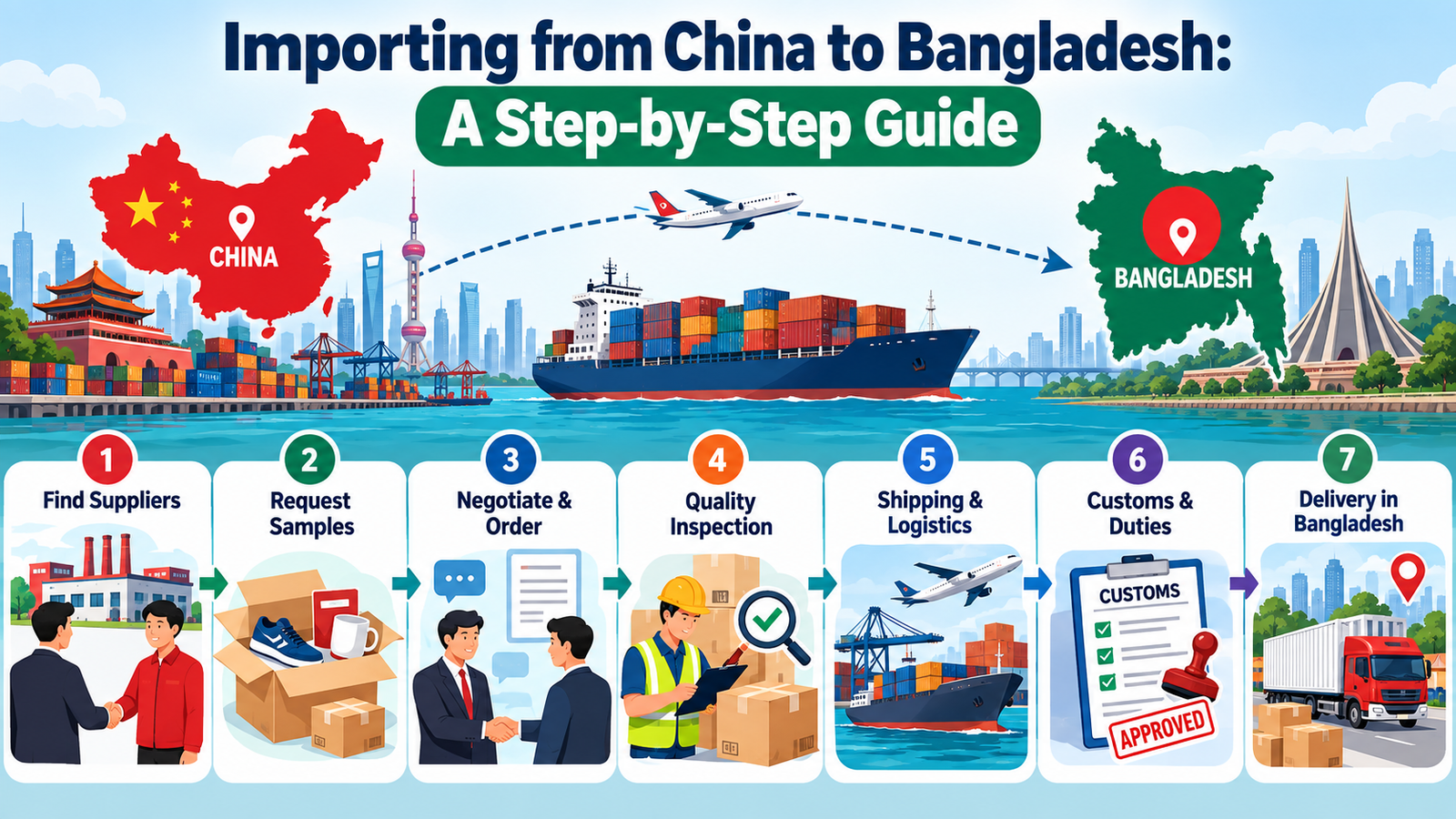
China is the starting point for a large share of the goods Bangladeshi businesses sell, use or process, from consumer products and packaging to machinery parts and raw materials. Buying from a Chinese supplier is only half the job. To import from China to Bangladesh legally and without costly delays, you also need the right registrations, a bank-approved payment route, correct shipping documents and a clean customs declaration.
This guide sets out the process in nine steps, with what each step should produce, who is responsible for what, and the rules that changed in 2026. It is written for traders, retailers, ecommerce sellers and procurement teams in Bangladesh placing commercial orders with Chinese suppliers.
How do you import from China to Bangladesh?
To import from China to Bangladesh, register your business (trade licence, TIN, BIN and an Import Registration Certificate from the CCI&E), confirm the product’s HS code and any permits, verify a Chinese supplier, and pay through an authorised dealer bank by L/C or a bank-registered contract. Then ship by sea or air, and have a C&F agent clear the goods through customs.
Regulations in this guide reflect the Import Policy Order 2026–2029 and Bangladesh Bank rules as of October 2026. Import rules change, so confirm current requirements with your bank and C&F agent before each order.
What changed for China imports in 2026
The Ministry of Commerce published the Import Policy Order 2026–2029 in the Bangladesh Gazette on 24 August 2026. It applies until 31 December 2029. For importers buying from China, the most practical change concerns payment.
Under the previous order, commercial importers could import without a letter of credit (L/C) only up to US$500,000 a year. The new order removes that value ceiling. Bangladesh Bank’s implementing guidance, issued on 13 September 2026, confirms that permissible goods for industrial and commercial use can be imported through purchase or sale contracts without opening an L/C, regardless of value, as long as foreign exchange rules are followed.
That gives smaller importers more flexibility. It does not remove the bank: every foreign payment still goes through an authorised dealer (AD) bank, which checks the documents and reports the transaction.
Importing from China to Bangladesh in 9 steps
Each step below ends with a clear deliverable. If you cannot produce it, do not move to the next step.
- Check the product’s import status. Deliverable: confirmed 8-digit HS code and a list of any permits or certificates needed.
- Complete your business registrations. Deliverable: trade licence, TIN, BIN and a valid IRC.
- Find and verify a Chinese supplier. Deliverable: a verified supplier with an approved sample.
- Agree terms and get a proforma invoice. Deliverable: a proforma invoice with full description, HS code, unit price and Incoterm.
- Arrange payment through your bank. Deliverable: an opened L/C or a bank-registered sales contract.
- Check quality before shipment. Deliverable: an inspection report you have accepted.
- Book shipping and collect documents. Deliverable: bill of lading or air waybill, invoice, packing list and certificate of origin.
- Clear customs. Deliverable: an assessed bill of entry with duties and taxes paid.
- Take delivery and close the file. Deliverable: goods in your warehouse and the bank import file closed.
Step 1: Check the product’s import status
The Import Policy Order sorts goods into three groups: freely importable, controlled (needing prior permission) and prohibited. Start by identifying the product’s HS code in the Bangladesh Customs Tariff. Your bank needs the 8-digit code on the proforma invoice, and customs uses it to set the duty.
Then check whether the product needs anything extra. Goods on the Bangladesh Standards and Testing Institution (BSTI) mandatory certification list need a BSTI certificate before customs will release them. Food, cosmetics, medicines, chemicals, electrical goods and wireless devices may need clearance from other agencies. Many of these permits are now applied for online through the Bangladesh Single Window, which the National Board of Revenue (NBR) launched in 2025.
Step 2: Complete your business registrations
Commercial importing needs a registered business. The usual set is a trade licence from your city corporation or local authority, a Taxpayer Identification Number (TIN), a Business Identification Number (BIN) for VAT, and an Import Registration Certificate (IRC).
The IRC is issued by the Office of the Chief Controller of Imports and Exports (CCI&E) under the Ministry of Commerce, through its online licensing portal. Applicants typically provide a trade licence, TIN certificate, bank solvency certificate, chamber or trade association membership, identity documents and, for companies, incorporation papers. The fee depends on the import value slab you register for, and the IRC must be renewed every year.
Step 3: Find and verify a Chinese supplier
Shortlist suppliers through B2B platforms, trade fairs, wholesale markets such as Yiwu, or a sourcing partner. Before you pay anything, confirm that the company is legally registered in China, that it actually makes or reliably supplies your product, and that it has exported before. Use our 10-step Chinese supplier verification checklist for the detailed pre-payment checks. For larger or custom orders, a factory audit is the most direct way to check the second point. Approve a sample and keep it as the reference for quality checks.
This stage is covered in detail in our guide on how to source products from China, from writing a specification to comparing quotes and approving samples. Jingxin Sourcing’s Product Sourcing service covers supplier search and verification for buyers who cannot do this from Bangladesh.
Step 4: Agree terms and get a proforma invoice
The proforma invoice (PI) is the document your bank works from, so it needs to be complete. Bangladesh Bank requires a full description of the goods, quality, brand where relevant, unit price, quantity and the 8-digit HS code. It should also state the Incoterm (for example FOB Ningbo or CFR Chattogram) so everyone knows who pays freight and insurance, and where risk passes from seller to buyer.
Agree packing, labelling, production time and the inspection point at the same time. Changing any of these after the L/C or contract is registered usually means a bank amendment.
Step 5: Arrange payment through your bank
Payments to Chinese suppliers must go through an AD bank, and each payment is declared on the IMP Form. The main routes are compared below.
| Payment route | How it works | Points to know |
|---|---|---|
| Letter of credit (L/C) | Your bank promises payment once the supplier presents documents that match the L/C terms. | Strongest documentary protection for the buyer. Bank charges and document checks add cost and time. Some controlled goods still need an L/C. |
| Sales or purchase contract (without L/C) | Bank-registered contract; payment is usually made against shipping documents. | No value ceiling under the 2026–2029 order. Bangladesh Bank requires it on a documents-against-payment basis unless usance terms are permitted. |
| Advance payment by T/T | Part or all of the price is remitted before shipment. | Banks may send up to US$20,000 in advance without a repayment guarantee; above that, a guarantee is needed. You must later submit the customs-certified bill of entry to the bank. |
For larger orders, the bank will also want a credit report on the Chinese supplier. Under the August 2026 circular, this applies above US$30,000 for direct proforma invoices.
Step 6: Check quality before shipment
Once goods leave China, fixing problems is slow and expensive. A pre-shipment inspection against the approved sample and your specification gives you evidence before the balance is paid or the documents are released. Under an L/C you can make an inspection certificate a required document, so the supplier cannot be paid without it. Learn more about quality control inspections.
Step 7: Book shipping and collect documents
Most commercial cargo from China arrives by sea at Chattogram Port, which handles nearly 99% of Bangladesh’s container trade, with Mongla Port handling most of the rest. Urgent or high-value goods often come by air into Hazrat Shahjalal International Airport in Dhaka. Under FOB terms you book the freight; under CFR or CIF the supplier does.
| Mode | Best for | Main entry point | Trade-offs |
|---|---|---|---|
| Sea FCL (full container) | Large orders that fill a 20ft or 40ft container | Chattogram Port, Mongla Port | Lowest cost per unit at volume; longer transit and port time |
| Sea LCL (shared container) | Smaller orders, typically a few cubic metres | Chattogram Port | Pay only for your space; extra handling at consolidation and deconsolidation |
| Air cargo | Urgent, light or high-value goods | Hazrat Shahjalal International Airport, Dhaka | Fast but priced by chargeable weight, so bulky goods get expensive |
| Express courier | Samples and small parcels | Dhaka | Simplest door-to-door option; not economical for commercial volumes |
Sea transit depends heavily on routing. Many services tranship at Singapore, Port Klang or Colombo. When a direct Ningbo to Chattogram service started in 2024, its first vessel arrived in nine days, compared with the 20 to 25 days port officials cited for transhipment routes. For a deeper explanation of direct services, transhipment hubs, ports and air routes, see our guide to shipping from China to Bangladesh. See our Shipping & Logistics service for help coordinating freight from Chinese suppliers.
Before or at shipment, make sure you will receive the commercial invoice, packing list, bill of lading or air waybill, certificate of origin and insurance documents. For some tariff lines, a valid Asia-Pacific Trade Agreement (APTA) certificate of origin may qualify the goods for a lower customs duty. Ask your C&F agent whether your HS code is covered before the supplier issues the certificate.
Step 8: Clear customs
The shipping line or airline files the import manifest. Your clearing and forwarding (C&F) agent, or you as the importer, then lodges the bill of entry electronically in ASYCUDA World, the NBR’s customs system. Customs checks the declaration and documents, may examine the goods physically, assesses the value and duties, and issues a release order once the duties and taxes are paid.
Typical documents with the bill of entry are the L/C or contract, commercial invoice, packing list, bill of lading or air waybill, certificate of origin, insurance document and VAT (BIN) certificate, plus any BSTI or agency certificates from Step 1.
Step 9: Take delivery and close the file
After customs release, the port or airport releases the cargo once its own charges are settled. The goods then move by truck, rail or river to your warehouse. Containers bound for Dhaka can also be routed through inland container depots. Finally, give your bank the customs-certified bill of entry so the import payment can be matched to the cleared goods. Where you paid before clearance, Bangladesh Bank requires this within four months of the remittance.
Can you import from China to Bangladesh without an IRC?
No, not for commercial imports. Bangladesh Bank’s consolidated import circular of August 2026 states that, under the Importers, Exporters and Indentors (Registration) Order, 2023, no person can import goods into Bangladesh unless registered with the CCI&E. Banks will not open an L/C or register an import contract without a valid IRC. Personal baggage, gifts and small samples follow separate rules, so check with customs before relying on an exemption.
Who does what in a China to Bangladesh import
| Party | Main responsibilities |
|---|---|
| Importer (you) | Registrations (trade licence, TIN, BIN, IRC), product compliance, supplier choice, payment instructions, paying duties and taxes |
| Chinese supplier | Production to the agreed specification, packing and marking, export customs declaration in China, commercial documents |
| AD bank in Bangladesh | Opening the L/C or registering the contract, checking documents, sending payment, reporting to Bangladesh Bank |
| Freight forwarder or carrier | Booking space, consolidation for LCL, issuing the bill of lading or air waybill, tracking |
| C&F agent | Filing the bill of entry in ASYCUDA World, attending examination, paying duties on your behalf, arranging port release |
| Bangladesh Customs (NBR) | Assessing the declaration, value and duties, examining goods, issuing the release order |
In practice, many delays come from gaps between these parties, such as a PI that does not match the L/C, or a packing list that does not match the cargo. Assign one person to check every document against the others before the goods ship.
Import duties and taxes in Bangladesh
Duty is set by the HS code and calculated on the assessable value of the goods, which is normally based on the CIF value. Several charges can apply to one shipment, and together they make up the total tax incidence.
| Charge | Legal basis | What to know |
|---|---|---|
| Customs duty (CD) | Customs Act, 2023 | Rate depends on the HS code; some lines may get APTA concessions |
| Regulatory duty (RD) | Customs Act, 2023 | Applies to selected goods |
| Supplementary duty (SD) | VAT Act | Mainly on goods the government wants to discourage |
| Value-added tax (VAT) | VAT Act | Standard 15% at import unless exempted |
| Advance income tax (AIT) | Income-tax Act | Collected at import and adjustable against income tax |
| Advance tax (AT) | VAT Act | Collected at import and adjustable in VAT returns where eligible |
Because these charges stack, the duties on some consumer goods can exceed the price paid to the supplier. Work out the total landed cost (product, freight, insurance, duties, port and C&F charges, inland transport) before you confirm the order.
How long does customs clearance take at Chattogram?
There is no fixed clearance time. The NBR’s Time Release Study, carried out in May 2022, found an average of 11 days and 6 hours from arrival to release at the Chattogram Custom House. About 75% of that time was taken by importers and C&F agents preparing and submitting documents, with port processes accounting for 14% and customs procedures for 8%.
The lesson for importers is that the biggest delay is usually on their side. Having original documents ready, a correct HS code and any BSTI or agency certificates in hand before the vessel arrives is the most reliable way to shorten clearance. Chattogram Customs House announced in September 2026 that assessment and clearance would run 24 hours a day, including weekends and public holidays.
Checklist: common mistakes to avoid
- ☐ Ordering before confirming the HS code and whether the product needs BSTI or other certificates
- ☐ Letting the IRC lapse, or importing above its registered value slab
- ☐ Accepting a proforma invoice without the 8-digit HS code, Incoterm or full description
- ☐ Paying a supplier’s personal account or any account outside the bank route
- ☐ Shipping without a pre-shipment inspection on a first order
- ☐ Invoice, packing list and bill of lading that do not match each other
- ☐ Waiting for original documents after the vessel arrives, which adds port storage charges
- ☐ Pricing the product without the full landed cost, including duties and local charges
Frequently asked questions
How do I pay a Chinese supplier from Bangladesh?
Through an authorised dealer bank in Bangladesh, using a letter of credit, a bank-registered sales contract or an advance telegraphic transfer. Each payment is declared on the IMP Form. Paying through informal channels breaks foreign exchange rules and leaves you without documents for customs.
Is a letter of credit mandatory for imports from China?
Not for most goods. Since the Import Policy Order 2026–2029, permissible industrial and commercial goods can be imported under sales or purchase contracts without an L/C and without a value ceiling. Many buyers still choose an L/C for new suppliers because it ties payment to compliant documents.
Which documents do I need for customs clearance in Bangladesh?
Usually the bill of entry, L/C or contract, commercial invoice, packing list, bill of lading or air waybill, certificate of origin, insurance document and BIN certificate. Some products also need BSTI, health, quarantine or other agency certificates.
Which port should I use for goods from China?
Chattogram Port handles nearly all of Bangladesh’s container trade, so most sea shipments from China arrive there. Mongla Port is an alternative for some cargo and destinations. Air shipments normally arrive at Hazrat Shahjalal International Airport in Dhaka.
Do I need a C&F agent?
In practice, most importers use a licensed C&F agent. The agent files the bill of entry in ASYCUDA World, attends customs examination and handles port release. Choose one with experience in your product category, because classification and valuation questions are where most disputes start.
Can I reduce import duty on goods from China?
Only through legal routes. Correct classification matters, and some tariff lines may qualify for concessional duty under the Asia-Pacific Trade Agreement with a valid APTA certificate of origin. Under-declaring value or misdeclaring goods risks penalties, seizure and delays.
Conclusion
Importing from China to Bangladesh is a chain of documents as much as a chain of transport. The registrations, the proforma invoice, the bank’s payment file, the shipping papers and the bill of entry all need to agree. Importers who prepare these early, check quality before shipment and price in the full landed cost tend to clear faster and with fewer surprises. The 2026 payment rules give more flexibility, but the bank and customs checks remain.
Jingxin Sourcing has its head office in Dhaka, Bangladesh, and an office in Yiwu, China. Need help coordinating shipments from Chinese suppliers to Bangladesh? Learn more about Jingxin Sourcing’s Shipping & Logistics service.
