"AQL 2.5" appears on almost every inspection quote and report, and it is one of the most misread numbers in importing. It does not mean that 2.5% of your goods may be defective — it is a setting in a sampling plan, and understanding how it works changes how you write orders and read results.
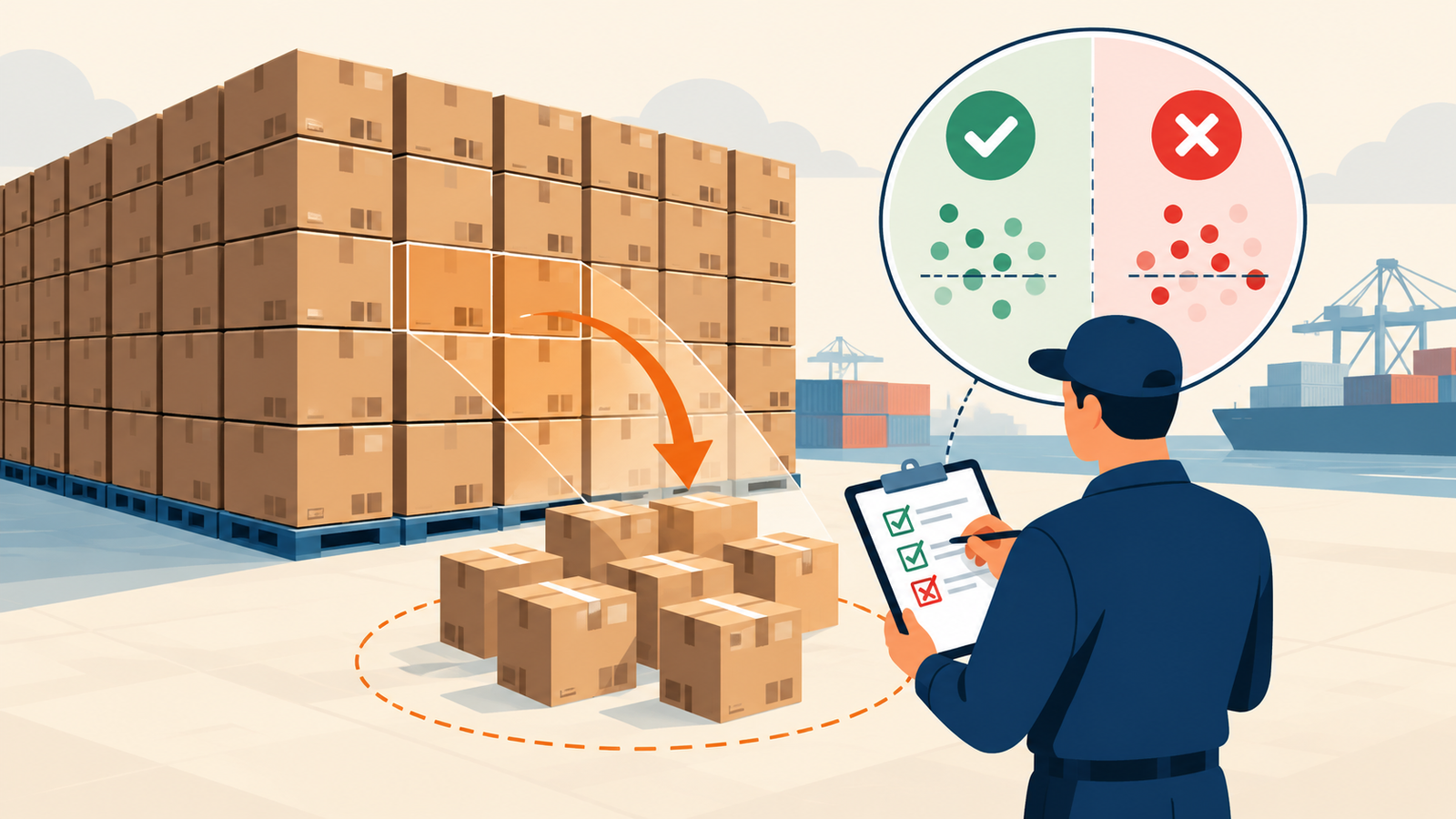
Direct answer: AQL (acceptance quality limit, often called acceptable quality limit or level) is the worst average defect rate a buyer is prepared to tolerate when accepting lots on the basis of a random sample. Under ISO 2859-1, the AQL value, lot size and inspection level together set how many units are inspected and how many defects are allowed before a lot is rejected.
What does AQL mean?
AQL is a parameter in acceptance sampling — the method of judging a large batch of goods by inspecting a random sample rather than every unit. The international standard most inspection providers use is ISO 2859-1, which calls it the acceptance quality limit. Its US counterpart, ANSI/ASQ Z1.4, follows the same logic. In everyday sourcing language you will also see "acceptable quality level" and "acceptable quality limit"; buyers use the terms interchangeably.
In plain terms, the AQL expresses the quality level a buyer considers tolerable as a long-run process average. A sampling plan built on that AQL is designed so that lots produced at or better than that level will usually be accepted, and lots that are clearly worse will usually be rejected.
Three things follow from that definition:
- AQL is a buyer decision. You choose it, ideally before production, and write it into the order.
- AQL is set per defect class. Critical, major and minor defects normally get different limits.
- AQL is about the sample decision, not a promise about the lot. Sampling always carries some risk of accepting a lot that is worse than the AQL or rejecting one that is better.
AQL is the engine behind the random sampling used in a pre-shipment inspection, and it also applies to during-production and incoming inspections.
How AQL sampling works: three inputs, two outputs
An AQL sampling plan needs three inputs:
- Lot size — the number of units in the batch being inspected (for example, the whole order of one product).
- Inspection level — how much inspection effort you want relative to lot size.
- AQL value — the tolerance you set for each defect class.
From these, the standard’s tables give two outputs:
- Sample size — how many units the inspector must check.
- Acceptance and rejection numbers (Ac/Re) — the maximum number of defective units allowed in the sample (Ac) and the number at which the lot is rejected (Re).
The route is: lot size + inspection level → sample size code letter → sample size; then code letter + AQL value → Ac/Re.
Inspection levels
| Level | What it means | Typical use |
|---|---|---|
| General level I | Smaller sample than level II | Lower-risk products, stable suppliers, cost-sensitive inspections |
| General level II | The standard default | Most consumer-goods inspections unless a reason exists to change |
| General level III | Larger sample than level II | Higher-risk products, new suppliers, previous quality problems |
| Special levels S-1 to S-4 | Much smaller samples | Time-consuming or destructive tests, such as function, measurement or opening sealed units |
A common arrangement is to use general level II for visual and workmanship checks and a special level for slow or destructive tests, all within the same inspection.
Normal, tightened and reduced inspection
ISO 2859-1 is designed for a continuing series of lots from the same supplier. It includes switching rules: if lots keep failing, inspection moves to tightened (stricter acceptance numbers); if quality is consistently good, it may move to reduced (smaller samples). Most one-off importer inspections stay at normal inspection. For a genuinely isolated lot, the standard’s companion part, ISO 2859-2, takes a different approach — worth knowing exists, though few small importers use it.
Worked example: from lot size to accept or reject
Hypothetical example. A buyer has ordered 3,000 units of a household product and books a pre-shipment inspection under ISO 2859-1, single sampling, normal inspection, general level II. The order sets zero tolerance for critical defects, AQL 2.5 for major defects and AQL 4.0 for minor defects.
| Step | Value | Notes |
|---|---|---|
| Lot size | 3,000 units | Whole order of one product |
| Inspection level | General II | Default level |
| Sample size code letter | K | From the lot-size table for 1,201–3,200 units at level II |
| Sample size | 125 units | Drawn at random from across the cartons |
| Critical defects | Accept 0 / Reject 1 | Buyer’s zero-tolerance policy |
| Major defects (AQL 2.5) | Accept 7 / Reject 8 | From the single-sampling normal table at code K |
| Minor defects (AQL 4.0) | Accept 10 / Reject 11 | Same table, AQL 4.0 column |
The inspector examines all 125 units and records each defect by class. Then:
- If no critical defects, 7 or fewer major and 10 or fewer minor defects are found, the lot passes.
- If one critical, 8 or more major, or 11 or more minor defects are found, the lot fails on that class.
Each class is judged separately: a lot can pass on minor defects and still fail on major ones. Check the values for your own lot size against the current edition of the standard or your inspection provider’s plan; this example is for illustration and does not replace the tables.
Notice what the numbers say. Seven major defects in 125 units is about 5.6% of the sample, yet the lot still passes at AQL 2.5. That is why AQL must not be read as "maximum 2.5% defective in this shipment" — the acceptance numbers are calibrated to the long-run process average, and a small sample cannot pin a lot’s defect rate down precisely.
If the sample exceeds the reject number, use our guide to what to do after a failed inspection before releasing shipment or balance payment.
Is AQL 2.5 good?
AQL 2.5 for major defects is a common starting point for general consumer goods, not a quality grade. Whether it is right for you depends on what a major defect costs you: returns, negative reviews, rework at destination or a lost retail account.
These are typical starting points buyers adjust from — not requirements of the standard:
| Defect class | Common starting point | When buyers go stricter | When buyers sometimes relax |
|---|---|---|---|
| Critical (safety, legal) | Zero accepted | — | Rarely appropriate |
| Major (function, saleability) | AQL 2.5 | Higher-value, branded or retail-ready goods; new supplier; previous failures (e.g. AQL 1.0 or 1.5) | Low-value goods where a defect is easily absorbed |
| Minor (cosmetic, small deviations) | AQL 4.0 | Premium cosmetic products where appearance is the product | Low-cost, non-visible items (e.g. AQL 6.5) |
A smaller AQL number is stricter: AQL 1.0 allows fewer defects in the sample than AQL 2.5 at the same sample size.
Stricter is not automatically better. Tight AQL values increase the chance of a fail, and a fail means rework, re-inspection and delay. Set limits that reflect the real consequences of each defect — and make sure the factory agreed to them before production, not after the report arrives.
What AQL does not tell you
- It is not a defect allowance for the lot. Suppliers sometimes argue that "AQL 2.5 means 2.5% defects are fine". It does not; it defines a sampling decision.
- It does not define what a defect is. The plan only counts defects. What counts as critical, major or minor for your product must be written down separately in a defect list — the topic of our guide to critical, major and minor defects.
- It does not test compliance. AQL sampling decides whether visible, measurable and functional defects are within tolerance. Laboratory testing and certification are separate.
- It does not judge the factory. A pass tells you about one lot. Whether the supplier’s processes can deliver that quality consistently is a question for a factory assessment — see how a factory audit differs from a product inspection.
How to choose AQL values for your order
Work through these questions before you send the purchase order:
- What is a critical defect for this product? If anything could injure a user or breach a legal requirement, set zero acceptance.
- What would a customer return? Defects that stop the product working or make it unsaleable are major; choose a major AQL that reflects how costly a return is for you.
- What is purely cosmetic? Decide how visible the product is at the point of sale; premium presentation justifies a stricter minor AQL.
- How well do you know the supplier? New suppliers or previous problems justify a higher inspection level or stricter AQL for the first orders.
- Which tests need a special level? List slow or destructive tests and assign a smaller sample size so the inspection remains practical.
- Is everything written down? Put the standard, inspection level, AQL per class and defect list into the purchase order or quality agreement.
A written quality specification that factories can follow brings these elements together; we cover how to write one in a separate guide.
Where you will see AQL in practice
- On the purchase order or quality agreement — the standard, inspection level and AQL per defect class.
- On the inspection booking — the provider confirms the plan before the visit.
- In the inspection report — the summary section shows sample size, defects found per class and the Ac/Re numbers, then a pass, fail or pending result. Our guide to reading a product inspection report walks through that layout.
- In the factory’s own quality system — better factories run incoming-material and in-line checks with defined sampling. Whether a supplier actually does this is something a China factory audit can examine on site, alongside the evidence buyers usually collect with a factory audit checklist.
For the wider picture of when each inspection stage happens and how AQL-based sampling fits into it, see our pillar on quality control stages when sourcing from China.
Frequently asked questions
Is AQL 2.5 good?
AQL 2.5 is a widely used default for major defects in general consumer goods. It is reasonable for many products, but buyers of higher-value, branded or safety-sensitive goods often choose stricter values such as 1.0 or 1.5 for major defects.
What does AQL 0 mean?
Strictly, zero is not an AQL value in the standard’s tables. Buyers use "AQL 0" or "zero tolerance" to mean that a single defect of that class — normally a critical defect — found in the sample rejects the lot.
Is a lower AQL stricter?
Yes. A lower AQL value produces lower acceptance numbers for the same sample size, so fewer defects are allowed before the lot fails.
What is the difference between ISO 2859-1 and ANSI/ASQ Z1.4?
They are closely related attribute-sampling standards built on the same approach. ISO 2859-1 is the international standard; ANSI/ASQ Z1.4 is the US national standard. Specify which one you want on the order so the inspector uses the matching tables.
Do I need to buy the standard to use AQL?
Inspection providers work from the official tables, so most importers simply specify the standard, inspection level and AQL values. If you manage inspections in-house, obtain the current edition from the standards body rather than relying on copied tables.
Conclusion
AQL is a tool for making a defensible accept-or-reject decision from a sample, and it only works when the buyer sets it deliberately: a zero line for critical defects, a major-defect limit that reflects what a return really costs, a minor-defect limit that matches how the product is sold, and all of it agreed with the factory in writing. Treat the numbers as part of your order terms, not as a line the inspector fills in.
If you would rather have AQL levels agreed with the supplier and checked on site by people in China, Jingxin Sourcing carries out quality-control and product inspections, with staff inspection activity in Yiwu, Shenzhen and Guangzhou — see its product inspection and quality-control service.